Artemis II Mission Nears High-Stakes Return to Earth
Artemis II astronauts are set to begin Orion re-entry Friday evening, targeting a Pacific splashdown near San Diego about 40 minutes later.
Jason Kwon ·
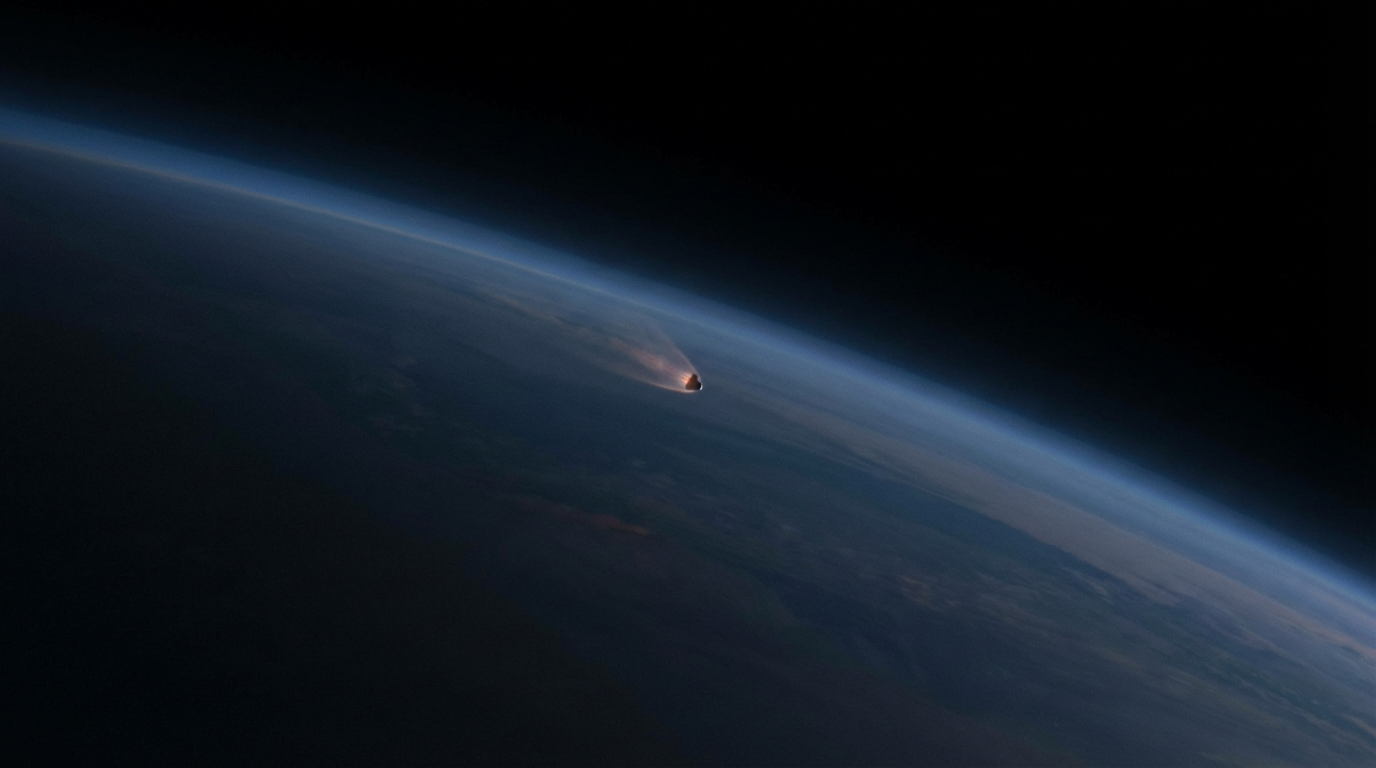
NASA’s Artemis II mission is entering its final and highest-risk phase as astronauts Reid Wiseman, Victor Glover, Christina Koch, and Jeremy Hansen prepare to return to Earth inside the Orion capsule. Officials said the re-entry sequence is scheduled to begin Friday evening, starting a rapid descent that will expose the spacecraft to intense heat and structural loads. NASA said Orion is expected to face atmospheric temperatures reaching 5,000 degrees during the plunge.
NASA said Orion is projected to hit the upper atmosphere at nearly 35,000 feet per second. The agency described the return as a demanding test of the capsule’s thermal protection and guidance systems before an ocean landing. Under the mission plan, NASA said splashdown is targeted for the Pacific Ocean near San Diego roughly 40 minutes after the re-entry sequence begins.
A U.S. Navy recovery team is set to be in position to retrieve the crew after landing, officials said. The recovery operation would close out the lunar flyby mission once the capsule is secured and the astronauts are brought to safety. Until splashdown and recovery are complete, officials said the outcome of the re-entry sequence remains uncertain.
The performance of Orion’s heat shield is a central focus after issues observed on the program’s previous flight. NASA said the uncrewed Artemis I mission in 2022 showed protective material on the heat shield chipped away in more than 100 different locations during re-entry. Officials said that result prompted an intensive investigation and contributed to delays as engineers worked to understand and address the problem.
NASA described the heat shield as nearly 17 feet in diameter on the underside of the capsule and made from Avcoat, a silica fiber composite. The agency said Avcoat is designed to ablate, meaning it burns away in a controlled way so heat is carried away from the vehicle and its occupants. Officials said Friday’s re-entry is intended to validate engineering adjustments made after Artemis I and to support NASA’s confidence in a safe crewed return.
NASA has long treated safe return as a defining requirement of human spaceflight , and the source material notes that President John F. Kennedy’s 1961 Apollo directive included bringing a crew “safely to the Earth.” The source material also cites the Challenger and Columbia space shuttle disasters, which together claimed 14 lives, as events that reinforced how risks are concentrated during launch and re-entry.
During the final descent, the crew is expected to maintain radio silence while Wiseman and Glover monitor the vehicle’s performance, according to the source material. In a briefing referenced in the source material, Victor Glover emphasized the priority of the final phase, saying, “We have to get back.”