Thailand Reviews BrahMos Missiles for Naval Modernisation
Thailand is reviewing a possible BrahMos supersonic cruise missile buy after June’s Thailand-India Defence Dialogue, though no decision or timeline is set.
Atlas Newsdesk ·
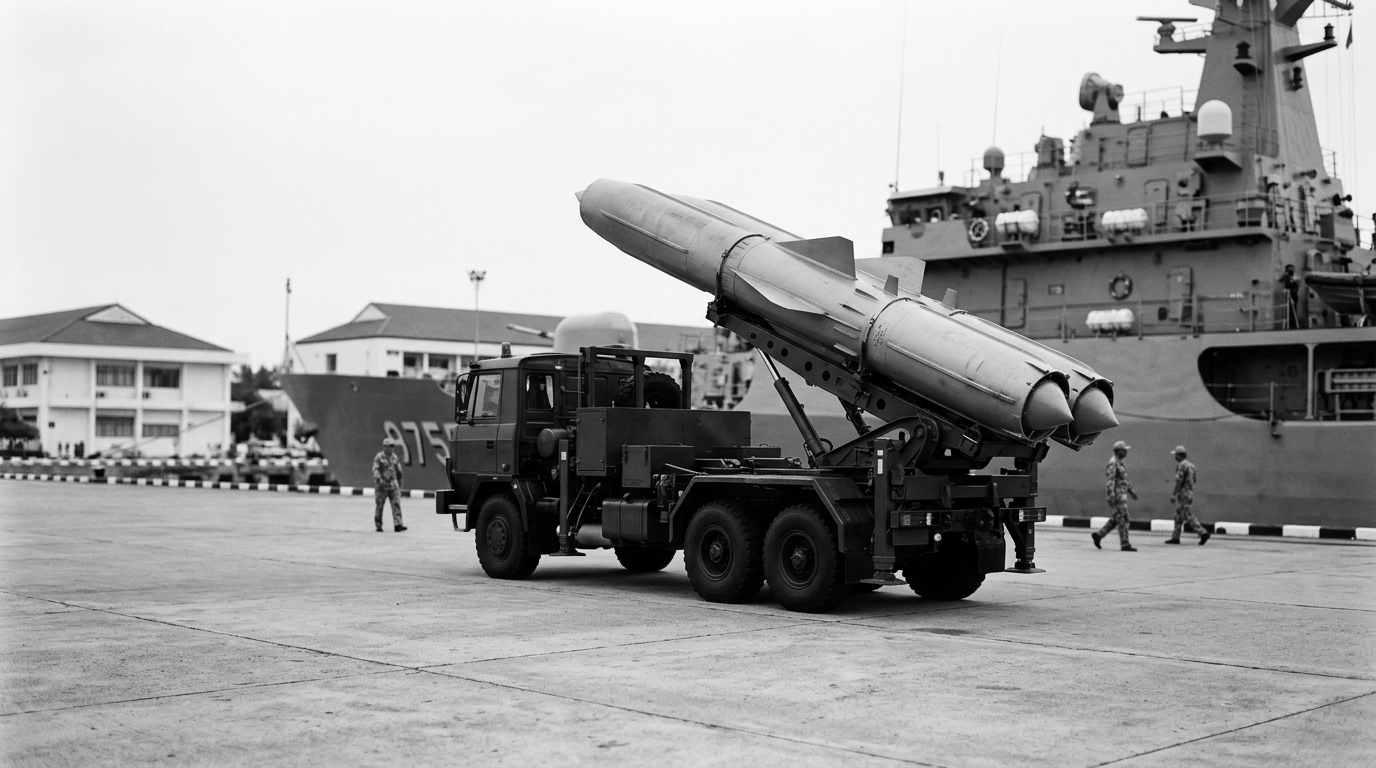
Thailand is assessing a possible acquisition of BrahMos supersonic cruise missiles as part of efforts to modernise its naval capabilities, according to regional analysts and details described around recent bilateral talks.
The evaluation surfaced after the 10th Thailand-India Defence Dialogue held in June, when Thailand and India said they would work to expand bilateral cooperation in defence manufacturing. The available information did not include a timeline, contract value, or any final decision.
Thailand-India defence talks and manufacturing cooperation
Officials presented the June dialogue as a milestone in deepening defence ties, including collaboration on manufacturing. In that setting, analysts said Thailand’s consideration of the BrahMos system has been framed as one option among the tools being reviewed to support broader modernisation objectives.
There have been no public details on how a BrahMos purchase might fit within Thailand’s wider naval plans. Officials have not specified whether the assessment covers quantities, intended basing concepts, or the scope of training and support arrangements that would accompany any future procurement.
Key unknowns in the evaluation phase
With Thailand still in an assessment stage, multiple variables remain unresolved. The source material does not indicate whether the evaluation is focused on a single service branch or a wider set of requirements across maritime and coastal defence roles.
It also remains unclear what portion of Thailand’s modernisation programme could be addressed by a supersonic cruise missile capability, or how any potential system would be integrated into existing operational planning.
Why analysts see BrahMos as operationally flexible
Regional analysts describe BrahMos as attractive in part because it can be integrated across multiple launch platforms. As outlined in the available descriptions, the missile could be deployed from ships, submarines, aircraft, and land-based launchers, offering varied options for positioning and employment.
Analysts assess that a broader mix of launch options could strengthen maritime deterrence. They also say such flexibility can complicate an adversary’s planning near critical coastal zones and disputed waters by increasing uncertainty over where and how the capability might be used.
Potential regional implications raised by analysts
Analysts said that, if Thailand proceeds from evaluation to procurement, the move could affect the security balance between Thailand and Cambodia. The source material does not identify which operational scenarios or geographic areas would be most affected, and it does not include any response from Cambodia.
Any shift, analysts added, would depend on what Thailand ultimately buys and how it deploys the system—two elements that remain undecided while the review continues.
Fit with wider Southeast Asian naval modernisation
Analysts link the reported assessment to a broader pattern of naval modernisation across Southeast Asia. In that framing, interest in a supersonic cruise missile option reflects heightened attention to maritime deterrence and operating in contested coastal environments.
At the same time, analysts warn that modernisation efforts across multiple countries can intensify competition for maritime influence. The available information does not detail how other regional forces might adjust their plans in response, leaving the central uncertainty whether Thailand will move beyond evaluation and, if so, which configuration it would choose across ship, submarine, aircraft, or land-based platforms.