Federal Ruling Confirms Only Humans Can Hold Patent Rights for AI Inventions
Current US intellectual property law requires human inventors for patents, posing legal risks for AI-generated discoveries in sectors like drug development.
Atlas Newsdesk ·
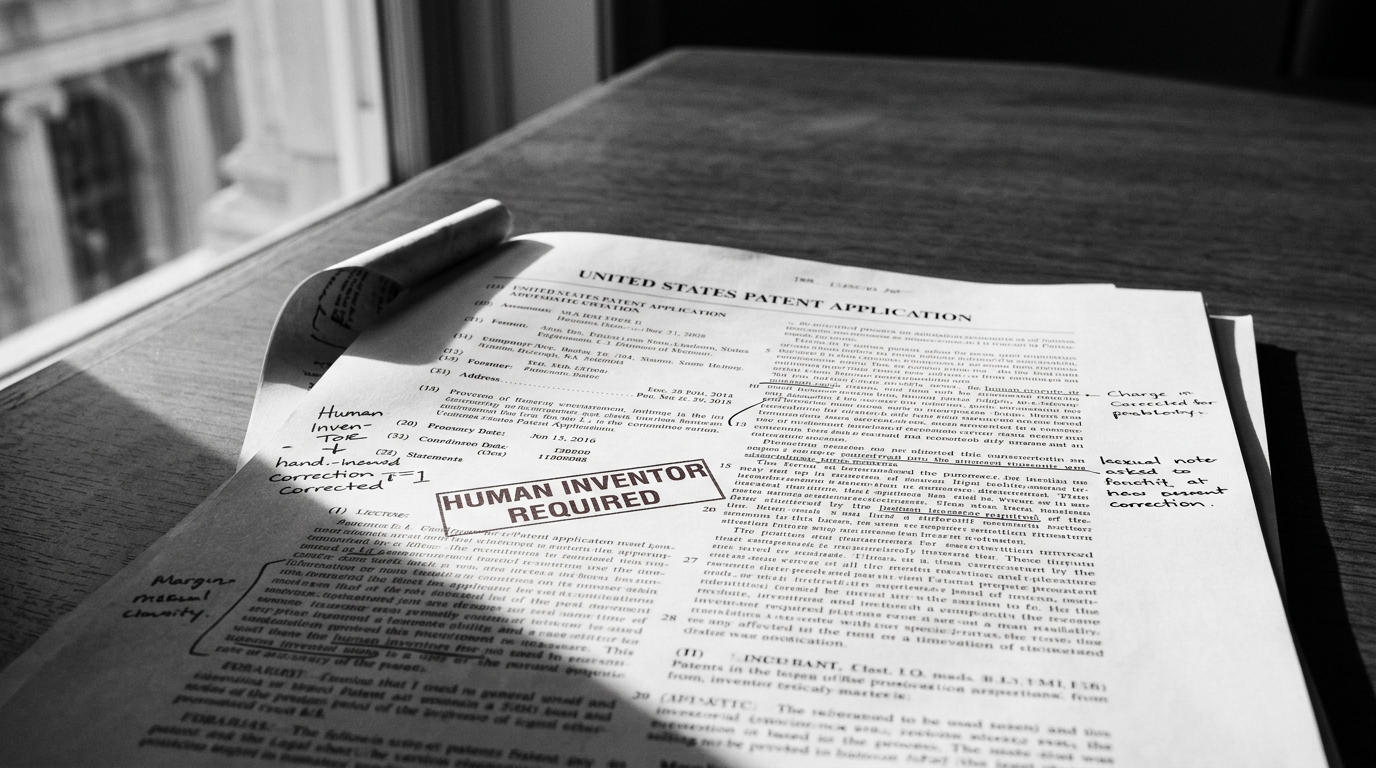
United States intellectual property regulations currently stipulate that only individuals can be formally recognized as inventors on patent applications. This legal framework has been consistently reinforced by judicial decisions, which explicitly state that artificial intelligence (AI) systems do not meet the criteria for legal inventorship, irrespective of their contribution to a discovery process.
Consequently, organizations that leverage generative AI technologies, particularly in fields such as pharmaceutical research and development, are required to credit human personnel for inventions to ensure their eligibility for patent protection. This existing regulatory environment introduces considerable legal uncertainties regarding the enforceability and validity of patents for outcomes largely derived or assisted by AI.
Human Contribution in AI-Driven Innovation
Should a patent application fail to precisely identify human contributors, or if the human involvement is subsequently judged insufficient to establish genuine inventorship, the intellectual property rights associated with that invention could face invalidation. Legal professionals frequently highlight that existing statutes may necessitate legislative revisions to adequately address the escalating degree of machine autonomy observed in contemporary research and development activities.
The United States Patent and Trademark Office (USPTO) presently considers AI as a technological instrument, akin to a calculator, and does not mandate the disclosure of its utilization during the invention process. However, companies are strongly advised to meticulously document human oversight throughout AI-assisted innovation workflows. This practice is crucial for mitigating potential legal challenges to patent claims.
Future Legal Clarifications Expected
The evolving landscape of AI in discovery implies that future legal proceedings are anticipated to establish clearer benchmarks for the extent of human contribution required to uphold patent claims. This clarification will be vital as automated discovery methods become more sophisticated and prevalent across various industries.
The debate surrounding AI's role in inventorship underscores a broader challenge for legal systems globally: adapting traditional intellectual property concepts to disruptive technological advancements. As AI's capabilities expand, the distinction between a 'tool' and a 'creator' becomes increasingly blurred, compelling policymakers to consider new frameworks that balance innovation incentives with established legal principles.
Global Implications for AI-Assisted Patents
The US stance on human inventorship resonates internationally, as many patent systems worldwide share similar foundational principles. While some jurisdictions may explore different interpretations or reforms, the core challenge of defining inventorship in an age of advanced AI is a shared concern. This necessitates ongoing dialogue among international intellectual property organizations to potentially harmonize approaches or at least provide clear guidelines for cross-border patent protection.
Businesses operating globally, especially those heavily investing in AI-driven R&D, must navigate these complex legal waters carefully. Robust internal documentation, clear policies on AI use, and proactive engagement with intellectual property legal experts are becoming essential to safeguard their innovations and maintain competitive advantages.