Wandering black hole raises merger questions after flare
A wandering black hole candidate was revealed by TDE 2025abcr, an off-center stellar flare that may expose merger debris in a nearby galaxy.
Jason Kwon ·
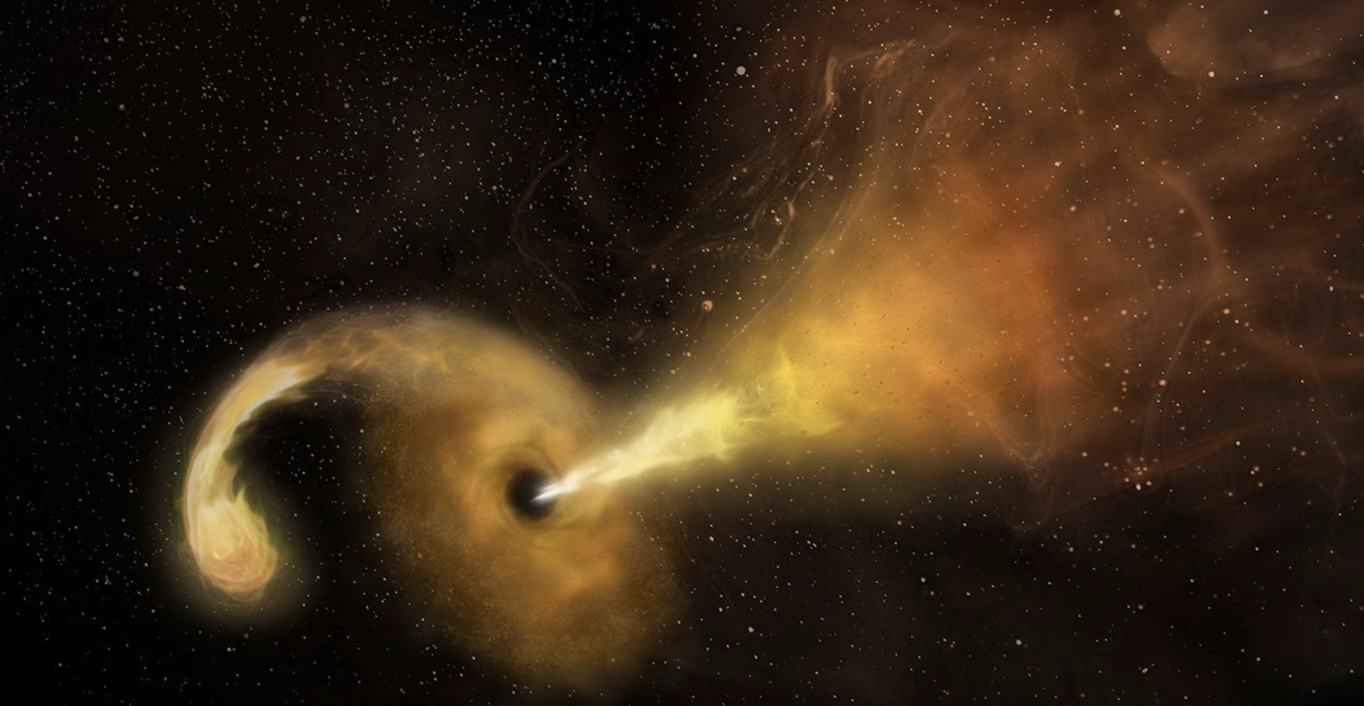
A wandering black hole was spotted through TDE 2025abcr, an off-center flare that puts merger-driven black hole motion under scrutiny.
A University of North Carolina at Chapel Hill astronomy team reported the event in The Astrophysical Journal Letters . The flare appeared roughly 30,000 light-years from its host galaxy's nucleus, a separation the paper identifies as the largest yet reported for an optical tidal disruption event.
TDE 2025abcr breaks pattern
A tidal disruption event happens when a star passes close enough to a massive black hole for gravity to shred it, producing a bright flare as stellar material is consumed. The paper says these events are uncommon anywhere in a galaxy, with an average rate near one per 100,000 years.
Astronomers have cataloged more than 100 TDEs during the past decade, but the known sample has been dominated by flares near galactic centers. Jonathan Carney, a co-author and Ph.D. student at UNC-Chapel Hill, said: "Almost every tidal disruption event we've ever observed has occurred at the center of a galaxy, right where we expect the biggest black holes to be."
The source behind TDE 2025abcr is estimated at about 1 million solar masses. The team outlined two possible histories: the object may be a leftover from an older galaxy merger, or it may have been flung away from the nucleus after close gravitational encounters with other black holes.
AI classifier widened the search
The detection also turned on a data-filtering choice. Researchers used tdescore, an artificial intelligence classifier developed by Robert Stein at the University of Maryland and NASA Goddard, to sift telescope alerts for TDE candidates that did not sit neatly on top of galaxy centers.
Akash Anumarlapudi, a UNC-Chapel Hill postdoctoral researcher, said the classifier was adapted for off-nuclear events. "By removing the assumption that these events only happen in the galactic center, we were able to find a black hole that might have otherwise been missed," he said.
After the software flagged TDE 2025abcr, the Carolina team used the Southern Astrophysical Research Telescope in Chile to test the signal. SOAR is a 4.1-meter telescope that UNC helped build and still operates through an international consortium, giving the team ground-based follow-up capacity after the initial alert.
Merger debris becomes testable
The result matters because black holes do not reveal themselves directly; outside an accretion episode, they produce no light for optical surveys to catch. A rare stellar disruption can therefore function as a temporary marker for massive black holes that are otherwise hidden in a galaxy's outskirts.
If future surveys turn up more off-center TDEs, models of galaxy mergers will face a larger observational sample for testing how often massive black holes are displaced and how long they remain adrift. If TDE 2025abcr proves unusual, the case will still sharpen search methods by showing that center-biased filters can miss real black hole activity.
The main uncertainty is the black hole's origin. Continued monitoring of the flare's fading light, spectral behavior and host-galaxy environment will determine whether TDE 2025abcr becomes an early member of a broader population or remains a rare clue from one unsettled galactic merger history.