Trump envoys push Iran talks after Hormuz attacks halt deal
Iran talks in Qatar showed progress after US envoys held positive discussions, but Hormuz control disputes still threaten the temporary accord.
Lauren Collins ·
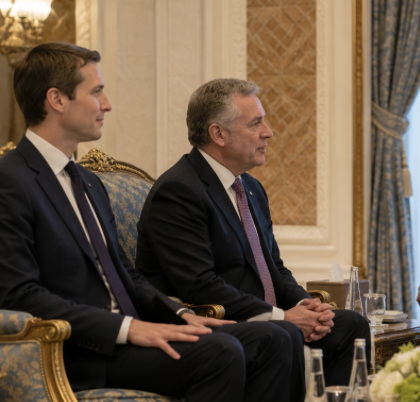
Iran talks in Qatar advanced after US envoys Steve Witkoff and Jared Kushner held positive discussions, a senior administration official said.
The discussions in Doha are part of an indirect diplomatic track between Washington and Tehran, with mediators carrying messages between the two sides. The goal is to convert a temporary agreement signed last month into a durable settlement before a 60-day negotiating period closes.
Doha channel stays open
Witkoff and Kushner were in Qatar on Tuesday after the US and Iran agreed late last week to stop a renewed cycle of attacks linked to the Strait of Hormuz. The senior official’s account suggests the technical track has regained some momentum after a difficult opening phase.
A diplomat whose name was not disclosed said mediated contacts between US and Iranian officials were expected to continue Wednesday. Witkoff and Kushner were not expected to take part in that round, according to the account, leaving the next stage to lower-level or mediator-led discussions.
Hormuz dispute shadows negotiations
The Strait of Hormuz remains the pressure point inside the talks. The waterway is central to the dispute because both sides are debating how it should be managed after recent confrontations, and any incident there can quickly test whether the interim arrangement is holding.
Iranian state television reported that a non-Iranian vessel grounded in shallow water after taking a route authorities had not approved. The report did not resolve the larger question facing negotiators: who will set the rules for movement through the strait, and how those rules will be enforced.
The 60-day window matters because it gives both governments a deadline without guaranteeing a final bargain. Technical talks can clarify operating rules, verification steps and sequencing, but they can also stall if either side treats control of Hormuz as a sovereignty test rather than a practical security issue.
Markets weigh conditional paths
The direct impact is diplomatic rather than corporate: there is no named company at the center of the source account. The exposed sectors are shipping, energy logistics and insurance, because any uncertainty around Hormuz can affect route planning, risk premiums and the willingness of commercial operators to use contested channels.
If the technical channel holds and incidents in the strait remain contained, the 60-day period gives Washington and Tehran a mechanism to move from de-escalation toward written terms. For the global macro picture, that would remove one source of transport risk; for the US-Iran process, it would strengthen the envoys’ mandate; for shipping and energy firms, it would reduce the need for contingency routing.
If control disputes return, the mechanism runs in the opposite direction. A fresh clash or another navigation dispute would make mediators spend political capital on crisis management, pressure Trump’s envoys to defend the interim accord, and push the maritime sector to plan around higher operating uncertainty.
The open questions are narrow but consequential. Negotiators still need to define how Hormuz traffic will be supervised, whether Wednesday’s mediator-led talks can preserve Tuesday’s progress, and whether the 60-day clock creates urgency or simply exposes the distance between the two governments.