The U.S.-Iran Maritime War Spreads Beyond Hormuz
Tehran’s retaliatory campaign is turning a dispute over shipping access into a broader test of Gulf security and global energy supply.
Omar Farouk ·
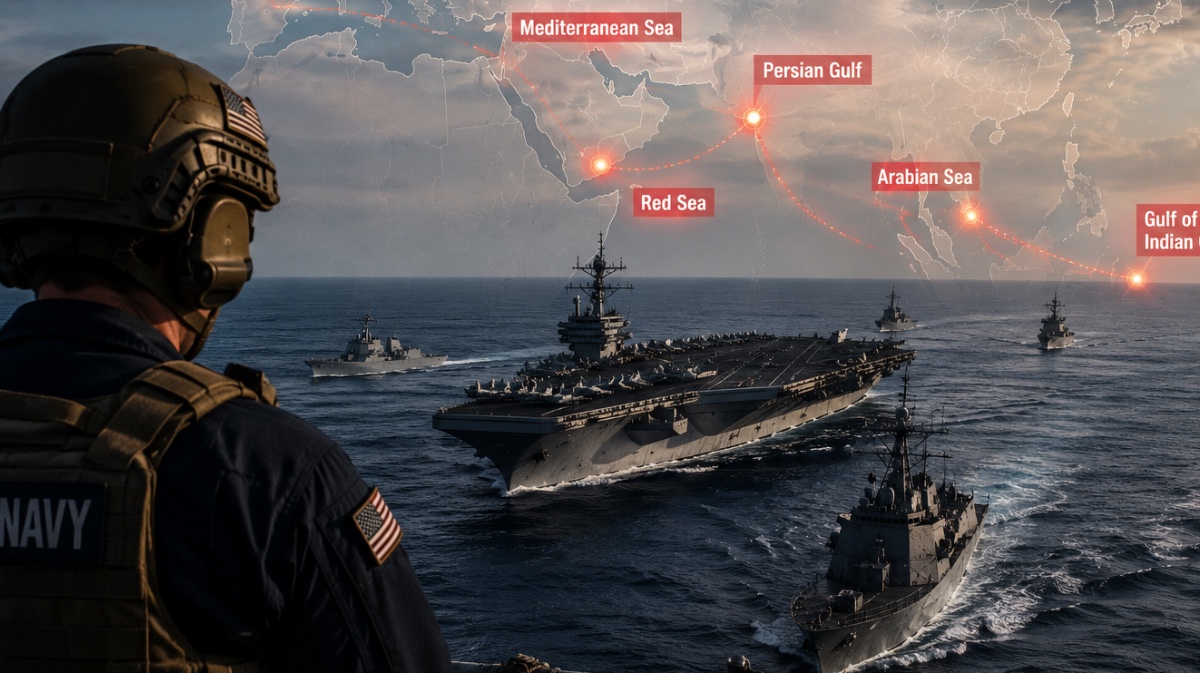
American forces extended their renewed campaign against Iran into a fourth night after Washington brought back restrictions on vessels entering or leaving Iranian ports, deepening a confrontation centred on control of the Gulf’s most important maritime passage. Tehran answered with fresh missile and drone operations aimed at countries hosting U.S. personnel, while its Revolutionary Guard warned that export channels serving Washington and its partners could also be disrupted if Iranian trade remained constrained. Iranian forces claimed attacks on American facilities in Bahrain, Kuwait and Jordan, including logistical and aviation sites, although the full scale of any damage could not immediately be established independently. The exchange has effectively ended the limited calm established in June and has widened the battlefield from Iranian coastal positions to military infrastructure across several Arab states.
At 4 P.M., Blockade Returns
The latest escalation followed President Donald Trump’s order for the blockade to resume at 4 p.m. Eastern time on July 14, with U.S. Central Command instructed to stop traffic linked to Iranian ports while permitting other regional shipping to continue. Washington says the measure responds to Iranian attacks on seven merchant ships during the previous week, incidents that left almost a dozen sailors dead, wounded or unaccounted for. American commanders have paired the cordon with attacks on coastal surveillance equipment, air defences, missile positions, drone facilities and naval assets intended to threaten merchant vessels. Trump has added a deadline of his own, warning that Iranian electricity stations and major bridges could be targeted unless Tehran returns to the negotiating table.
June 17 Deal Comes Apart
The confrontation is the latest rupture in a war that began with U.S. and Israeli attacks on Iran on February 28 and was temporarily restrained by an agreement signed on June 17. That arrangement was supposed to create space for discussions covering Iran’s nuclear programme, maritime security and a more durable end to hostilities, but the two governments never resolved who would control passage around Hormuz. The current blockade also revives a policy Washington applied between April 13 and June 18, when the U.S. military said it redirected more than 140 cooperative vessels, disabled nine ships that refused instructions and admitted over 50 humanitarian cargoes. Its return shows how quickly the interim accord lost authority once commercial vessels again became targets and the two sides adopted incompatible rules for navigation.
Jordan Downs Three Missiles
For Gulf governments, the conflict is no longer confined to nearby waters or Iranian territory. Jordan’s armed forces said air defences destroyed three ballistic missiles arriving from Iran early Wednesday, with no reported deaths, injuries or property losses; military engineers were dispatched to secure areas where fragments landed. Kuwait brought a fire under control at a location struck during the Iranian barrage, while Tehran said it had attacked the Bahrain-based Fifth Fleet and a logistics installation at Mina Abdullah in Kuwait. Inside Iran, government officials said recent American attacks in the south killed at least 30 civilians, and the Iranian army reported seven military deaths at Bampur; those casualty figures remained claims from Iranian authorities rather than independently confirmed totals.
Bab el-Mandeb Enters the Fight
The greater economic danger lies in Tehran’s suggestion that pressure could extend beyond Hormuz to other export corridors, particularly the Bab el-Mandeb gateway linking the Red Sea and Gulf of Aden. Iran has not publicly demonstrated that it can order a complete closure there, but its Houthi partners in Yemen have threatened the passage before and recently resumed attacks on Saudi Arabia following strikes around the airport in Houthi-held Sanaa. The group’s previous campaign against Red Sea shipping forced carriers to reroute vessels around Africa, increasing voyage times, fuel consumption, insurance costs and pressure on freight capacity. Saudi Arabia also sends an estimated 4 million to 5 million barrels a day through pipelines connected to Red Sea terminals, meaning simultaneous danger around Hormuz and Bab el-Mandeb would weaken one of the kingdom’s main alternatives for avoiding the Gulf passage.
Brent Near $85 Signals Fear
Energy markets have started pricing the prospect of a longer disruption rather than treating the attacks as a brief exchange. Brent crude rose to about $85.23 a barrel during Wednesday trading, while the U.S. benchmark advanced to roughly $79.89, extending gains after both contracts reached one-month highs. The price movement remains smaller than the most extreme forecasts circulated by regional combatants, but it reflects a growing premium for physical supply risk, tanker availability and insurance coverage. A sustained interruption would travel beyond oil markets: higher freight and fuel bills could reach airlines, manufacturers and consumers, complicating inflation policy in economies that have limited control over the military decisions driving the shock.
Trump’s Grid Threat Narrows Diplomacy
The immediate uncertainty is whether the two governments are using force to improve their negotiating positions or have lost the political room required to stop. Trump says American representatives remain in contact with Iranian counterparts, yet his threat against electricity infrastructure raises the potential civilian cost and could make concessions harder for Tehran to defend domestically. Iran’s ability to maintain restrictions around Hormuz, the Houthis’ willingness to reopen a sustained Red Sea campaign and the accuracy of competing battlefield claims are all unresolved; declarations of successful strikes have frequently appeared before damage could be independently assessed. The clearest tests will be actual vessel movements, insurer willingness to cover Gulf voyages, the target list in the next American strike cycle and whether regional governments can push Washington and Tehran back toward the June framework before a second maritime front fully opens.