The Swoosh Just Got Dumped — And It Happened Over Running Shoes
Atlas Newsdesk ·
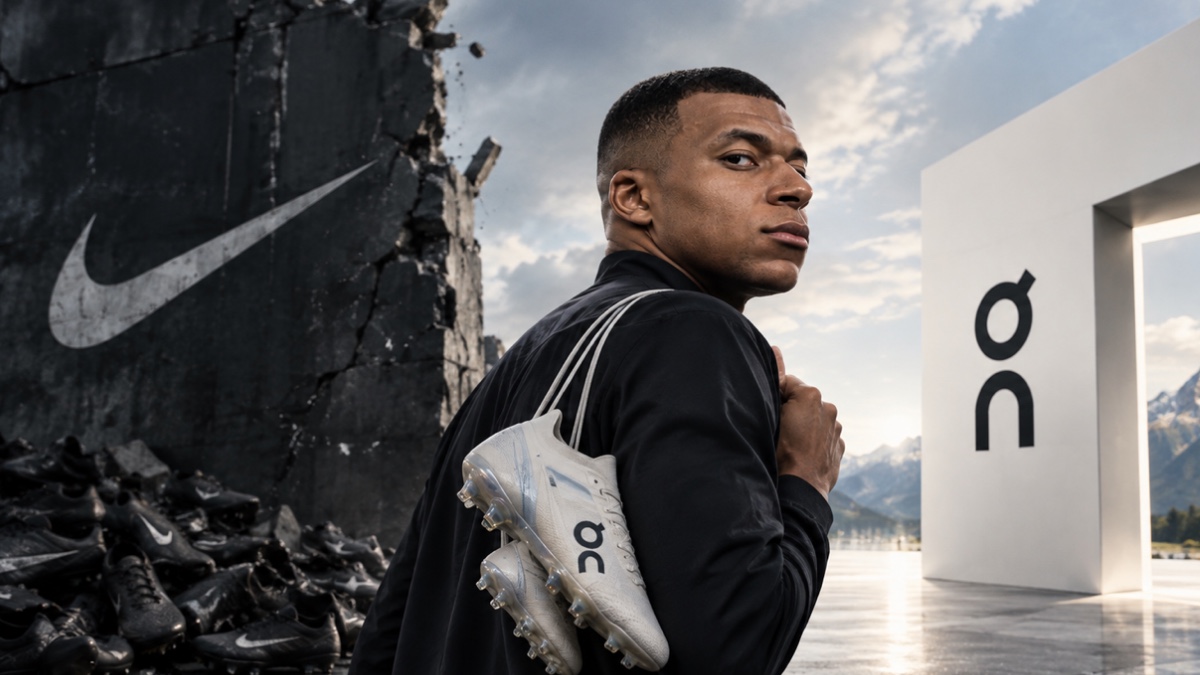
For twenty years, Kylian Mbappé and Nike were basically married. He signed with them at eight years old — an age when most kids are still arguing about Pokémon cards — and stayed loyal through World Cups, transfers, and twelve signature shoes. It was the kind of brand relationship marketing departments dream about: unbreakable, generational, a little bit boring in its stability.
Then, last Friday, Mbappé did the sportswear equivalent of leaving his high school sweetheart for the new person at the gym. He signed with On — yes, the Swiss running brand your marathon-obsessed coworker won't shut up about — and On, in turn, announced it is doing something it has never done in its 16-year history: making football boots.
Nobody saw this coming. On has spent a decade and a half perfecting shoes for people jogging around Prospect Park, not people bending free kicks into the top corner in front of 80,000 screaming fans. Football boots are a completely different animal — different traction, different torsion, different everything. And yet here we are.
The Twist Nobody Expected
Here's the part that actually makes this interesting, because "athlete signs shoe deal" is not, on its own, a story: Mbappé isn't just wearing On's stuff. According to Reuters reporting, he's being paid partly in cash and partly in shares of the company . He's not an endorser anymore. He's an owner.
Think about what that means. Every time On sells a shoe, Mbappé's net worth moves with it. He has, quite literally, skin in the game — which is either a genius alignment of incentives or the kind of thing that gets very awkward if the boots turn out to have a design flaw. Either way, nobody's done a deal quite like this before, and it might just rewire how superstar athletes get paid going forward. Why take a flat check when you can take equity in the next Nike?
On isn't going halfway on the football bet, either. It's bringing in Thierry Henry — Arsenal legend, France icon, a man who has apparently been quietly whispering football strategy into On's ear since late last year — as its Director of Football. And the boots themselves, due out in 2027, will be built using LightSpray, On's weird and slightly sci-fi spray-painted-shoe-upper technology that it originally developed for road racing. Translating "spray-on running shoe" into "boot that survives a 50-50 tackle" is, to put it mildly, an unproven leap.
Nike's Very Bad, Not-Great Week
Meanwhile, over at Nike headquarters, things were already rough before Friday. The company has been mid-turnaround under CEO Elliott Hill, its stock has been sliding toward territory it hasn't seen in over a decade, and — depending on which report you believe — shares are down anywhere from 30% to 44% this year alone. Losing arguably the most famous footballer on the planet is not the vibe check Nike needed.
Nike's official statement was admirably composed given the circumstances: "We are proud of what we achieved together on and off the pitch." Which is corporate-speak for "it's not us, it's... okay, it's kind of us." A source told CNBC that Nike actually chose not to renew Mbappé's deal, betting instead on younger stars like Erling Haaland and Vinícius Júnior. And Yahoo Sports reports Mbappé isn't even the only one walking — Martin Ødegaard, Emma Raducanu, and Lamine Yamal have reportedly also exited Nike recently, which, if the pattern holds, is less "one player left" and more "something's up at Nike."
Mbappé, for his part, sounded genuinely energized about starting from scratch with a brand that has zero football history: "We have a shared dream, and this is only the beginning," he said. Which either means something profound about co-creating a legacy product, or is exactly what you'd expect a 27-year-old with a new equity stake to say. Possibly both.
Wall Street's Reaction: Cautiously Into It
The market's response was swift and, honestly, kind of funny in its proportions. On's stock popped roughly 5-6% in premarket trading — a genuine jolt of investor enthusiasm. Nike and Adidas, meanwhile, dipped about 1% each, a shrug rather than a gasp. It's the financial equivalent of your ex posting a new relationship and everyone reacting with a single "👀" instead of full-blown panic.
Analysts, ever the buzzkills, stayed measured. Needham & Co. kept a "buy" rating on On but set its price target ($37) noticeably below the Street's broader consensus (reported anywhere from about $41 to $44, depending who you ask). And On's last earnings report actually missed expectations on profit, even with sales up a healthy 13.5%. Translation: investors like the story of On going after football. Whether the business can actually pull it off is a separate, much slower-moving question.
So... Is This a Big Deal?
Genuinely? Maybe. Football boots are a category that's been a two-brand monopoly for essentially forever — Nike and Adidas have carved up the sport between them for decades, the way Coke and Pepsi own soda. On elbowing into that with the sport's biggest current name attached is either going to look like a masterstroke in three years or a very expensive, very public science experiment.
What we don't know yet: how much this deal actually cost, how long it runs (one report floated a decade, but nobody's confirmed it), or whether On's spray-on running-shoe tech can survive a Champions League tackle without falling apart. What we do know: for the first time in twenty years, Kylian Mbappé is walking onto a pitch in a brand nobody has ever seen on a football field before — and he owns a piece of the company that made it.
That's not just a shoe deal. That's a bet.