Taiwan keeps US arms-sales channel open before Trump-Xi meeting
Taipei said it will maintain close contact with Washington on arms sales as President Trump prepares for talks with Xi Jinping.
Lauren Collins ·
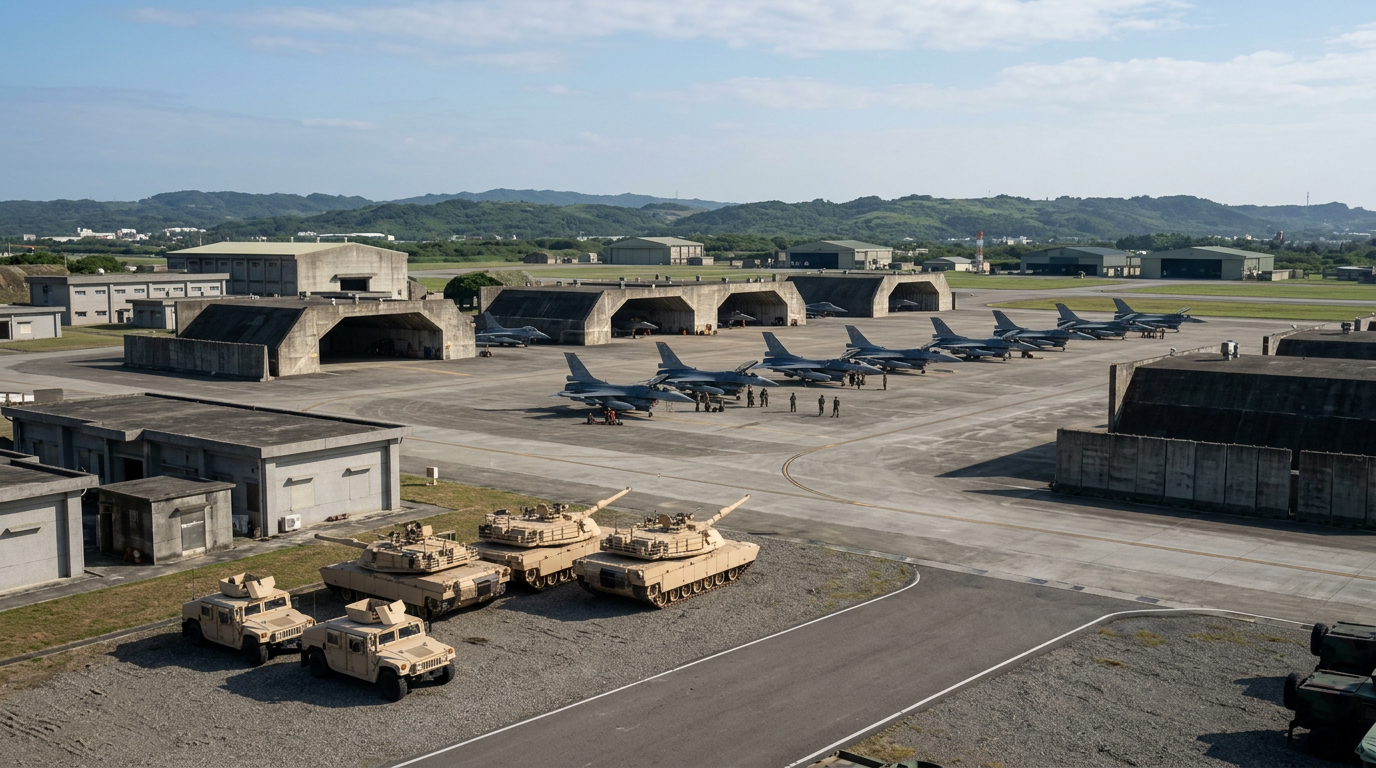
Taiwan keeps US arms-sales channel open before Trump-Xi meeting
Taiwan said on September 23 that it will maintain "close contact" with the United States on arms sales, putting Taipei’s defense pipeline into focus before an expected meeting between President Trump and Chinese President Xi Jinping.
Chiao Fu-chun, Taiwan’s defense ministry deputy spokesperson, made the comments to reporters in Tainan, framing the issue around security and stability in the Indo-Pacific. For Washington, the timing matters: arms transfers to Taiwan are one of the clearest instruments the US uses to signal deterrence to Beijing without formally changing its diplomatic posture.
US arms sales to Taiwan sit inside a deliberately narrow legal and political lane. Washington does not have formal diplomatic relations with Taipei, but US law requires the United States to make available defense articles and services that help Taiwan maintain a sufficient self-defense capability. That framework lets administrations approve weapons packages while still saying they do not support a unilateral change to the status quo across the Taiwan Strait.
In practice, that means several parts of Washington have a role. The White House sets the strategic tone, the State Department handles diplomatic messaging and notifications, the Pentagon manages security assistance and delivery questions, and Congress can scrutinize or pressure the administration over timing, scale and backlogs. For Taiwan, public confirmation of contact with Washington reassures domestic audiences that the arms channel remains active even as US-China diplomacy intensifies.
United States
The Trump-Xi context makes the message more sensitive. Beijing treats US weapons sales to Taiwan as interference in what it calls an internal matter, while Taipei sees those sales as part of the military balance that makes coercion more costly. Washington’s problem is to keep deterrence credible without giving Beijing a pretext to cast routine defense coordination as a crisis.
That tension has shaped US Taiwan policy for years. Successive administrations have used arms sales, military training, transits and public statements to support Taipei while preserving enough ambiguity to avoid making a direct defense commitment. President Trump’s meeting with Xi gives both sides reason to manage the optics: China will look for signs that Washington is limiting support for Taiwan, while Taiwan and members of Congress will look for signs that the White House is not trading away security commitments for broader diplomatic gains.
The specific substance of the next arms-sales discussion has not been publicly detailed in the provided account. That matters because the policy signal differs depending on what Washington emphasizes. Air-defense systems, anti-ship missiles, drones, surveillance equipment, training support and munitions stocks would each point to a slightly different view of what Taiwan needs most urgently.
The arms-sales channel is also a test of execution, not just messaging. Announcing a package is one step; contracting, production, delivery and integration into Taiwan’s forces can take longer. If Washington wants arms sales to function as deterrence, the credibility comes from systems Taiwan can field, maintain and use, not from communiques alone.
Congress is likely to remain a pressure point. Lawmakers in both parties have generally backed stronger Taiwan defenses, though they can differ over funding mechanisms, delivery priorities and how explicitly the US should frame its commitments. Ahead of any Trump-Xi exchange, congressional reaction could constrain the White House if lawmakers perceive the administration as softening its Taiwan posture.
For the Pentagon, the Taiwan issue sits inside a wider Indo-Pacific force-planning problem. US officials must consider not only what Taipei can absorb, but also how arms sales fit with American stockpiles, defense-industrial capacity and commitments to other partners. A package designed to help Taiwan defend itself can also reveal where US production lines are strained.
For Beijing, the same actions carry a different meaning. Chinese officials often portray arms transfers as proof that Washington is undermining stability, while US and Taiwanese officials describe them as tools to preserve it. That clash in definitions is why the language around this issue tends to be calibrated: each side tries to signal resolve without creating an obligation to escalate.
Taipei’s statement also serves a domestic function. Taiwan’s leaders must show voters that they are not passive spectators in great-power diplomacy, especially when US and Chinese leaders meet. Saying the defense ministry remains in close contact with Washington gives Taipei a way to project agency without announcing a new weapons package.
The industry effects would depend on whether a package follows.
If the US moves ahead with new or clarified sales, defense contractors tied to air defense, maritime denial, drones, sensors or munitions could see added demand signals. If no package follows, the defense-industrial effect would be limited, and the political message would rest mainly on rhetoric.
At the macro level, the issue feeds into a broader pattern of security competition in Asia. A steadier US-Taiwan arms channel can reassure allies and partners that Washington remains engaged in the Indo-Pacific. It can also add friction to US-China talks if Beijing decides to respond with military activity, sanctions or suspended dialogues.
The falsifiable test is whether Washington pairs the pre-summit language with a concrete arms-sales action or clarified delivery message by December 22, 2026.
If the White House or State Department announces or frames a Taiwan package around deterrence and cross-strait stability, the signal will favor continuity: global markets would likely read it as managed competition rather than a rupture, Taiwan would gain a clearer defense-planning marker, and the defense sector would see a stronger demand cue. If no package, delivery clarification or senior-level messaging follows, the opposite reading gains force: Washington may be leaning on diplomatic language more than hardware, leaving Taipei to manage uncertainty and the regional defense industry with less immediate policy visibility.