South Korean stocks jump as AI spending hopes return fast
South Korean stocks surged Friday as chipmakers recovered from a leverage-driven selloff and fresh AI spending plans revived risk appetite.
Atlas Newsdesk ·
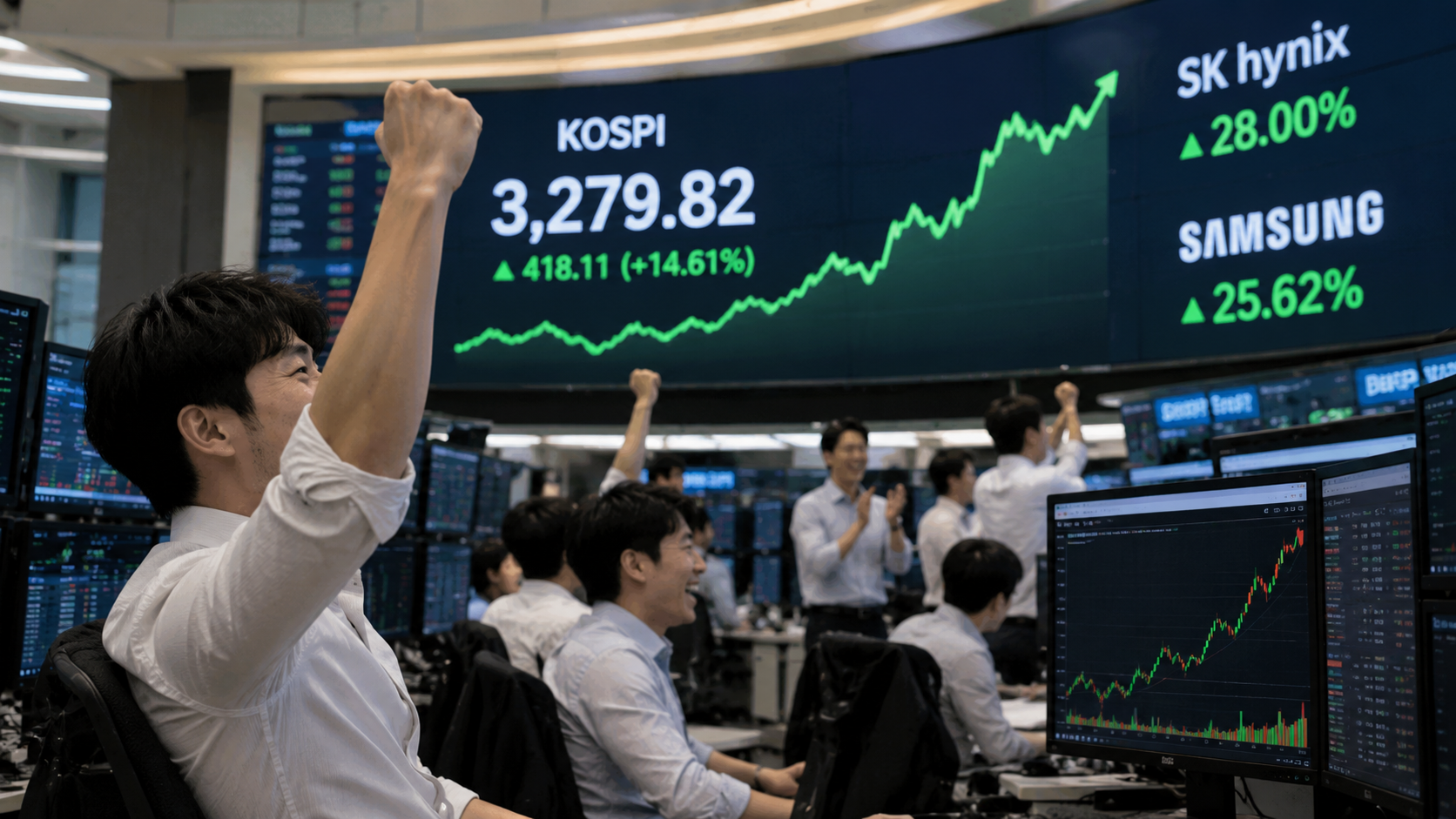
South Korean stocks surged Friday as chipmakers recovered from a leverage-driven selloff and fresh AI spending plans revived risk appetite.
The Kospi climbed as much as 15%, reaching its highest level in roughly a month after a punishing three-session slide. The move put South Korea’s equity market back at the center of the artificial intelligence trade, where memory-chip suppliers have become a direct proxy for demand from global technology groups.
Chipmakers reverse the damage
SK Hynix Inc. led the rebound, rising as much as 28% in what the source described as a record advance for the stock. The gain followed a rare direct share purchase by SK Group Chairman Chey Tae-won, a signal investors read alongside improving sentiment toward AI-linked hardware suppliers.
Samsung Electronics Co. also rallied, gaining as much as 26% during Friday’s session. The two companies sit at the core of South Korea’s technology-heavy market because their memory chips are tied to spending on servers, data centers and advanced computing systems used for AI workloads.
The reversal came after both Samsung and SK Hynix had reported buoyant profit figures earlier in the week, according to the source. Those results had not been enough to stop the selloff at first, showing how quickly positioning and macro fears can overwhelm company-level earnings momentum.
Leverage cuts both ways
The Kospi had dropped 17% across the previous three sessions. The fall reflected worries about rising debt among the world’s largest technology companies and the possibility that Chinese rivals could threaten the pricing power of established chip suppliers.
The decline was also intensified by forced unwinding of leveraged trades. When investors borrow to increase exposure, falling prices can trigger margin pressure, turning a normal retreat into a sharper and faster liquidation cycle.
Friday’s rebound therefore carried two messages at once. It showed that investors still want exposure to AI infrastructure, but it also showed that South Korean equities remain vulnerable when crowded trades are funded with borrowed money.
“Today’s rebound looks like a relief rally, but it is supported by improving fundamentals rather than bargain-hunting alone,” said Jung In Yun, chief executive officer at Fibonacci Asset Management Global. “After such extreme volatility, we would view this as an early recovery signal.”
AI spending resets the trade
The immediate catalyst was renewed optimism around technology spending plans overseas. The source also cited domestic regulatory support as one of the forces helping sentiment, though it did not specify the policy measures or agencies involved.
For SK Hynix, the market’s focus is whether AI-related demand can keep supporting earnings after a rapid share-price swing. The chairman’s purchase adds a governance and confidence angle, but investors will still judge the company on memory pricing, supply discipline and orders tied to AI servers.
For Samsung, the rebound gives shareholders a chance to reassess whether its chip cycle has turned decisively after earlier profit strength. Its broader role in consumer electronics and semiconductors means the stock often reflects both global device demand and expectations for high-end memory components.
The wider chip sector is now facing a cleaner test. If large technology companies keep expanding AI infrastructure budgets, memory suppliers could see firmer demand and better pricing, which would support South Korea’s export-linked equity market and reinforce AI as a global capex theme.
If debt concerns at major technology companies return, the mechanism would run in the opposite direction. Investors would question whether AI spending is being financed too aggressively, valuation multiples for suppliers could compress, and leveraged positions in Korean equities could again become a source of forced selling.
A third path depends on Chinese competition. If Chinese chipmakers gain ground faster than expected, pressure could shift from demand to supply, weighing on margins at SK Hynix, Samsung and peers across the memory industry even if global AI spending remains high.
The next signals are likely to come from company guidance, memory-chip pricing and any clearer details on South Korea’s regulatory support. Friday’s rally repaired some of the week’s market damage, but it did not remove the central uncertainty: whether the AI buildout can keep generating profits fast enough to justify the capital behind it.