European industry talks revive combustion-car fault line
European industry policy is entering a new Franco-German test as Paris and Berlin seek job protection while countering Chinese competition.
Atlas Newsdesk ·
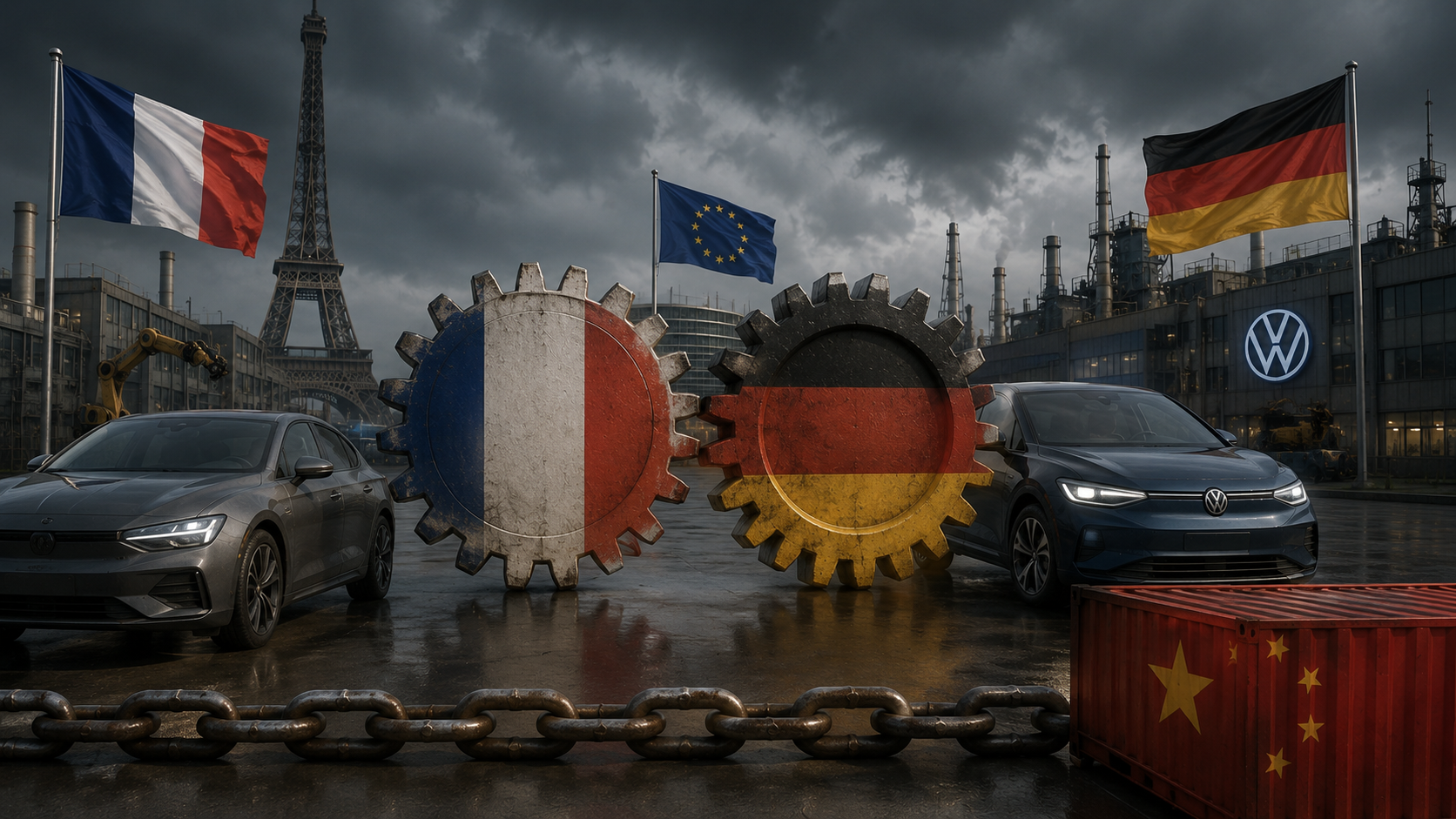
European industry policy faces a Franco-German test as Paris and Berlin seek to protect car jobs and answer China’s trade pressure.
The initiative described in the available account puts two old European priorities back into conflict: climate rules and industrial employment. France is considering a softer approach to a planned halt in new combustion-engine car sales, while Germany is trying to relieve pressure on its carmakers.
The effort comes after a separate defense project exposed how hard joint industrial policy can be in practice. A Franco-German fighter jet program collapsed last month after disputes among defense contractors, according to the account, weakening the case that Europe can quickly align national champions behind shared goals.
Car rules meet factory strain
The auto industry is the clearest pressure point because Chinese manufacturers are competing directly in electric vehicles and lower-cost models. The account says Volkswagen is weighing as many as 100,000 job cuts, a figure that shows how trade pressure can move from policy debates into payroll decisions.
France’s potential relaxation of the combustion-engine phaseout would matter because it could give carmakers more time to adjust production lines, supplier contracts and workforce plans. For Berlin, the issue is less theoretical: German employment and regional factory networks are deeply tied to large automakers and their parts suppliers.
The tension is that a slower transition may help incumbent manufacturers while complicating Europe’s climate and electrification strategy. If rules loosen too much, Chinese rivals could still gain share in electric vehicles while European firms spend longer defending older engine platforms.
Defense collapse shadows new talks
The failed fighter jet effort is a warning for the new industrial push. Defense and autos are different sectors, but both require governments and companies to agree on technology, funding, ownership and where production work is placed.
Those questions often become national before they become European. Paris tends to place more weight on industrial sovereignty and state guidance, while Berlin faces direct pressure from export-oriented manufacturers and large workforces exposed to global competition.
The China element sharpens that divide. The account says the EU is struggling to form a united response to China’s expanding trade surplus, while Beijing is engaging individual European states rather than treating the bloc as one negotiating counterparty.
"It has always been a favourite pastime of the Chinese leaders to divide and conquer us,"
an unnamed trade expert said, according to the account. The comment reflects a central risk for Brussels: if national capitals pursue separate accommodations, collective leverage in trade, tariffs and market-access talks weakens.
Three paths for Europe’s response
If France and Germany reach a practical bargain, the immediate macro effect would be a clearer European industrial stance at a time of rising trade friction with China. Volkswagen and its peers would gain a more predictable policy runway, while the auto sector could coordinate investment decisions with less fear of abrupt regulatory shifts.
If the talks produce only a narrow auto compromise, the gains would be more limited. Volkswagen could receive breathing room on combustion-engine timing, but the wider industry would still face unresolved questions over electric vehicle competitiveness, supply chains and exposure to Chinese pricing.
If the effort breaks down as the fighter jet program did, the damage would reach beyond one company. Europe would look less able to defend strategic industries, Volkswagen would remain under pressure to make its own cost decisions, and Chinese manufacturers would face a less coordinated European market.
The open questions are concrete. The available account does not provide a formal policy text, a timetable for any French shift, or official confirmation from Volkswagen on final job decisions.
For investors, workers and policymakers, the next signal is whether Paris and Berlin can convert shared anxiety into a plan with enforceable details. Without that, the bloc’s industrial debate stays stuck between defending today’s jobs and building tomorrow’s competitive base.