Projects for AP1000 reactors secure $17.5bn in DOE loans
DOE AP1000 loans totaling $17.5bn would finance long-lead equipment for 10 Westinghouse AP1000 reactors across five two-unit projects, the agency said.
Atlas Newsdesk ·
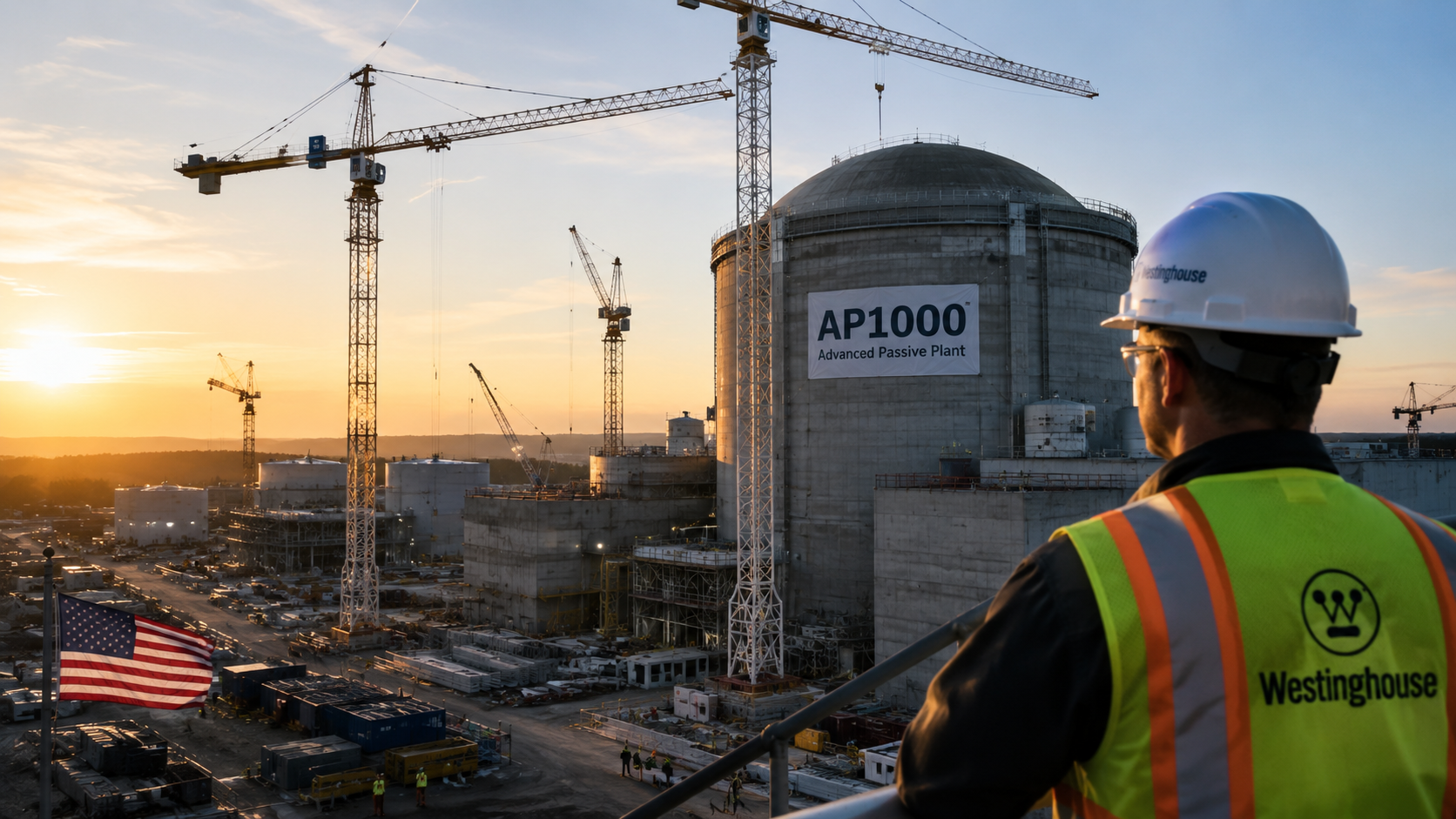
DOE AP1000 loans totaling $17.5bn would finance long-lead equipment for 10 Westinghouse AP1000 reactors across five two-unit projects, the agency said.
The U.S. Department of Energy (DOE) announced the conditional loan commitments on 23-Jun-2026, positioning the financing as a way to place early equipment orders that can set the schedule for large nuclear builds.
The structure disclosed by DOE centers on five separate projects, each planned for two AP1000 units. DOE said each project would be jointly owned by Westinghouse and a utility or energy company partner.
How the loan commitments are designed to speed timelines
DOE indicated the loans are aimed at procurement of long-lead items, a category of equipment that often must be ordered well before full construction ramps up. By moving those purchases forward, DOE said project timelines could be brought forward by as much as three years.
DOE also linked the potential schedule benefits to contracting terms. Westinghouse is expected to commit to fixed-price contracts, a mechanism intended to limit exposure to equipment cost inflation.
Access to federal financing would come only after a private-capital hurdle is met. DOE said Westinghouse and its partner for each project must each provide $500m of upfront equity, or $1bn per two-unit project, before drawing on DOE funds.
Fixed pricing and earlier procurement are designed to address two of the most persistent risks in large nuclear construction: extended durations and escalating input costs. Even with those measures, cost- and schedule-risk allocation between owners, contractors, and other stakeholders is likely to remain central to whether projects advance.
Policy backdrop: targets for large reactors and an $80bn ambition
The financing announcement fits into a broader U.S. policy push to expand firm, low-carbon electricity generation. DOE’s move follows a May-2025 Executive Order issued by President Donald Trump that sets a goal of having 10 new large nuclear reactors under construction by 2030.
It also follows a strategic partnership announced between the U.S. government and Westinghouse to support at least $80bn in new-build reactor projects. The DOE loan commitments focus specifically on enabling early equipment orders for AP1000 units, an area that can determine whether a build sequence can realistically meet policy timelines.
For developers and utilities, the practical question is whether conditional loan commitments translate into bankable project financing packages. The combination of federal lending support, fixed-price equipment arrangements, and defined equity prerequisites signals an attempt to de-risk the earliest—and often most time-sensitive—phase of new nuclear development.
Market implications for Westinghouse stakeholders, including BEP
The announcement also has read-through implications for companies with exposure to Westinghouse and the nuclear supply chain. Brookfield Renewable Partners (BEP) has an ownership stake in the Westinghouse nuclear business, creating potential upside if AP1000 deployments convert from planning to procurement and construction.
Based on an estimated ~11% ownership stake in Westinghouse, BEP has been modeled as having meaningful indirect exposure to new AP1000 unit economics. Using that ownership share, 10 additional AP1000 units have been estimated to represent roughly $420m of incremental EBITDA opportunity for BEP over the longer term.
More broadly, the conditional loan commitments arrive as electricity systems face rising demand and heightened interest in clean, dispatchable generation. If the five projects progress from conditional commitments to executed orders and construction activity, investors and developers are likely to watch procurement milestones, final project partners, and how remaining risks—particularly overruns and delays—are contractually shared.
Next steps are expected to include finalizing project partners, meeting equity funding requirements, and converting conditional commitments into drawn financing as long-lead orders are placed. The pace and terms of those early procurements will be a key signal of whether the AP1000 pipeline can align with the 2030 construction target.