Pentagon's Middle East Buildup Puts Oil, Defense in Play
The deployment of a third U.S. carrier strike group to the Middle East, adding 10,000 troops, reprices geopolitical risk across energy and defense sectors.
Jurgen Goldmeier ·
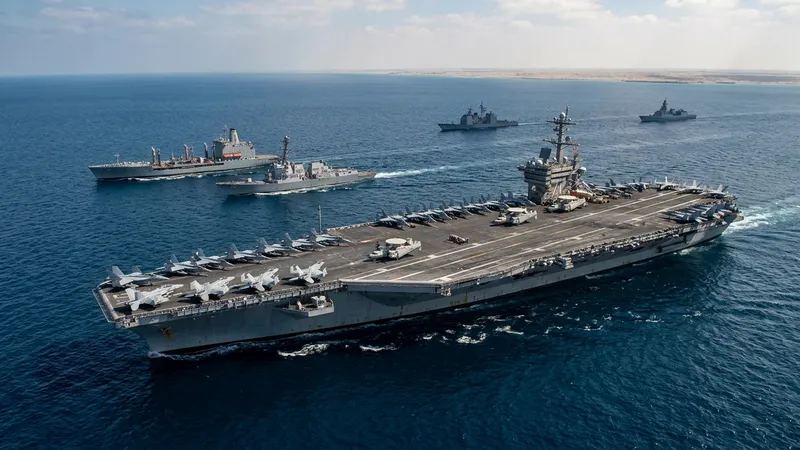
Pentagon's Middle East Buildup Puts Oil, Defense in Play The reported deployment of a third U.S. aircraft carrier group, the USS Theodore Roosevelt, and an additional 10,000 military personnel to the Middle East brings the total American force posture to over 60,000 troops. This significant military escalation, first detailed by the Wall Street Journal, puts an immediate bid under crude oil futures and defense contractor stocks, shifting market focus from economic data back to geopolitical risk. ## Background The market tape has been conditioned for months by regional conflict, including the Israel-Hamas war and Houthi attacks on Red Sea shipping, yet broader indices have remained focused on domestic inflation and Federal Reserve policy. Oil prices have traded within a defined range, balancing OPEC+ production cuts against persistent questions about global demand. Investor positioning had reflected a degree of complacency, with the Cboe Volatility Index (VIX), a key measure of expected market volatility, trading well below its fourth-quarter highs. Defense sector stocks have outperformed since the initial October conflict, with investors pricing in higher future government spending, known as guidance, and a corresponding expansion of valuation multiples—the ratio of stock price to a metric like earnings per share (EPS). This deployment marks a material increase in force concentration not seen in the region for several years. Previous escalations have led to sharp, albeit sometimes temporary, spikes in energy prices. The market's primary concern is the potential for a wider conflict that could threaten transit through the Strait of Hormuz, a chokepoint for roughly a fifth of global oil supply. This event interrupts a market narrative that was centered on the path of disinflation and the timing of central bank interest rate cuts. ## Why it matters The direct read-through impacts energy and defense. A sustained, heavy U.S. naval presence implies higher risk of direct confrontation, which traders will price into crude futures. This serves as a headwind for energy-intensive sectors like transportation and heavy manufacturing, and complicates the inflation outlook for the Federal Reserve. Should energy prices rise materially, it could challenge the case for imminent rate cuts, putting pressure on interest-rate sensitive assets. Those on the wrong side of the move are traders positioned for a continued decline in market volatility and a straight-line path to lower inflation. The primary beneficiaries are energy producers and the defense sector primes like RTX, Lockheed Martin, and General Dynamics. An elevated operational tempo translates directly into higher consumption of munitions and services, supporting revenue and reinforcing the bull case for increased defense budgets. Credit markets will watch for any widening in spreads, particularly in high-yield debt, if rising energy costs are seen as a threat to corporate margins and economic growth. ## What to watch We will monitor for official confirmation of the deployment's scale and mission from the Department of Defense and any retaliatory statements or actions from regional actors. The key observable will be the front-month contract for Brent crude and the performance of the SPDR S&P Aerospace & Defense ETF (XAR) relative to the S&P 500. By July 20, 2024, official Pentagon confirmation alongside any direct military exchanges in the region will likely see Brent crude break and hold above its recent trading range, with the XAR ETF outperforming the S&P 500. Conversely, a diplomatic de-escalation or a quiet reversal of the deployment would see the geopolitical risk premium fade, returning Brent crude to its prior range and market focus to inflation data.