Makkah Defence Pact Signed by Pakistan, Saudi, Türkiye
Makkah Defence Pact signed Friday by Pakistan, Saudi Arabia and Türkiye sets mutual defence terms and plans an implementation timeline by Sept. 1, 2026.
Mateo Fernandez ·
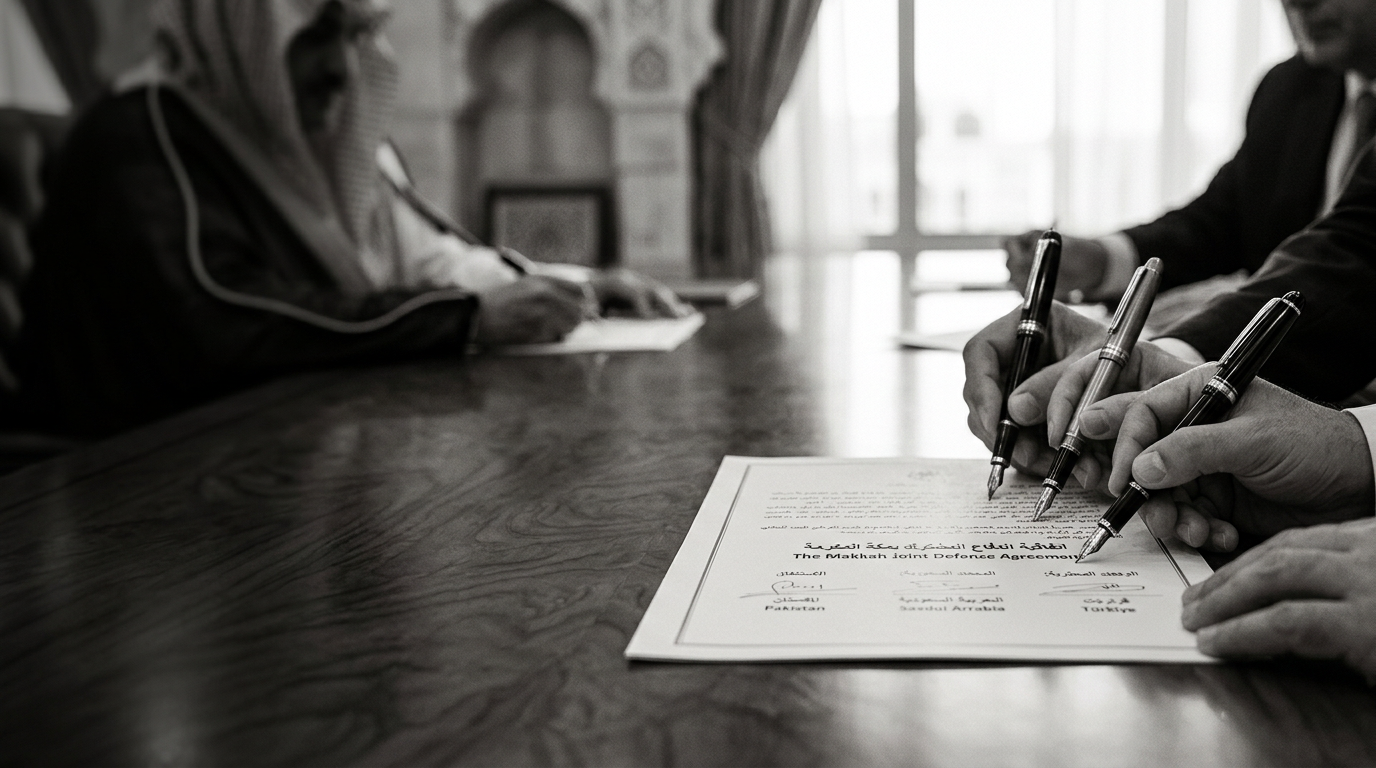
Pakistan, Saudi Arabia and Türkiye signed the Makkah Joint Defence Agreement on Friday, creating a mutual-defence framework under which an armed attack on one member can be treated as an attack on all, officials said.
The agreement was signed at Al-Safa Palace in Makkah by Saudi Crown Prince Mohammad bin Salman, Prime Minister Shehbaz Sharif and President Recep Tayyip Erdogan, according to officials.
Makkah Joint Defence Agreement sets collective response principle
Officials said a joint statement accompanying the pact describes it as a step “to strengthen collective deterrence against any act of aggression” and to expand defence cooperation among the three countries.
The text of the joint statement was released by Pakistan’s Foreign Office and by Saudi officials , who framed the accord as grounded in longstanding historical and strategic ties as well as Islamic solidarity.
Officials said the delegations included Pakistan’s chief of defence staff , the defence minister and the foreign minister , while Saudi and Turkish defence and foreign ministers also attended.
Ceremonial elements and participation details highlighted by officials
After the signing, the leaders offered prayers at the palace, a ceremonial step that officials described as reflecting the religious setting of the gathering in Makkah.
Officials also said the pact is open to other friendly states. They added that it is not intended to create a sectarian bloc and is not meant to provoke an arms race.
Implementation schedule and regional debate on impact
Officials said defence ministers are expected to meet to set an implementation timetable by September 1, 2026 . Specific operational details beyond that expectation were not provided in the officials’ remarks.
Analysts, however, said the pact could change regional security calculations by formalising mutual defence commitments and potentially speeding up joint planning and exercises.
A key uncertainty is how quickly the members translate the agreement’s language into concrete mechanisms, including how any future participation by additional states would be handled under the pact’s structure, based on what has been released so far.