Nike’s China Problem Exposes the End of Easy Growth for US Brands
Nike’s China sales slump shows how local rivals, nationalism and weaker spending are reshaping the sportswear market for US brands and investors now.
Jason Kwon ·
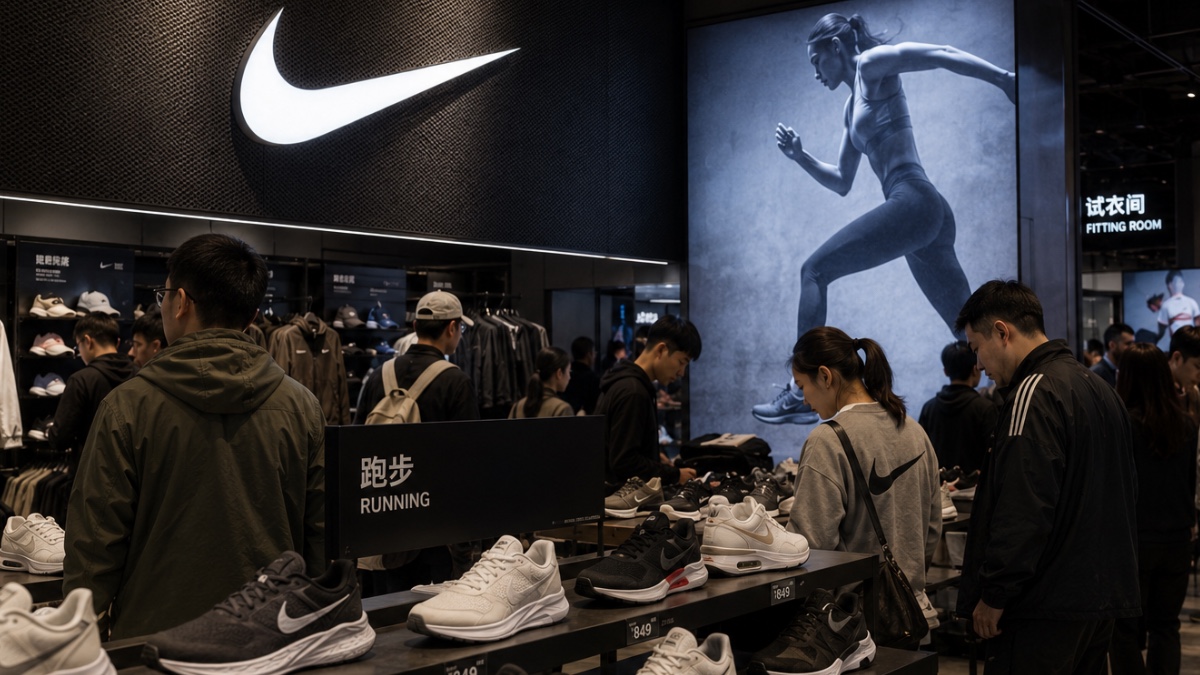
Nike’s China business has turned from a growth trophy into a warning sign for American consumer companies trying to defend their place in the world’s most contested retail market. The company’s Greater China revenue was down 7% in its fiscal third quarter, or 10% on a currency-neutral basis, while sales for the first nine months of the fiscal year fell 11% from a year earlier. A Wall Street Journal analysis found Nike’s China revenue across the latest three-quarter stretch was 28% below the comparable period five years earlier, even as demand for athletic apparel and footwear in the country kept expanding. For a brand that once treated China as one of its safest long-term growth stories, the reversal shows how quickly global prestige can lose force when local competition improves and shoppers become harder to persuade.
Twenty Percent Warning Lands
The latest damage is showing up in Nike’s forecast as well as its income statement. Executives have warned that revenue in Greater China could drop about 20% in the fiscal fourth quarter, a projection that helped push the stock to levels not seen in more than a decade. Nike has also moved deeper into cost-cutting, with roughly 1,400 additional jobs set to be eliminated as part of a wider effort to simplify operations and sharpen execution. The cuts, following earlier workforce reductions, suggest the company sees the China problem as part of a larger operating reset rather than a short-term inventory issue.
Anta Rewrites the Race
Nike is not losing China because Chinese consumers stopped buying sportswear. Euromonitor’s 2025 China sportswear report said the category remains fragmented and intensely competitive, with Nike and Adidas still among the top brands by retail value, while local and specialist players have become more aggressive. Domestic names such as Anta and Li-Ning have benefited from better local positioning, faster product cycles and a consumer shift toward Chinese brands that feel closer to national identity and daily athletic habits. That changes the old equation: Nike can no longer rely on the Swoosh alone to justify premium pricing when Chinese rivals can offer credible performance products with sharper local relevance.
Starbucks and Guess Retreat
Nike’s slide fits a broader pattern across US brands that once saw China as almost mandatory for global scale. Starbucks has agreed to give Chinese investment firm Boyu Capital a 60% interest in its China retail business, a transaction valued at $4 billion, while retaining 40% and keeping ownership of the brand and licensing rights. The coffee chain built a large presence in China, with about 8,000 stores, but has faced sustained pressure from fast-growing local competitors such as Luckin Coffee. Guess has also moved in the opposite direction from expansion, with Yicai reporting that the Los Angeles fashion brand planned to close its online and physical stores in China as parent Authentic Brands Group studies a different model for the market.
Douyin Changes the Storefront
The competitive threat is also about how China sells, not only what shoppers buy. Euromonitor flagged livestreaming, specialty retail formats and Douyin’s rise against Tmall as key forces reshaping sportswear distribution in China. That matters for Nike because brand heat in China is increasingly built through local digital ecosystems, rapid product feedback and community-driven commerce, not just flagship stores or global campaigns. A company designed around global scale can still win in China, but only if it moves at the speed of the platforms and subcultures where younger shoppers are discovering running shoes, outdoor gear and training apparel.
A US Brand Premium Shrinks
The macro setting has made the fight harder for Nike and other American companies. China’s softer consumer economy has pushed shoppers to be more selective, while geopolitical tension has made foreign-brand identity more complicated than it was during the earlier boom years. A premium US label can still carry status, but it now competes with a stronger local alternative and a more price-conscious customer. That combination is dangerous for Nike because its China problem is not simply that people are spending less; it is that more of the spending that remains is moving toward brands that look faster, closer and more Chinese.
Hill's China Test
Nike’s next challenge is to prove that its turnaround can travel across markets rather than work only in North America. CEO Elliott Hill’s plan has focused on improving the quality of the business, rebuilding momentum in priority categories and restoring discipline after years of uneven product and channel decisions. China will be the hardest test because the company must clear inventory, refresh local leadership, defend its premium image and respond to domestic rivals that are no longer chasing from far behind. The risk is that Nike stabilizes globally while China remains a weaker, lower-margin market than investors once assumed, forcing Wall Street to reprice not just one region but the long-term growth story around the Swoosh.