NASA Launches Roman Telescope to Probe Dark Energy
NASA's $4.3 billion Nancy Grace Roman Space Telescope has launched, targeting the Earth-Sun L2 point to study dark energy and exoplanets.
Atlas Newsdesk ·
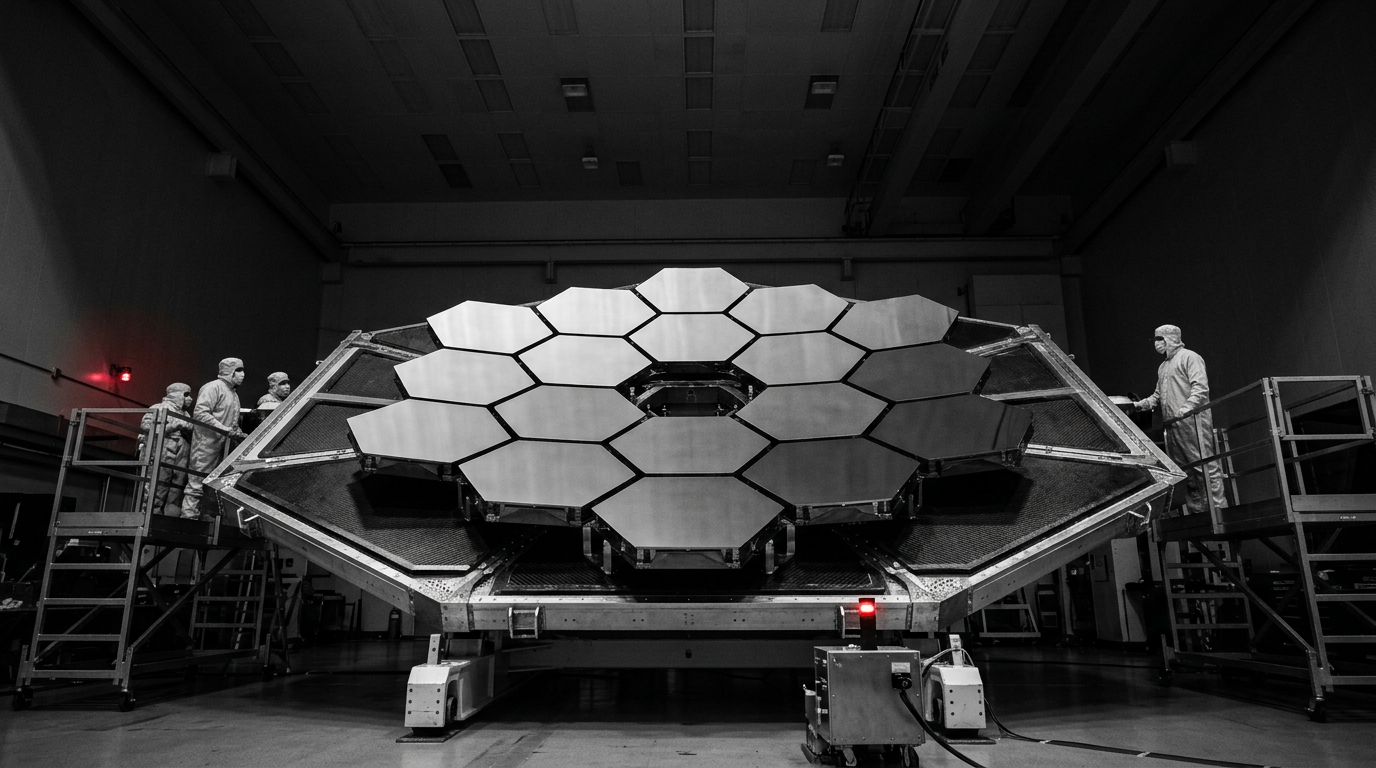
The Nancy Grace Roman Space Telescope, a significant $4.3 billion observatory from NASA, has successfully lifted off from Kennedy Space Center. Carried by a SpaceX Falcon Heavy rocket, the mission's primary objective is to investigate cosmic phenomena, including the enigmatic dark energy and dark matter. The telescope is now en route to its designated operational position at the Earth-Sun L2 Lagrange point.
Officials anticipate that the Roman Telescope will achieve full operational status within the next three months. The collection of scientific data is scheduled to commence shortly thereafter, with an expected public release of this initial information before the end of the current calendar year. This project remarkably concluded nine months ahead of its original May 2027 deadline and remained within its allocated budget, demonstrating efficiency in execution.
Efficient Development and Innovative Design
The successful and timely development of the Roman Space Telescope stands in notable contrast to some prior large-scale astrophysics projects, which have frequently encountered multi-year delays and budget overruns. This accomplishment highlights advancements in procurement strategies and development methodologies employed by the agency, facilitating quicker and more cost-effective mission delivery.
A crucial aspect of the telescope's engineering involved adapting a 2.4-meter primary initially developed for a surveillance program managed by Reconnaissance Office (NRO). Repurposing this component for deep-space observation necessitated a substantial redesign of its optical configuration to meet the stringent requirements for astronomical research.
Expanding Cosmic Observation Capabilities
Once operational, the Roman Space Telescope is poised to offer an unparalleled view of the universe, providing a field of view 100 times larger than that of the renowned Hubble Space Telescope. This expansive observational capacity is vital for its core scientific objectives, which encompass detailed investigations into dark energy—the mysterious force believed to accelerate the universe's expansion—and dark matter, the unseen substance thought to comprise a significant portion of the universe's mass.
Data from the mission is expected to enable scientists to construct extensive cosmic maps, meticulously trace the distribution of galaxies, and observe distant supernovae. These observations are anticipated to yield critical insights into the universe's evolution and fundamental physics. Additionally, the telescope's advanced instrumentation will facilitate the discovery of exoplanets through gravitational microlensing, thereby broadening the ongoing search for other worlds beyond our solar system.
The information gathered by the Roman Telescope will complement findings from other space-based and ground-based observatories, contributing to a more comprehensive understanding of the cosmos. Its wide field of view will prove particularly effective for large-scale astronomical surveys, allowing for statistical analyses that can unveil subtle patterns in the universe's structure and its historical expansion. Scientists expect that this mission will not only corroborate existing theories regarding dark energy and dark matter but also potentially uncover new phenomena or challenge current cosmological models.
The telescope's capacity to observe vast sections of the sky with high resolution is set to revolutionize astrophysics, providing a wealth of information for researchers for generations to come.