Mount Etna ash halts Catania flights until Saturday
Mount Etna’s ash cloud shut Catania Airport on Friday, with officials keeping flights suspended until at least 14:00 local time Saturday.
Atlas Newsdesk ·
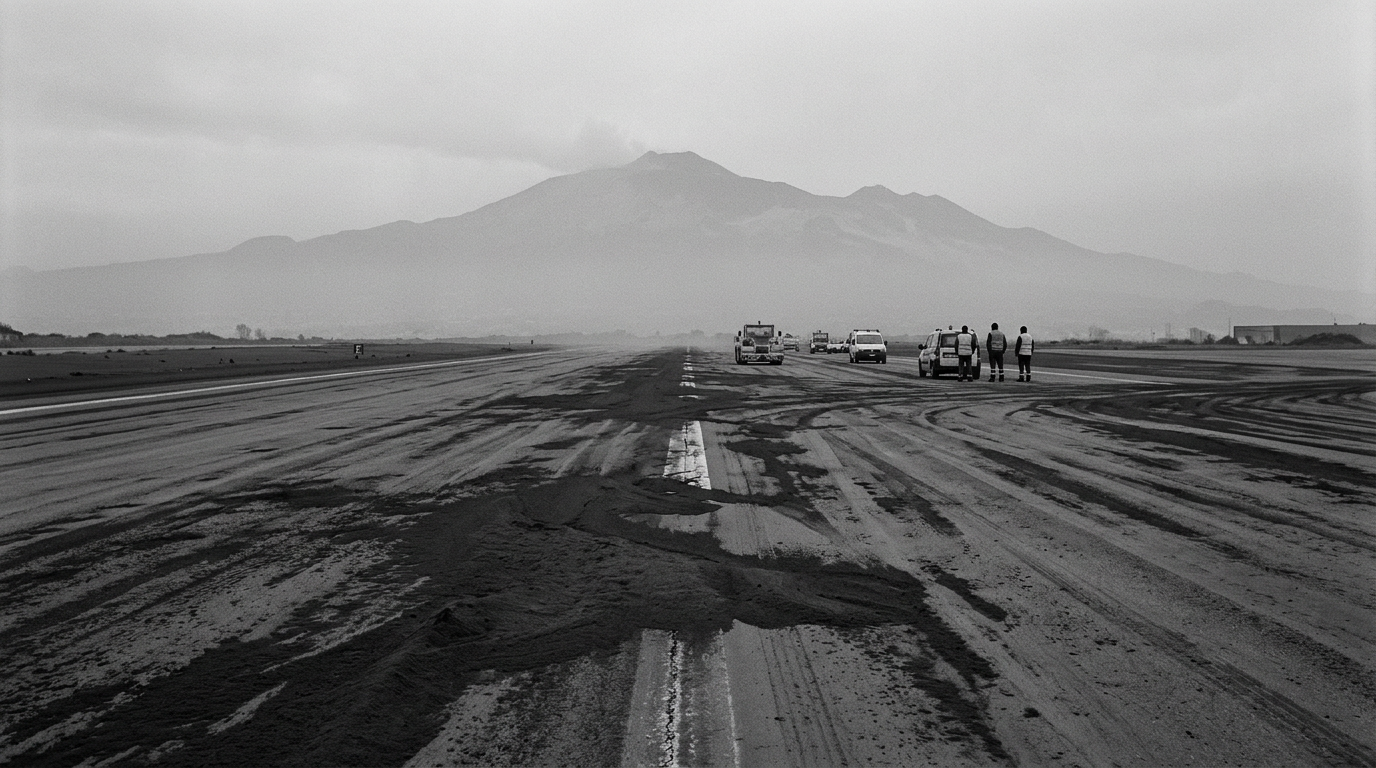
Flight operations at Vincenzo Bellini Airport in Catania, Sicily, were halted on Friday after Mount Etna emitted a large ash cloud, officials said. Airport management said the suspension would remain in place until at least 14:00 local time on Saturday, disrupting traffic during the peak summer travel period.
Officials described the stop as the airport’s most severe interruption in more than 20 years. With the airport typically handling around 40,000 passengers a day, the sudden shutdown quickly led to crowding in the terminal as hundreds of travelers were unable to leave.
Disruptions built up before the full shutdown
The complete closure came after several days of heightened volcanic activity that had already complicated flight planning across eastern Sicily, officials said. Before operations were fully stopped, cancellations and diversions had been accumulating as airspace conditions changed.
Between last Thursday and this Wednesday, more than one-third of the 1,974 scheduled flights were cancelled, according to figures cited in the report. Over the same period, 600 additional flights were diverted, adding operational strain for airlines, airport services, and passengers.
Knock-on effects for airlines and airport services
The wave of disrupted flights created broader congestion beyond individual departures, as carriers and ground handling teams had to manage aircraft rotations, stranded passengers, and revised schedules. Officials said the loss of capacity during a busy summer window intensified pressure on rebooking systems and customer services.
Airport authorities said any restart would depend on conditions linked to the ash emission from Mount Etna. That uncertainty left travelers facing longer waits while operators worked within limits set by airspace safety requirements.
Why ash in the airspace triggers flight suspensions
Officials said volcanic ash is treated as a major aviation hazard because it can harm aircraft engines and interfere with navigation systems. When ash is detected in flight paths, standard take-offs and landings may not meet safety thresholds, leading to temporary closures or restrictions.
The ash plume was also reported to have reached as far as North Africa, adding complexity for air traffic management beyond Sicily. Officials said such dispersion can require wider coordination when rerouting aircraft away from affected airspace.
Alternatives for travelers and limits on compensation
As passengers searched for other ways to move around the region, Italy’s rail operator Trenitalia increased capacity on the Palermo–Messina–Catania line. The company said it deployed six extra trains on the route to help absorb demand while air operations remained constrained.
For passengers seeking refunds or assistance, officials noted that aviation rules classify volcanic eruptions as “extraordinary circumstances.” Under those rules, airlines are not legally required to pay financial compensation for disruption directly attributed to the eruption, even though many travelers may still face extended delays and the practical challenge of arranging replacement travel.
Timing remains tied to conditions at Mount Etna
Airport management said the suspension will continue until at least 14:00 local time on Saturday. Officials said the timing of any return to normal operations will depend on how the ash situation develops.