IEA electrification drive draws 61% of global energy funds
IEA electrification spending reached 61% of global energy investment this year as Seoul and the agency started an Asia energy security partnership.
Atlas Newsdesk ·
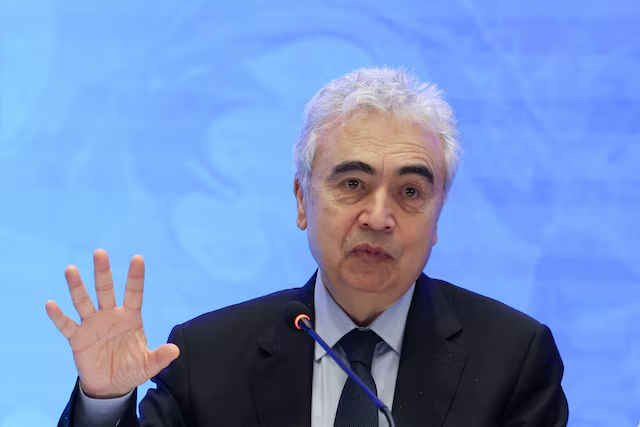
IEA electrification drew 61% of global energy investment this year, Fatih Birol said, as grids and costs test Asia’s power shift.
The International Energy Agency executive director told reporters in Seoul on Thursday that capital markets still support the move toward electricity, even with power networks under strain. Fossil fuels accounted for the remaining 39% of global energy investment this year, according to Birol.
Birol points to grid limits
Birol framed the transition as uneven rather than stalled. Asked whether power infrastructure risks being overbuilt if artificial intelligence investment slows, he said electrification was "not a rose garden," but that the broad direction remained clear.
"Electricity demand increases three times faster than the total energy demand," Birol said. The comparison matters because faster power demand requires grids, storage, transformers and cables to expand alongside generation, not after it.
Birol identified two constraints on wider electrification. One is the shortage of grid capacity linking power plants to consumption centers; the other is the cost of electricity for households and businesses choosing between power and fossil fuels.
Governments can address the affordability problem through financing tools, Birol said, without detailing specific measures. The point places public balance sheets and tariff design at the center of a transition often discussed mainly through wind farms, solar panels and electric vehicles.
Seoul and IEA launch RISE ASIA
Birol made the remarks alongside South Korean Energy Minister Kim Sung-whan as the two announced Resilient & Integrated Strategy for Energy Security in Asia, or RISE ASIA. Kim said the partnership would begin with coordinated responses to what he described as an energy crunch since the war in Iran.
Over a longer horizon, Kim said the effort is meant to help Asian economies move away from fossil fuels and toward electricity. Seoul and the IEA plan to work with other Asian countries toward a 35% electrification target by 2035, with the goal to be announced around the COP31 climate summit, he said.
The near-term focus will be Southeast Asia, according to Birol. He said South Korea’s manufacturing base gives the program a practical starting point because the country produces batteries, wires, cables and transformers needed for regional electrification.
Birol called that industrial base "a big advantage to start with." For South Korean manufacturers, the partnership links domestic production capacity to a regional demand story that depends on grid investment, financing terms and policy alignment across multiple Asian markets.
LNG strain complicates the shift
The power push is unfolding as Asia’s fuel security remains exposed to liquefied natural gas prices. Birol said LNG markets have been strained by the war’s impact on Qatar, a major exporter, and could tighten further if Europe imports more cargoes after cutting energy ties with Russia.
A harsh European winter would intensify competition between European and Asian buyers for LNG, Birol said. That mechanism would put upward pressure on spot cargo prices and make it harder for import-dependent Asian economies to keep power affordable.
Birol also said market pressure should ease in a few years as new LNG projects start operating in the US, Canada, Australia and Malaysia. The timing matters for Asia because gas often backs up power systems when renewables and grids cannot meet demand reliably.
If grid investment keeps pace with demand, Asia’s electrification drive would reduce fuel import exposure over time and support suppliers of equipment across South Korea and the wider region. If grid bottlenecks persist, the same demand growth would leave countries more reliant on gas-fired generation and exposed to LNG price swings.
If electricity prices remain low enough for consumers to switch, the 35% electrification target would become a demand anchor for batteries, cables and transformers. If tariffs rise or financing falls short, governments may face pressure to slow the transition, leaving utilities, manufacturers and fuel importers to plan around a less predictable path.