Gold prices steady as Fed bets shift before US jobs data
Gold prices steadied before US payrolls, with traders trimming September rate-hike wagers after Fed Governor Christopher Waller signaled support for holding…
Atlas Newsdesk ·
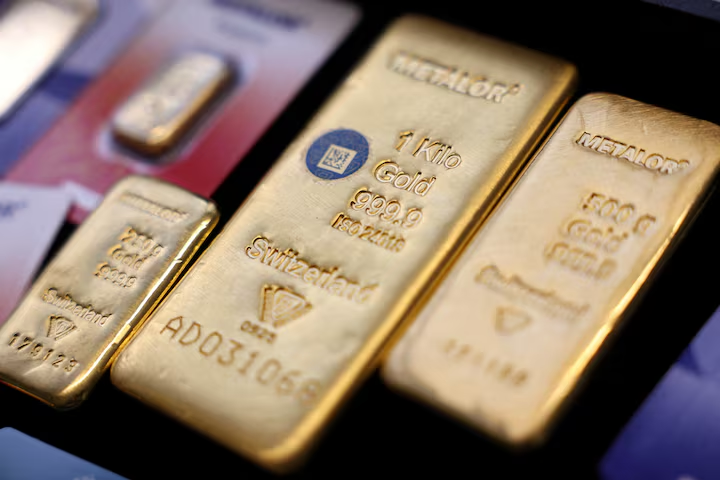
Gold prices steadied near $4,475 an ounce before US payrolls data, leaving bullion on course for a weekly gain as Fed bets shifted.
Spot gold was little changed at $4,474.78 per ounce by 0910 GMT, while December US gold futures fell 0.4% to $4,521.40 per ounce. The metal remained above a three-week low touched on Wednesday, with the weekly move helped by a rebound following comments from Federal Reserve Governor Christopher Waller.
Waller comments reset rate bets
Traders reduced wagers on a September interest-rate increase after Waller said he was leaning toward leaving rates unchanged at this month’s policy meeting if incoming inflation data shows price pressures easing. The statement put the next batch of US economic figures at the center of the gold trade.
The non-farm payrolls report was scheduled for 1230 GMT, with August consumer and producer inflation readings due the following week. Those releases matter for bullion because interest-rate expectations shape the opportunity cost of holding an asset that pays no yield.
Independent analyst Ross Norman attributed the move to Waller’s remarks, while warning that the next data releases could quickly take over the market narrative. “The news that Governor Waller was leaning towards no increase gave gold something of a steroid shot, with the metal gaining around 2%. But the effect is likely to prove short-lived as fresh data takes precedence,” Norman said.
Payrolls become the next test
Gold is often bought as a hedge against inflation, but higher interest rates tend to reduce its appeal compared with cash, bonds and other yield-bearing assets. That leaves the metal sensitive to each payrolls and inflation print when investors are trying to judge the Federal Reserve’s policy path.
Norman said sentiment among gold buyers had improved after the rebound from Wednesday’s low. “There is a sense of refreshed optimism among gold investors just now, almost as if the market is looking for excuses to move higher,” he said.
Citi maintained a bullish view on precious metals, setting a zero-to-three-month gold target of $4,800 per ounce, about $325 above the spot price cited at 0910 GMT. The bank’s six-to-12-month forecast stood at $5,000 per ounce, compared with the current level near $4,475.
“Momentum in gold prices will likely attract retail buying similar to the second half of 2025, both physical and futures globally,” Citi said in a note. That view links the price move to investor demand rather than only to central-bank expectations.
India buying improves after drop
Physical demand offered another support point in Asia. Gold buying in India improved during the week after lower prices encouraged some consumers, while investment flows continued to support consumption in China, the top consumer market cited in the report.
The India and China data point matters because retail and investment demand can affect how strongly global price moves feed into physical markets. If lower prices keep drawing buyers in India, dealers may see firmer seasonal demand; if prices rise toward Citi’s targets, affordability could become a constraint.
Other precious metals were mixed against gold’s steadier tone. Spot silver held at $66.95 per ounce, platinum slipped 0.7% to $1,812.66 per ounce, and palladium dropped 0.7% to $1,411.57 per ounce.
Fed path sets bullion scenarios
If payrolls and next week’s inflation reports support Waller’s case for no September increase, gold could retain support through lower expected real yields. That path would ease one pressure point for the global macro picture, support gold producers and dealers tied to bullion prices, and keep attention on precious-metals demand across Asia.
If the data instead points to stronger hiring or persistent inflation, traders may rebuild expectations for tighter policy. That would lift the hurdle for non-yielding bullion, weigh on companies exposed to gold-price momentum, and test whether retail demand in India and investment flows in China can offset a less favorable rates backdrop.
The main open question is whether the US data confirms the moderation Waller described before the Fed meeting this month. Until then, gold’s weekly gain rests on a narrow mechanism: softer rate expectations, resilient physical demand and investor willingness to keep adding exposure near elevated prices.