French Open line-calling debate flares after Ruud–Fonseca tiebreak call
The French Open's human line-calling system sparked controversy after a critical call against Casper Ruud was contradicted by electronic replays.
Mehmet Şahinoğlu ·
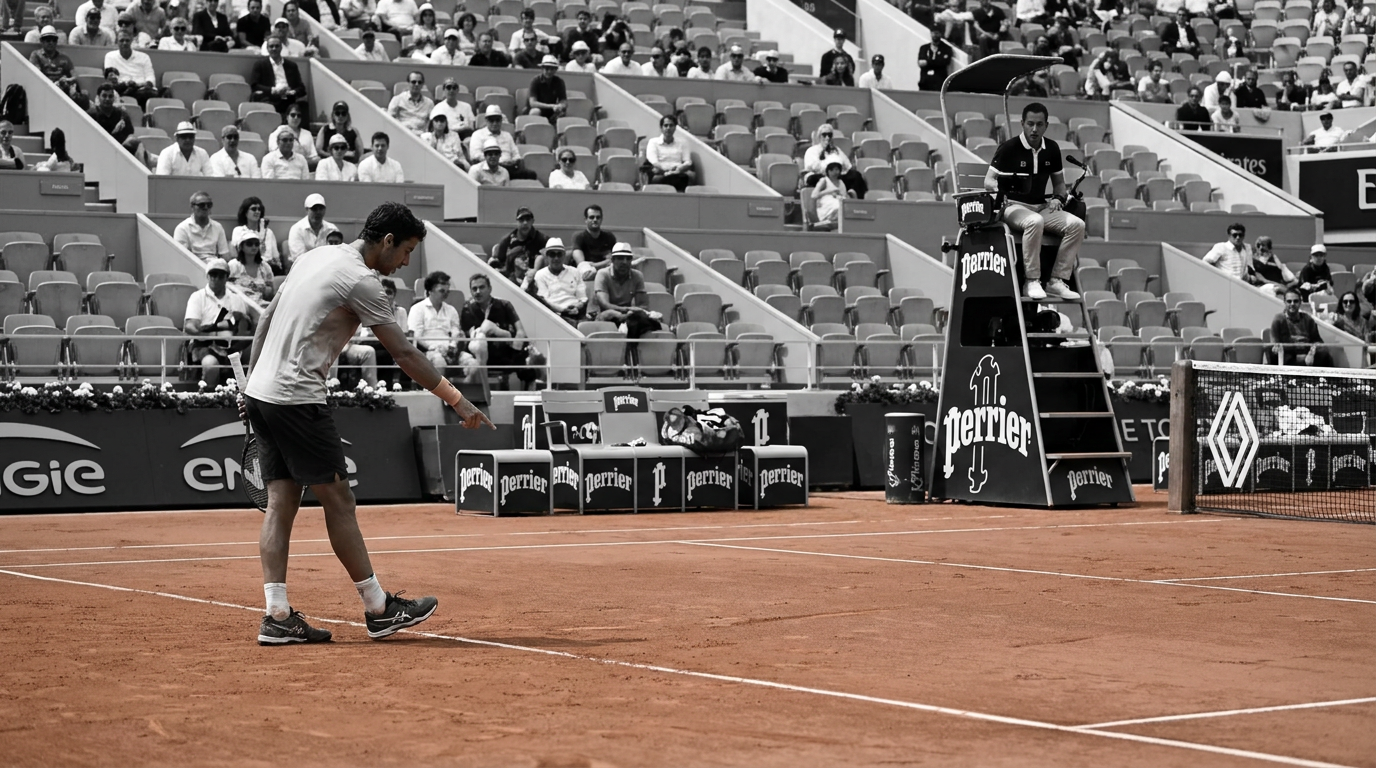
The French Open came under renewed scrutiny on May 31, 2026, after a second-set tiebreak line call in Casper Ruud’s fourth-round match against João Fonseca appeared to contradict electronic line-calling (ELC) replays shown on television. Fonseca won the match 7-5, 7-6(8), 5-7, 6-2 in Paris to reach his first Grand Slam quarterfinal, and the incident reignited debate over Roland Garros’ continued use of human line judges and ball-mark inspections on clay.
The flashpoint arrived with Ruud leading 8-7 in the second-set tiebreak. A Fonseca forehand was ruled in by the chair umpire after a court-side inspection, despite audible dissent from the crowd. Television graphics using ELC suggested the ball was out. Later in the breaker, a Ruud shot initially called out was overruled as in, which the ELC replay supported, and Fonseca ultimately closed out the set to move ahead by two sets to love.
Unlike the other Grand Slams and most ATP/WTA events, Roland Garros continues to rely on on-court officials and ball marks to adjudicate close calls on clay. This approach has spurred multiple disputes throughout the tournament, with players frustrated by perceived inconsistencies and the time consumed by repeated mark checks. The Ruud–Fonseca episode distilled those concerns for a global audience.
The discrepancy between what officials see at court level and what viewers see on broadcast is central to the controversy. Ball marks on clay can be ambiguous due to wind, foot traffic and uneven distribution of the red-brick dust, which can distort the impression a ball leaves. ELC, by contrast, tracks the ball’s trajectory and contact point and is generally cited with an approximate 3 mm margin of error, offering a different evidence set than a visual mark alone.
That difference of inputs matters. A human umpire can only judge whether a visible trace overlaps the line, while ELC integrates flight data to infer the true contact point. When television presents an ELC rendering that conflicts with an on-court inspection, fans and commentators perceive an error even when each method is operating as designed. The outcome is a credibility gap that places additional pressure on officials and players alike.
For athletes, the adjustment is not trivial. Many grew up treating the clay ball mark as the ultimate arbiter. Shifting between tournaments that use full electronic systems and Roland Garros’ traditional model can challenge a player’s instincts, and it can complicate in-the-moment decision-making during high-stakes points. The tiebreak swing in Ruud–Fonseca—coming at a hinge moment of a best-of-five match—underscored how pivotal a single call can be.
None of this diminishes Fonseca’s achievement. The 19-year-old Brazilian held his nerve after the contentious sequence, protected his lead and finished the job in four sets to book a maiden major quarterfinal. Ruud, a two-time finalist in Paris, mounted a response by taking the third set but could not extend the match to a decider.
The tournament’s stance reflects a broader debate about tradition, technology and clarity for spectators. While promoters of ELC argue it brings consistency and speed, proponents of the clay-court mark system point to the surface’s unique properties and the historical role of umpires in interpreting them. Until there is alignment between the method used on court and the graphics shown to viewers, moments like the Ruud–Fonseca call will continue to spur skepticism.
Tiebreak call reignites Roland Garros officiating debate
The visible divergence between the ball mark inspected by the chair umpire and the ELC replay became a touchstone for fans who expect a single, authoritative verdict. The mismatch amplified frustration and overshadowed an otherwise compelling performance by a breakthrough contender.
Clay’s unique challenges for technology and officials
On clay, marks can smear or overlap, and the final trace may not reflect the true contact point. ELC systems compile trajectory data to compensate, but that visualization is not the official determinant at Roland Garros, creating parallel narratives of the same point for those on site and those watching at home.
What to watch next
Attention now turns to whether tournament officials review protocols for future editions and how players and coaches calibrate expectations during the remainder of this French Open. Fonseca’s quarterfinal run and the broader officiating discussion will both be in focus as the event reaches its closing week.