Freedom 250 faces scrutiny as critics pan DC Mall fair
Freedom 250 opened on the National Mall after cancellations and state pullouts, drawing sharp reviews, online mockery, and a divided response from visitors…
Sophie McAlister ·
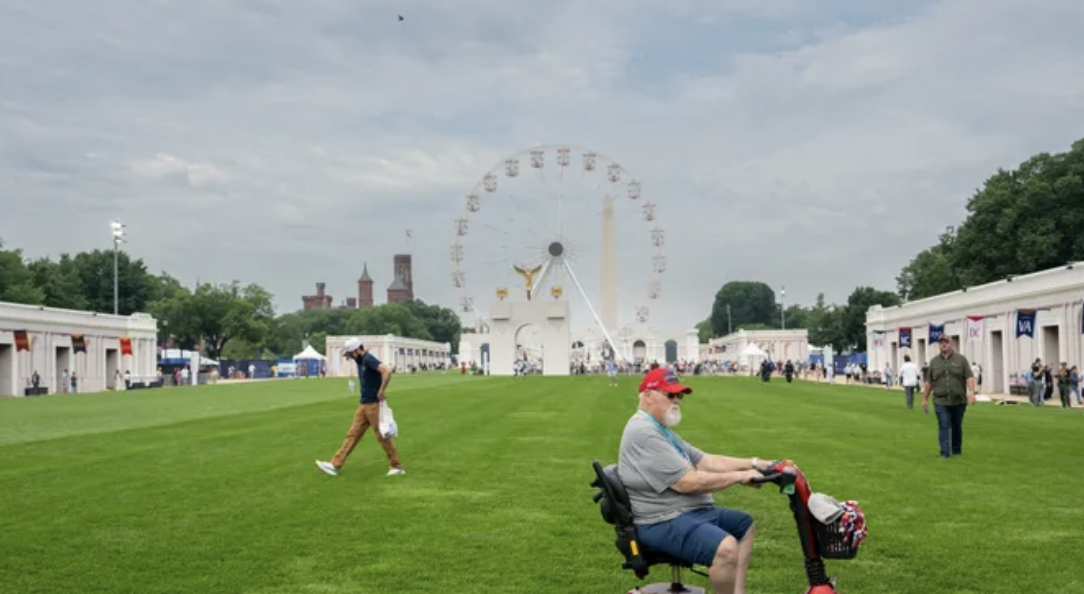
Freedom 250 has opened on the National Mall amid cancellations, state withdrawals, and online criticism, even as supporters circulate photos they say show healthy crowds.
The Trump administration-backed event arrived with significant pre-opening turbulence, including musicians dropping out, food vendors departing, and some states pulling their participation. Once gates opened, the fair quickly became a Rorschach test for what visitors expect from a civic showcase in the heart of Washington.
Early exits and harsh reviews set the tone
Several local and national observers have described the experience in unflattering terms. Washingtonian labeled it “bleak,” while The Washington Post called it “crushingly dull,” comparing it to an expo-style hall of interest groups, tourism pitches, and defense-adjacent branding.
On social media, attendees and critics posted images of what they characterized as thin crowds, lightweight-looking displays, and state-themed exhibits that felt underbuilt. Complaints also centered on the cost of food, which some visitors said was high for a daytime stop on a hot weekday.
Those critiques intensified with weekend headlines. A Confederate flag appeared inside a privately funded North Carolina booth before later being removed, and police arrested a man on an allegation described as “lewd, indecent, or obscene acts” at the fair.
On the Mall, lines formed in unexpected places
Despite the negative framing, a midweek visit suggested more foot traffic than many would predict in blistering weather. The most consistent lines were seen at a Department of “War” booth and at Florida’s tent, where attractions included a miniature mini-golf feature and a “Florida Man” wall.
The fair’s patchwork feel was also visible in the spaces left behind by departing participants. Booths vacated by states including Maine, Washington, and Oregon were repurposed by Freedom 250 volunteers who stamped visitors’ “passports,” a small interactive hook designed to keep people moving through gaps on the floor.
One of the clearest examples of improvisation appeared in the Hawaii area. In front of a mural featuring Barack Obama, a tourist wearing a “Surfers for Trump” shirt greeted passersby and told a reporter he was not an official volunteer, but began stamping passports anyway, saying Hawaii’s tourism authority “doesn’t like us.”
A carnival of contrasts, with 50 million visitors expected on the Mall
Inside at least one air-conditioned tent, the National Endowment of the Arts shared space with a student art contest and conservative groups including Moms for America. That kind of adjacency—public-facing arts programming alongside ideological organizing—captured the event’s broader mixing of messages.
Visitors could move from calls for unity to overtly pro-Trump displays in the span of a few steps, from nostalgic Americana themes to demonstrations aimed at signaling technological ambition. Maryland’s booth offered a notable example: an AI camera experience that places guests into “Colonial Annapolis,” though at least one glitch reportedly transformed participants into colonial-era men regardless of who stepped in front of the lens.
The debate over Freedom 250 is also unfolding against a larger reality for the National Mall. The Trust for the National Mall expects nearly 50 million visitors this year—well above the typical 36 million—according to The Washington Post, a surge that raises the stakes for any major activation competing for attention, staffing, and crowd control.
For District residents and tourists passing through neighborhoods like Foggy Bottom and Southwest en route to the Mall, the immediate question is less about the online verdict and more about what the fair becomes day to day. With organizers touting turnout and critics pointing to uneven execution, the next signals to watch will be whether vacant booths fill back in, whether programming draws repeat visits, and whether additional controversies emerge as the event continues.