Fed renovation fight puts Powell's board role in focus again
President Trump urged Jerome Powell to leave the Fed board after a headquarters renovation report found mismanagement but no criminal wrongdoing.
Jurgen Goldmeier ·
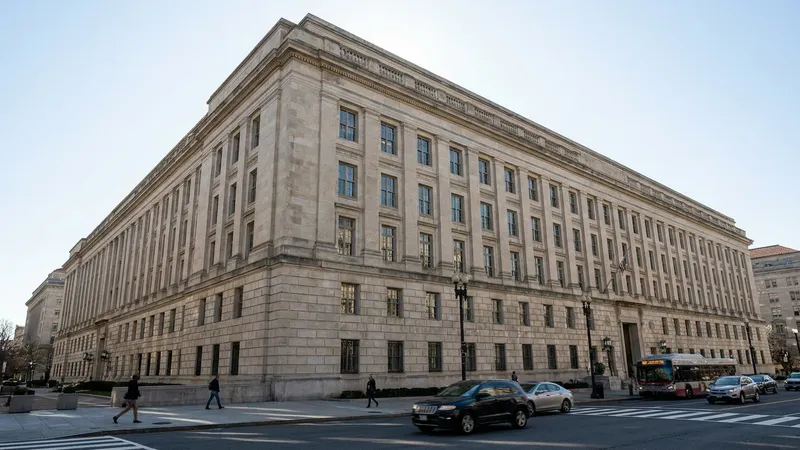
President Trump urged Jerome Powell to quit the Fed board over a $2.4 billion Fed renovation, escalating pressure on central bank governance.
The demand followed a September 30 report from the Federal Reserve’s Office of Inspector General that found no evidence of criminal wrongdoing in the headquarters project. The report said the renovation’s cost had risen to $2.4 billion from an initial estimate of $1.3 billion in 2020.
Trump said he had asked Attorney General Todd Blanche to review the watchdog’s findings and decide whether further action was warranted. A Fed spokesperson declined to comment, according to the account of the exchange provided in the source material.
A $2.4 billion headquarters fight
The inspector general’s report gave both sides different material to use. It rejected the criminal premise that had surrounded the project while identifying management failures that increased the cost and weakened oversight.
"At no point during our evaluation did we find reasonable grounds to believe that a violation of federal criminal law had occurred requiring a referral to the US Attorney General in accordance with the Inspector General Act," the watchdog said. That finding leaves the White House with a governance dispute rather than a criminal referral from the Fed’s own inspector general.
The report cited several lapses: the board did not impose a stated cost limit, did not request a construction cost estimate, and still lacked a guaranteed maximum price as recently as July. It also pointed to weak bidding for some work, design changes, inflation, site conditions and internal governance that was not suited to a project of that size and complexity.
Warsh brings in GSA
Fed Chairman Kevin Warsh said in a response included with the report that the central bank would adopt the watchdog’s recommendations. He said the General Services Administration would become project executive and work with the Fed to finish the renovation while reporting to the Board of Governors and to Warsh.
Warsh also said the Fed would hire an independent auditor to review all costs awarded so far. In his letter to Inspector General Michael Horowitz, Warsh wrote that the findings and GSA recommendations would have "permanent value for our successors on the Board of Governors."
The renovation has become a political proxy for a larger fight over the Fed’s independence and interest-rate policy. Trump criticized Powell during his tenure as chair and has continued to target him after Powell’s chair term ended in May, while Powell remained on the board.
Powell’s term runs to 2028
Powell’s seat as a governor runs through January 2028, giving the dispute legal importance beyond the building project. Fed governors are nominated by the president and confirmed by the Senate, and the Federal Reserve Act permits removal only “for cause.”
Mark Spindel, founder of Potomac River Capital and a co-author of a book on the Fed, said the fight reflects Trump’s broader goal of reshaping the central bank. "Trump’s frustration with Powell is unbounded as is his desire to control the Federal Reserve," Spindel said.
Kathryn Judge, a Columbia University law professor who studies the Fed, said the watchdog report offered little detail on Powell’s personal role in supervising the project. She said there is no simple measure for how much time a Fed chair should devote to construction oversight while managing monetary policy and financial stability duties.
If Blanche treats the report as closing the criminal issue, the Fed’s immediate problem shifts toward cost control, external oversight and damage to institutional credibility. That path would give Warsh and GSA the main operational role while leaving Powell’s board seat protected unless a separate legal basis emerges.
If the White House instead pursues a removal or civil action argument, the pressure would move from renovation management to the legal boundary around Fed independence. For global markets, the mechanism is policy credibility: investors generally price US rates, the dollar and bank funding costs around the assumption that monetary decisions are insulated from direct presidential control.
The main unresolved issue is whether the project’s new controls can prevent further overruns on the $2.4 billion budget. For the Fed, the answer will shape its internal governance record; for banks and rate-sensitive sectors, the larger risk is a prolonged fight that keeps the central bank’s independence in political view.