Factory output in Japan edges up as energy risks ease
Industrial production in Japan rose 0.5% in May, as officials outlined energy-security steps while some sectors still posted year-on-year declines.
Atlas Newsdesk ·
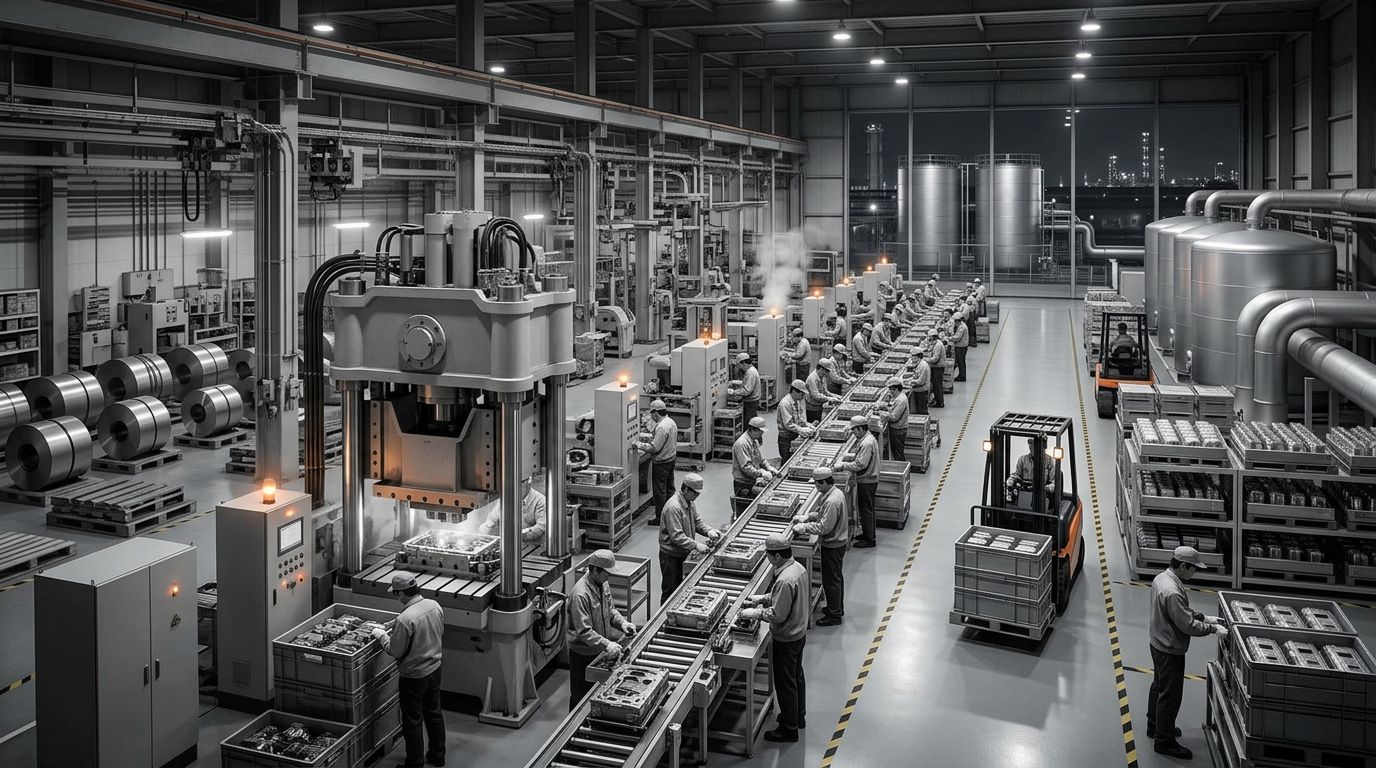
Industrial production in Japan rose 0.5% in May, helped by gains in transport equipment and energy-related sectors despite concerns tied to the war in Iran.
The Ministry of Economy, Trade and Industry reported the month-on-month increase on Tuesday. The result came in slightly under the 0.6% rise economists had expected.
On an annual basis, output fell 1.7%, undershooting all forecasts in a Bloomberg survey. The mixed picture highlights steady near-term demand in some industries alongside ongoing weakness compared with last year.
May output rises, but annual comparison remains weak
Takeshi Minami, chief economist at the Norinchukin Research Institute, said demand linked to production has held up. He added that the impact from the situation in Iran has been limited for the April–June quarter, and described Japan’s economy as remaining on a recovery track.
Sector details showed that transportation equipment excluding cars contributed to the monthly gain. The increase was supported by higher production of aircraft engine parts.
Chemicals also rose on the month, alongside petroleum and coal products. Standard passenger vehicles, as well as chassis and body parts, recorded increases, according to the ministry’s breakdown.
Year-on-year performance was more uneven. Chemicals and metal products were notable drags, declining 11.5% and 3.1% respectively compared with May last year.
Government highlights oil supply plans through March 2028
The production data arrived as the government emphasized steps to reduce vulnerability to disruptions in Middle East shipping routes. The Strait of Hormuz is a key passage for global crude flows and has been a focus for risk assessments amid the conflict involving Iran.
Japanese officials have said the country can secure sufficient crude oil through March 2028 by expanding procurement options that do not rely on Hormuz. The approach centers on diversifying supply routes and sourcing to maintain continuity if the strait becomes constrained.
Last week, Prime Minister Sanae Takaichi directed the industry ministry to prepare a comprehensive package to reinforce the resilience of Japan’s energy system. The ministry was instructed to compile the measures by the end of August.
What the latest figures signal for the recovery
May’s month-on-month rise suggests manufacturers were able to maintain operations even as geopolitical risks raised questions about energy costs and logistics. The improvement was narrow, however, and the annual decline indicates that some industries have not regained last year’s output levels.
The contrast between monthly gains and year-on-year weakness can reflect timing effects, inventory adjustments, and uneven end-market demand across sectors. Chemicals, despite improving from April, still led the annual drop, pointing to persistent softness relative to 2025 levels.
Energy policy developments may matter for factory activity because Japan’s industrial base is sensitive to fuel prices and supply stability. Clearer contingency planning through 2028 could help reduce uncertainty for manufacturers, particularly in heavy industry and transport-related supply chains.
Next, investors and businesses will watch for the ministry’s end-August energy-resilience plan and subsequent indicators on whether production momentum holds into summer. Attention is also likely to focus on whether year-on-year declines narrow in coming months, especially in chemicals and metals.