European equity market gains expose concentration risk now
The European equity market’s 2026 rally has narrowed sharply, with 10 stocks driving most of the Stoxx 600’s gains.
Claire Dubois ·
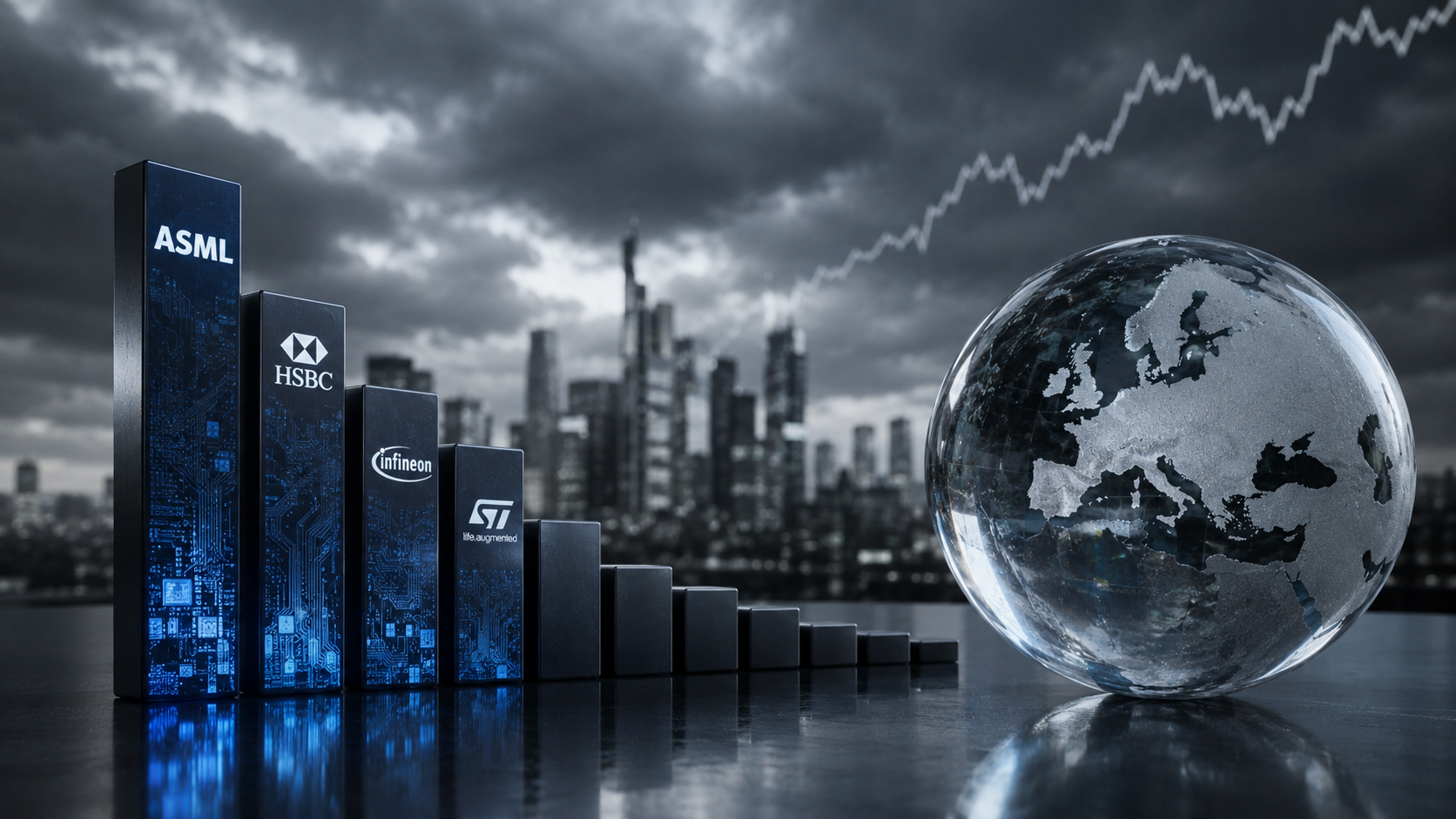
The European equity market is increasingly tied to a small group of chip and bank stocks in 2026. That narrows the diversification case for investors.
The Stoxx Europe 600 Index has climbed 8.8% this year, but the advance is no longer spread broadly across the region’s listed companies. Index-contribution data cited in the source show almost 60% of that rise has come from only 10 stocks.
ASML Holding NV has been the central force, accounting for nearly a quarter of the Stoxx 600’s increase. HSBC Holdings Plc ranks next with an 8% contribution, while Infineon Technologies AG and STMicroelectronics NV have benefited from the same semiconductor enthusiasm lifting global technology shares.
AI trade reaches Europe
The shift reflects how the artificial intelligence investment cycle has moved beyond the largest US technology companies. Demand linked to AI infrastructure has pushed investors toward European chip-equipment and semiconductor names, giving the region’s benchmark a sharper technology tilt than it had during its prior recovery.
That marks a change from the three years after the index’s September 2022 low. Over that period, the Stoxx 600 gained 55%, with support coming from financials, industrials, healthcare, insurance and technology rather than from a compact group of leaders.
ASML was also the biggest single contributor during that earlier stretch, but its share of the gain was less than 5%. In 2026, the company’s role is much larger, which makes the index more exposed to the earnings cycle of one supplier tied closely to advanced chip production.
ASML carries heavier index weight
For ASML, the current setup cuts both ways. Strong appetite for AI-related capacity can support valuation and earnings expectations, but any disappointment in capital spending by chipmakers would travel quickly into the stock and then into the wider European benchmark.
The same concentration changes how investors should read the Stoxx 600’s headline performance. A positive index return may now say less about Europe’s overall corporate health and more about the market’s willingness to pay for exposure to AI supply chains and a handful of large financial names.
Aneeka Gupta, director of macroeconomic research at WisdomTree UK Ltd., described the rally as unusually tight. "The return profile has become very narrow," she said. "That creates a clear near-term vulnerability. Investors buying Europe for diversification have become increasingly dependent on the same AI capital-expenditure cycle that is driving the US, Japan and emerging-market technology sectors."
Narrow gains test diversification
The risk is not that concentration is automatically negative. Narrow leadership can persist when earnings upgrades are strong and liquidity keeps favoring the same theme; the mechanism is simple, with rising profit forecasts attracting more capital and forcing benchmark-aware investors to keep pace.
If AI capital expenditure remains strong, the macro effect would be a continued global tilt toward technology-linked investment, with Europe participating through suppliers rather than consumer platforms. ASML would likely remain the clearest European beneficiary, while the region’s semiconductor sector could keep drawing capital away from more cyclical industries.
If the AI spending cycle cools instead, the pressure would run in the opposite direction. Slower orders or weaker guidance from chip customers would threaten ASML’s contribution, reduce support for Infineon Technologies AG and STMicroelectronics NV, and expose the Stoxx 600 to a pullback larger than a broad index reading might suggest.
A third path would be a rotation back into banks, industrials, insurers and healthcare. If that broadening takes hold, the global macro signal would shift from AI-led capital spending toward wider confidence in European earnings, while ASML’s dominance would ease and the Stoxx 600 would regain some of the diversification that defined its post-2022 rebound.
The immediate questions are concrete: whether AI-linked order momentum holds, whether HSBC and other financials can keep contributing, and whether earnings growth spreads beyond the leading 10 stocks. Until that happens, Europe’s benchmark looks less like a broad regional barometer and more like a test of a concentrated AI trade.