

DHS says 1,328 arrests follow D.C.-area immigration sweep
DHS said a two-week Washington-area immigration sweep produced 1,328 arrests across Virginia and Maryland, with nearly 400 linked to charges or convictions.
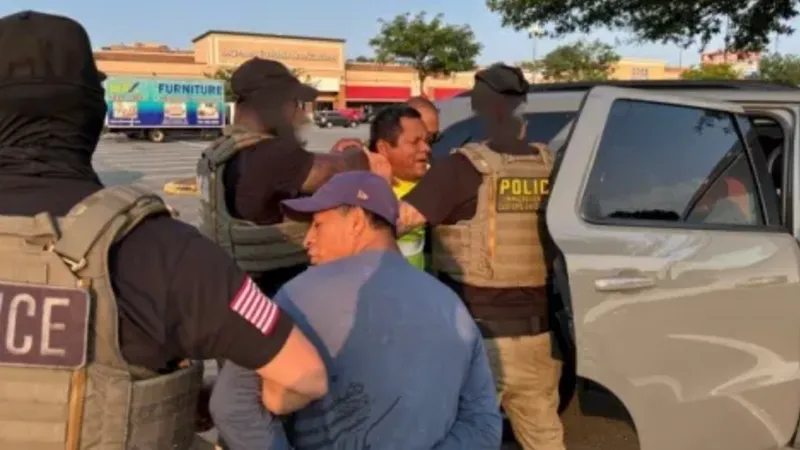
DHS said a two-week immigration enforcement sweep around Washington led to 1,328 arrests in Virginia and Maryland, focused on criminal histories.
The operation began on August 1 and ran for two weeks, according to the department. DHS said most arrests were made in the D.C. suburbs, with officers also working in other parts of both states.
August sweep reaches suburbs
The department identified the effort as the Washington, D.C., portion of Operation Safe Community. It said the campaign primarily targeted people DHS described as unlawfully present in the United States and as having criminal convictions, pending charges, or gang ties.
DHS Secretary Markwayne Mullin said ICE officers arrested people accused or convicted of offenses including sexual assault, kidnapping, drunk driving, robbery, and gang activity. Mullin also criticized local policies in Virginia and Maryland that DHS described as limiting cooperation with federal immigration authorities.
The department framed the arrests as part of President Trump's immigration enforcement agenda. Its statement did not provide a county-by-county total for the 1,328 arrests or a full list of cases.
Nearly 400 had case histories
Of the 1,328 people arrested, almost 400 had been convicted of or charged with crimes in the United States, DHS said. That figure was presented by the department as the main public safety measure from the two-week operation.
DHS named several arrests in the Washington suburbs. It said German Mejia-Baires was arrested in Manassas, Virginia, and identified him as an alleged MS-13 member from El Salvador with prior convictions for driving while intoxicated, driving on a suspended license, and illegal re-entry.
The department said Julio Hector Carranza-Rojano, from Mexico, was also arrested in Manassas after previous convictions for sexual battery, driving while intoxicated, and hit-and-run. In Alexandria, Virginia, DHS said officers arrested Angel Gabriel Ortiz-Hernandez, from Guatemala, whose history included arrests for rape of a mentally incapacitated victim and two counts of aggravated sexual battery of an incapacitated victim.
DHS also cited the Alexandria arrest of Rowan Andrew Brown, from Jamaica, saying he had prior convictions for identity theft, kidnapping an adult, and illegal re-entry, along with an arrest for fraud. In Hyattsville, Maryland, the department said officers arrested Mauricio Antonio Barrera-Navidad, an alleged MS-13 member from El Salvador with a criminal history there that included robbery, firearms offenses, illicit association with MS-13, and resistance-related offenses.
Gang allegations widen case
DHS said the operation included arrests of people linked to MS-13, 18th Street Gang, and Tren de Aragua. The department did not state how many of the 1,328 arrests involved alleged gang membership.
ICE Enforcement and Removal Operations Acting Assistant Director Patricia Hyde said officers were seeking people who did not want to be found. She said removing criminal immigration offenders from Virginia and Maryland neighborhoods was the purpose of the operation.
Virginians For Safe Communities President Sean Kennedy, a member of the Fairfax County Criminal Justice Advisory Board, said the arrests removed people with violent and sexually predatory criminal records from local streets. Kennedy described the operation as crucial for public safety.
The arrests arrive during a dispute over whether some local prosecutors and jurisdictions should cooperate more closely with ICE. DHS said officers completed the operation despite policies it characterized as sanctuary measures in parts of Virginia and Maryland.
The next steps depend on individual immigration cases, criminal histories, and any pending local charges. If DHS pursues removals from the two-state operation, the practical effect will turn on detention capacity, court proceedings, and cooperation between federal officers and local agencies.
More stories
- Regional flu data point to earlier activity, not severity
- DC firms face online licensing shift in October update
- 1,200 FNS staff face reorg as relocation pause holds
- DC reentry office loses director, 50, in scooter crash
- Isaias remnants soak D.C. with up to 2 inches of rain
- D.C. Council weighs $600 million Audi Field plan
- DC parking tickets draw Council scrutiny over old signs
- Friday burglary brings Protest Pizza neighbors inside nearby