Danish Whale Carcass Identified as 'Timmy' from German Rescue
A humpback whale found deceased off Denmark has been confirmed as 'Timmy,' the subject of a controversial rescue operation in Germany.
Hazal Anyalı ·
Humpback Whale's Identity Confirmed
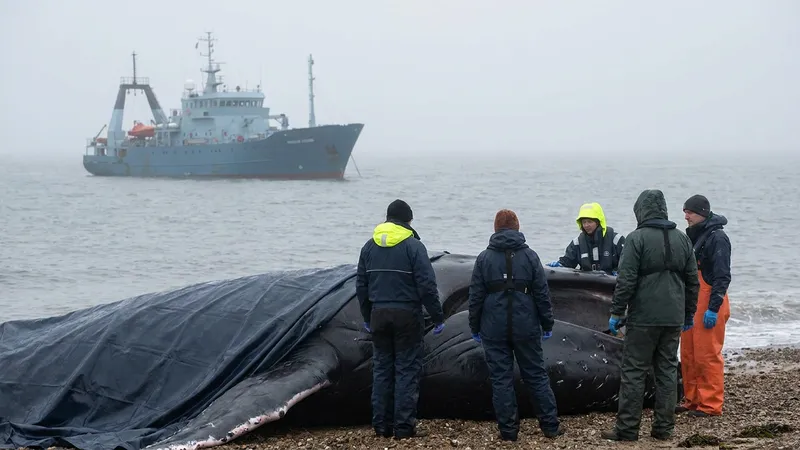
A deceased humpback whale discovered off the coast of Denmark has been definitively identified as “Timmy,” the same whale that underwent a contentious rescue effort in German waters. This identification was made possible through a tracking device attached to the whale's dorsal fin and analysis of its unique fin patterns.
Authorities have noted that the carcass is situated far from populated areas, and there are currently no immediate plans for its removal. This confirmation has reignited discussions surrounding the methods and outcomes of the earlier rescue attempts in Germany.
Tracking Device Key to Identification
Officials from the Danish Environmental Protection Agency reported that divers located and retrieved the tracking device from the whale's dorsal fin. The device's position and appearance conclusively matched records from the whale observed and intervened with in German waters, confirming its identity.
Weeks-Long Struggle in German Waters
The approximately 12-meter-long humpback whale was first sighted on March 3 in Wismar Harbor, Mecklenburg-Vorpommern. Rescue teams initially attempted to clear fishing net remnants from the animal. Later, on March 23, the whale became stranded near Timmendorfer Strand on the Schleswig-Holstein coast. After several days of effort, heavy machinery was used to dig a channel, guiding the whale back to deeper water.
However, the whale subsequently returned to shallow areas. Between March 27 and 29, it again became beached around Wismar Bay, remaining immobile for an extended period. Following numerous unsuccessful attempts, authorities announced the cessation of official rescue operations.
Private Rescue Operation and Criticisms
At this juncture, a private rescue initiative was launched, funded by equestrian sports figure Karin Walter-Mommert and retail entrepreneur Walter Gunz. Despite warnings, the whale was placed onto a water-filled barge, transported to the North Sea, and released on May 2.
Experts had previously highlighted that the whale, estimated to be between four and six years old, was likely already weakened and struggling to feed due to net fragments around its mouth. These same specialists also expressed concerns that the transportation and release process would impose additional stress on the animal.
Danish Plans and Safety Warnings
On May 14, a whale carcass was sighted off Anholt Island in Denmark, and subsequent examination confirmed it was Timmy. Danish authorities have stated there are no current plans to remove the carcass, as its remote location poses no immediate public health risk.
Officials have reiterated warnings for the public to avoid the area, citing the risk of explosion from gases accumulating during decomposition and the potential for the whale to carry diseases transmissible to humans.
Reactions from Germany
Till Backhaus, the Environment Minister for Mecklenburg-Vorpommern, extended gratitude to Danish authorities for their assistance in identifying the whale. Backhaus defended the decision to permit the private rescue attempt, despite objections from some marine life experts in the state. He expressed regret that the whale's chance of survival, however slim, could not be realized.
Authorities confirmed that safety warnings for the region would remain in effect, with any decisions regarding further intervention to be announced as developments unfold.