Orangutan Builds, Uses Forest Bridge
Sumatran orangutan filmed in 2024 using a canopy bridge in North Sumatra, a first documented crossing aimed at easing habitat fragmentation.
Ayla Demirhan ·
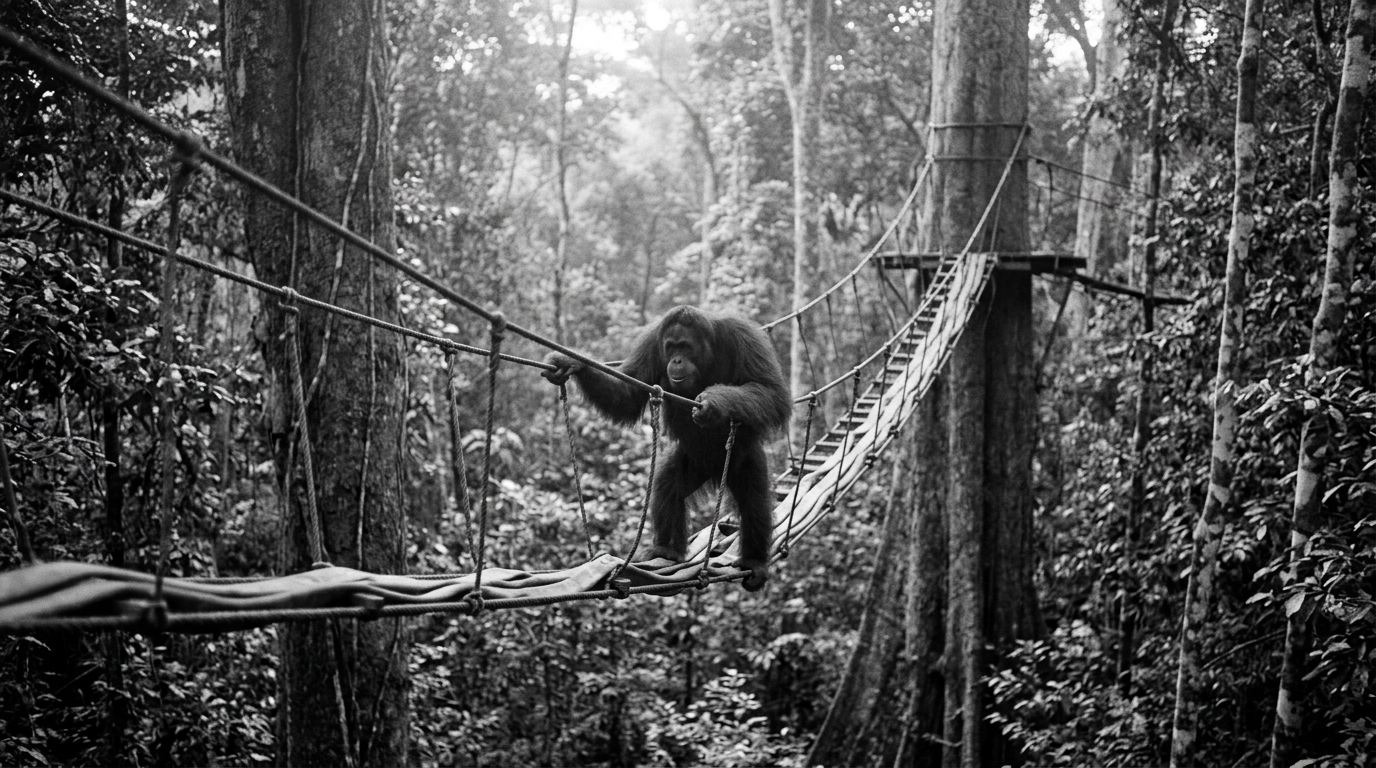
A critically endangered Sumatran orangutan was recorded in 2024 using a canopy bridge to cross a road in North Sumatra, Indonesia, conservationists said. The sighting is described as the first documented case of the species using this type of structure. The crossing was presented as a practical step to reduce the effects of habitat fragmentation on the species.
Conservationists from the Sumatran Orangutan Society (SOS) and Tangguh Hutan Khatulistiwa (TaHuKah) built the bridge two years earlier. It spans the Lagan-Pagindar road in the Pakpak Bharat district, an area where the road had cut through orangutan habitat. Officials involved in the project said the goal was to provide a safe route above traffic so animals could move between forest areas without descending to the ground.
The road’s construction had split a local population of 350 orangutans into two separated groups, according to conservationists. They said this separation created a genetic bottleneck, raising the risk of inbreeding and what they described as functional extinction. The canopy bridge was designed to reconnect the two sides and support movement that could help maintain genetic exchange.
Before the orangutan was observed using it, the bridge had already been used by other wildlife, including black giant squirrels, long-tailed macaques, and agile gibbons, conservationists said. The 2024 footage showed a young male orangutan making the crossing, providing the first direct evidence that the structure can work for the species it was built to assist.
Conservationists said the moment was significant because orangutans are large-bodied arboreal primates that may be cautious about unfamiliar crossings.
Officials said the development is relevant to the wider conservation challenge facing the species, with approximately 14,000 Sumatran orangutans remaining. Habitat fragmentation was highlighted as a key pressure, particularly where roads and other infrastructure divide forests into smaller, isolated patches. The bridge was presented as one tool that can reduce the barrier effect of roads while allowing transport links to remain in place.
Conservationists said the successful crossing supports the idea that infrastructure development and wildlife protection can be pursued together when mitigation is built into project design. At the same time, they did not describe the single observation as proof that all orangutans in the area will adopt the bridge, and broader uptake remains an open question.
The groups involved framed the footage as an encouraging sign that targeted interventions can help reduce the impact of human expansion on endangered species.