Anthropic to watermark Claude text ahead of EU rules
Anthropic will embed an invisible watermark in Claude text ahead of EU rules due in December 2026, but verification and edit-resistance remain unclear.
Atlas Newsdesk ·
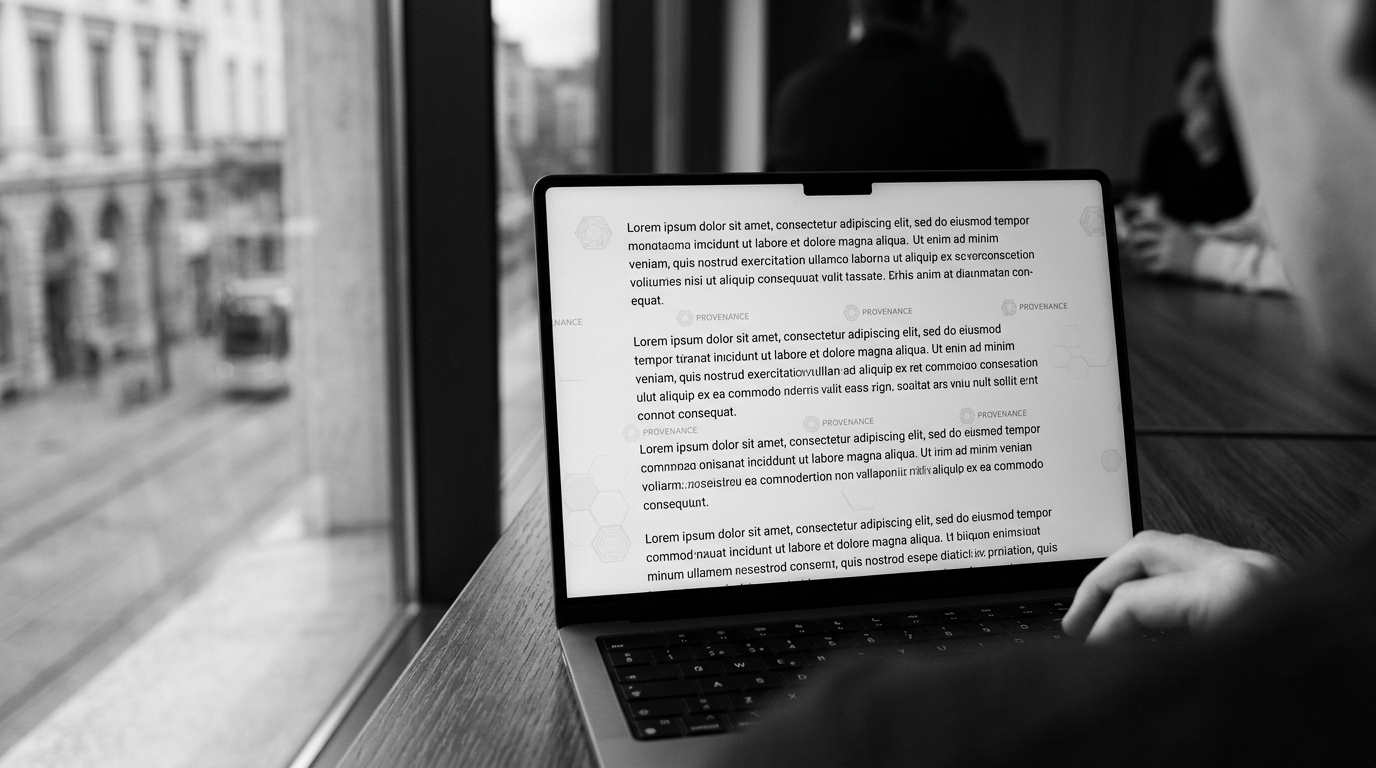
Anthropic said it will introduce an invisible watermark for text generated by its Claude AI models as it prepares for European Union requirements due to take effect in December 2026 . The company presented the change as something built into the model’s generation process, rather than a visible label added to completed text, with the stated aim of making AI-written passages easier to identify.
In its description, Anthropic said the watermark would be created during text generation by embedding a detectable statistical signature into how Claude selects tokens. The company said the intent is to keep the output readable and largely unchanged, while still leaving patterns that can be detected through specific methods.
How Anthropic says the watermark works
Anthropic described the mechanism as steering the model’s Anthropic described the mechanism as steering the model’s word-choice process so the resulting text contains statistically predictable patterns. The company characterized this as a modification to the stochastic processes used during language generation, not a post-processing step and not a visible marker appended afterward. According to Anthropic, the embedded signature is intended to be detectable by the developer and by “authorized parties,” enabling confirmation that a passage was generated by Claude. However, the company did not detail how verification would be administered across different users, or how authorization would be granted in practice. Open questions on quality, editing, and detection access Watermarking approaches have raised concerns about whether constraining token selection could affect output quality or linguistic precision. Anthropic said its technical analysis indicates any impact on model performance should be negligible, while also acknowledging the broader concern that steering token choice can be viewed as a constraint on generation.
Claude AI
The company’s material also did not clarify how the watermark would behave if generated text is later edited, reformatted, or otherwise transformed. That unresolved point could affect how reliably the watermark supports downstream provenance checks, depending on how detection is offered and under what conditions it can be applied.
Anthropic also did not specify how broadly detection would be available, leaving uncertainty around whether provenance checks would be limited to a narrow set of users or accessible more widely. The scope of detection access may shape how effective the watermark is once the EU timeline arrives.
Compliance and “model collapse” cited as goals
Anthropic linked the watermarking plan to two objectives. The first is to align with the EU regulatory timeline culminating in December 2026 . The second is to reduce the risk of “model collapse,” which the company described as a decline in conceptual accuracy when future AI systems are trained on synthetic text.
In Anthropic’s framing, marking AI-generated output could help developers exclude synthetic text from training pipelines or track where it appears, as a method intended to protect long-term model quality. The company also presented watermarking as supporting verification of digital content provenance by enabling checks on whether text likely originated from an AI system.
The material highlighted use cases where document integrity is central, including legal work , academic environments , and professional publishing . Even with a technical pathway outlined, the company’s description left key practical details unresolved, particularly around how detection would work at scale and who would be able to run verification.