China Tightens Rules on Overseas Investment as Tech Controls Expand
China's new outbound investment rules, effective July 1, tighten overseas deal reviews amid escalating US tech rivalry, focusing on national security.
Lauren Collins ·
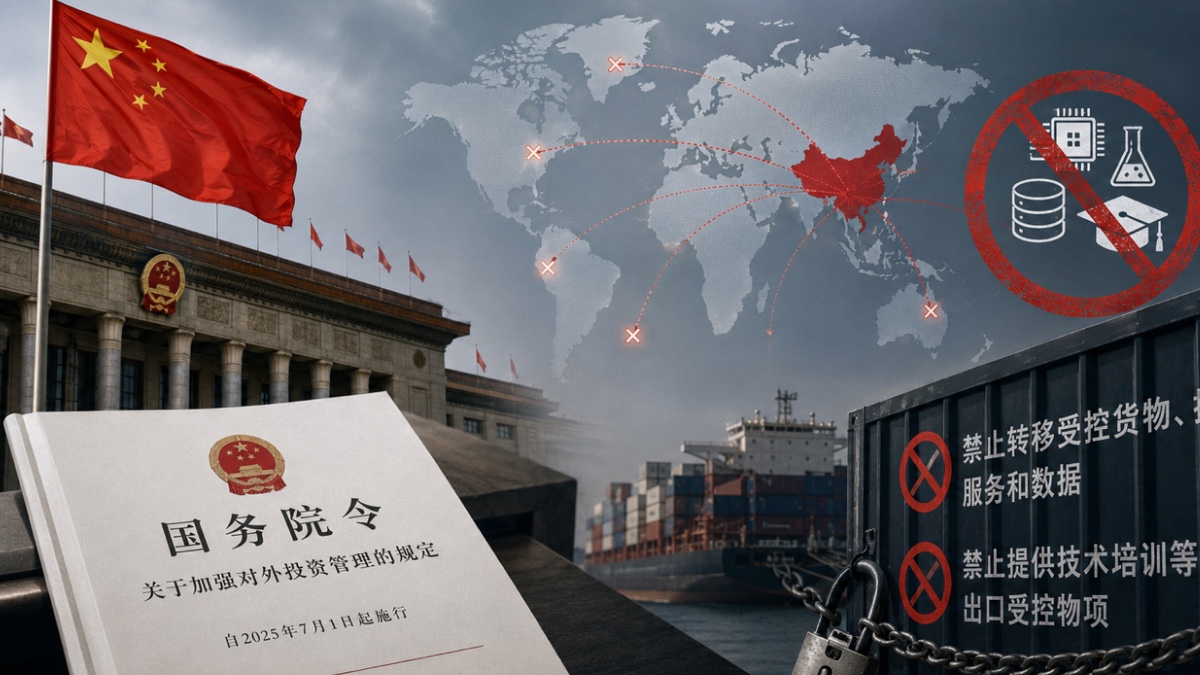
China has tightened its oversight of outbound investment with a new State Council directive that strengthens reviews of overseas deals tied to national security. The rules, published Monday and effective July 1, bar investors from transferring restricted goods, technology, services and data abroad. They also prohibit companies from providing technical training designed to export those controlled items. The move gives Beijing a sharper tool to manage cross-border capital and technology flows as competition with Washington intensifies.
A Unified Review System
The directive appears aimed at consolidating a patchwork of rules already enforced by several agencies. China’s outbound investment regime has involved bodies including the National Development and Reform Commission, the Ministry of Commerce and the State Administration of Foreign Exchange. The new framework strengthens obligations on domestic organizations and individuals to cooperate with national security reviews and follow official decisions. That shift matters because fragmented oversight can leave gaps between approval, financing, data movement and technology transfer.
China’s outbound investment has grown in recent years as domestic companies seek overseas markets, technology partnerships and global supply chains. At the same time, Beijing has become more cautious about capital leaving the country in ways that could weaken strategic industries or transfer sensitive capabilities abroad. The new directive sits at that intersection. It treats certain overseas investments not just as commercial transactions, but as potential national security events.
Companies Face Direct Limits
The immediate burden falls on Chinese investors, companies and individuals pursuing overseas transactions involving restricted assets or know-how. Under the rules, investors cannot move covered goods, technology, services or data overseas through prohibited investment channels. Firms also cannot use training as a workaround to help export those capabilities. That closes a practical loophole: knowledge transfer can matter as much as physical equipment when the asset is software, AI methods, engineering processes or sensitive data.
The timing places the directive inside the wider US-China contest over artificial intelligence and advanced technology. Beijing and Washington are both trying to protect strategic capabilities while limiting the other side’s access to key tools, talent and infrastructure. The rules were adopted at a State Council meeting on April 17, shortly before China ordered the cancellation of Meta Platforms’ $2 billion acquisition of agentic AI startup Manus, according to the source material. That sequence signals how outbound investment controls may now sit closer to China’s technology-security policy.
A Wider Message to Markets
For global investors, the new rules add another layer of political and regulatory risk around Chinese cross-border deals. Buyers, sellers and advisers will need to assess whether a transaction involves restricted technology, services, data or training. The directive could slow some overseas acquisitions, joint ventures or expansion plans if companies must clear more security questions before moving assets abroad. It may also push Chinese firms to structure international growth more cautiously, especially in sectors linked to AI, data and advanced manufacturing.
The directive gives regulators explicit penalties for prohibited outbound investments. Investors may be ordered to stop transactions, dispose of assets and pay fines of up to 1% of the investment amount. The main uncertainty is how broadly officials will interpret national security and restricted technology in practice. The next signal will come after July 1, when companies and dealmakers see whether enforcement focuses narrowly on sensitive technologies or becomes a broader brake on Chinese overseas expansion.