China AI rules push puts Xi in global standards contest
Xi Jinping used Shanghai’s World AI Conference to promote China AI rules as Chinese models gain traction and security questions deepen.
Jason Kwon ·
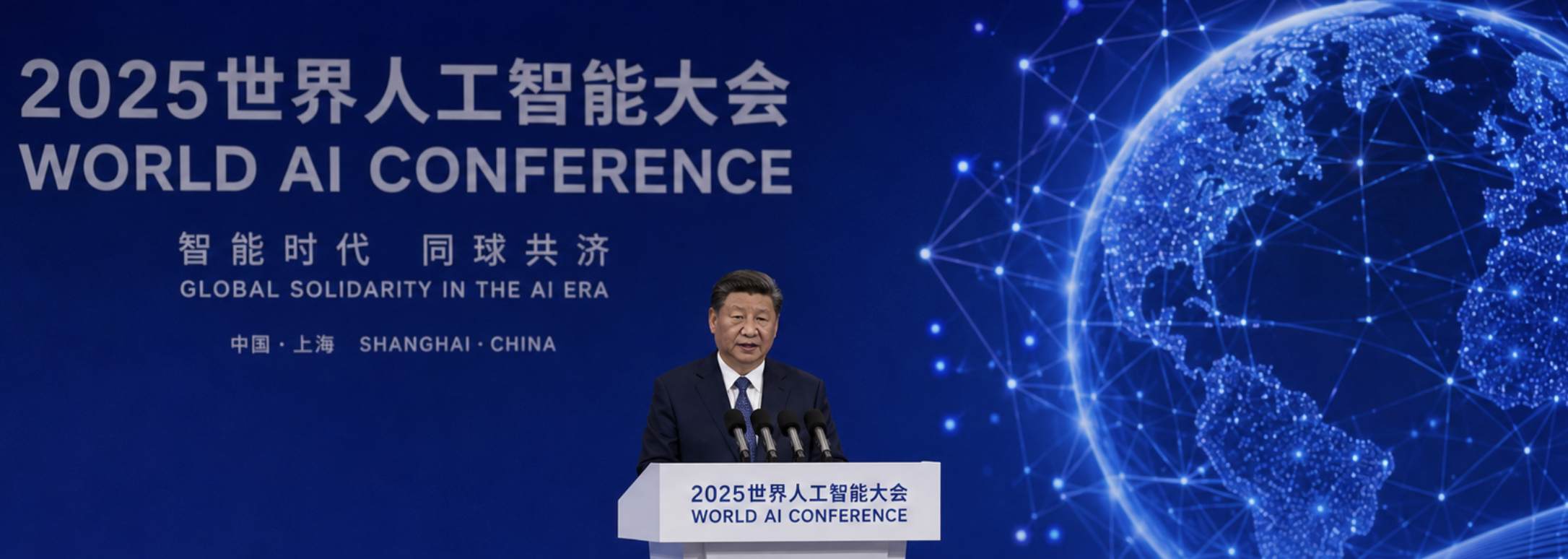
China AI rules took center stage in Shanghai as Xi Jinping urged global cooperation while Chinese models gained wider corporate use.
Xi used his first appearance at the World AI Conference on Friday to argue that China should help shape global governance for artificial intelligence. The speech placed safety, access and standards at the center of Beijing’s pitch, even as more capable Chinese models raise security questions in both China and the US.
The audience included technology and government figures at an event that has previously drawn Elon Musk and Jack Ma. Xi’s message came as Chinese models are winning users beyond China, including among US companies that route AI traffic through OpenRouter.
Xi sells cooperation in Shanghai
Xi framed AI access as a development issue, not only a commercial race among large technology economies. “We must carry out extensive international cooperation and help Global South countries in capacity building to bridge the AI and digital divides,” he said.
He also warned against creating “historical injustice in AI,” language that fits Beijing’s broader campaign to present itself as a counterweight to technology blocs and export controls. A party newspaper earlier in the week cautioned against an “AI Iron Curtain” and described open access to data and computing power as preferable to hoarding them.
The policy vehicle for that argument is the World AI Cooperation Organization, a group of nearly 30 countries proposed last year and established Thursday. Xi said the organization should align rules and technical standards so AI can “better benefit humanity.”
OpenRouter shows Chinese model pull
OpenRouter data cited in the source shows Chinese models approaching a 60% share of AI usage by US firms on the marketplace, near a record level. The platform is watched as a gauge of model adoption, though its figures exclude traffic sent directly to providers and capture only part of total AI consumption.
The same data showed Chinese models topping US peers in weekly global token share by the country of the model developer. That matters because token usage is one practical measure of how often developers and companies are putting models to work, even if it does not cover the entire AI market.
China’s rising usage gives Beijing a stronger argument that it deserves a larger role in rule-making. Gu Lingyu, an AI researcher at Peking University, said China is “the world’s largest open-source application market” and a major source of contributions, but its influence over international rules does not yet match that position.
Gu added that China could strengthen its role by explaining its open-source record more effectively. The comment was published in a roundtable by an official journal of the Supreme People’s Court, linking China’s technical ambitions to a legal and governance agenda.
Qwen access becomes security test
The harder question is whether China can promote openness while limiting risks from models that are becoming more powerful. People familiar with the matter said Chinese officials recently discussed security concerns with companies including Alibaba Group Holding Ltd., the developer of the Qwen model family.
Those discussions were described as early, with no enforcement action planned. Among the options raised was limiting foreign access to top models, according to the people familiar with the matter.
That tension mirrors the US debate over advanced AI, where governments want domestic champions to scale but also worry about misuse, strategic leakage and military applications. For Alibaba, tighter controls could protect sensitive capability but reduce the international reach of Qwen at a time when Chinese models are gaining users abroad.
If Beijing keeps access broad, Chinese model providers could keep expanding through open marketplaces and developer adoption. That path would support global competition in AI services, give Alibaba and peers more distribution, and pressure the wider sector to compete on cost, performance and accessibility.
If China instead restricts access to its strongest systems, the mechanism changes. Global companies may shift traffic toward alternative providers, Alibaba’s overseas momentum could slow, and the AI sector could fragment further around national rules, licensing limits and technical standards.
A third path is a standards-led compromise: Beijing could use the World AI Cooperation Organization to push common safety rules while preserving access to many models. That would give China a diplomatic platform, help companies keep some cross-border channels open, and test whether AI governance can be shaped by technical benchmarks rather than security blocs alone.
The open questions are concrete: whether the new organization gains influence outside China’s partners, whether OpenRouter usage translates into durable enterprise adoption, and whether Chinese officials move from discussion to enforceable limits. Those answers will determine whether Xi’s Shanghai pitch becomes a governance campaign, a market strategy, or both.