

Brazil election rallies draw Lula supporters across Rio
Brazil election rallies drew thousands of Lula supporters in Rio before the October 25 runoff, with student and cultural groups pushing turnout.
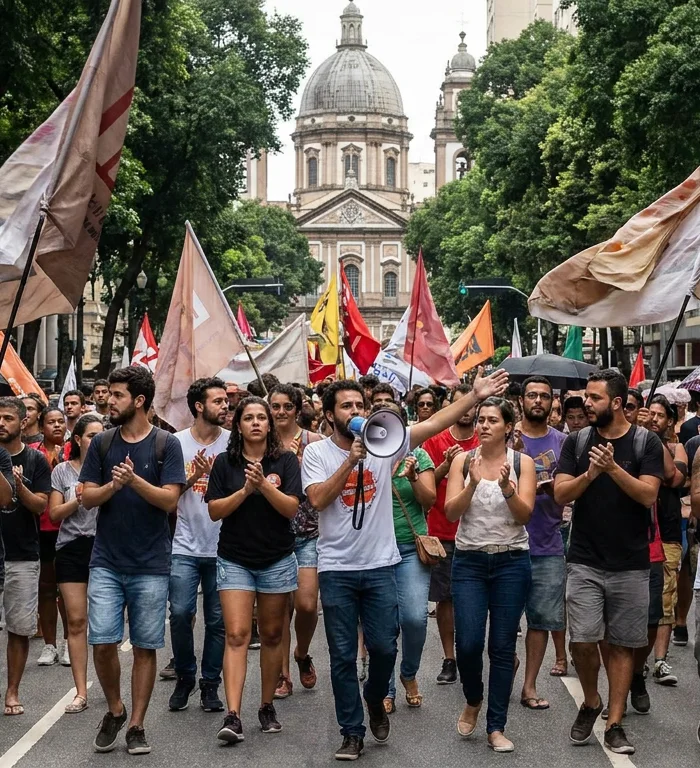
Brazil election rallies in Rio drew thousands of Lula supporters before the October 25 runoff, linking student groups, social movements and artists.
The Sunday mobilizations came one week before the second round of Brazil's presidential election. They showed how campaign activity was moving from formal party events into street demonstrations, campus networks and cultural stages.
Rio crowds fill two fronts
One gathering formed in the city center near the Church of Candelaria and Presidente Vargas Avenue. Student organizations were described as a driving force behind the event, which aimed to strengthen support for President Luiz Inacio Lula da Silva before the vote.
Recorded images showed placards reading "Dictatorship never again" and "Beloved Homeland Brazil", alongside chants supporting Lula and opposing Jair Bolsonaro. The same images showed a man being taken away by authorities in a patrol car, though the material did not state why he was removed.
Students press turnout case
Ryan, identified as one of the protesters, framed the gathering as broader than a youth demonstration. "Our voice must be heard, not only by young people but also by workers," he said.
Kevin, another attendee, said his opposition to Bolsonaro was tied to concerns about democratic rule. "I think that someone who flirts with a possible dictatorship is someone who cannot wield power, that's it," he stated.
The material also described efforts to reach people who did not vote in the first round. Alexandre, identified as being from the Federal University, said some acquaintances had abstained because they assumed their preferred candidate would win; "We are mobilising lots of people," he said.
Copacabana becomes campaign stage
Separate from the city-center rally, Copacabana beach hosted a musical event for democracy convened by musician Caetano Veloso. The gathering occupied roughly one kilometer of Atlantica Avenue, putting a prominent cultural figure at the center of the day's Rio mobilization.
Marco Aurelio, described as a demonstrator at the event, linked his optimism to youth participation. "Very optimistic, very optimistic, the youth has woken up. It's going to be Lula!" he said.
Lula did not attend the Rio events because he was scheduled to take part in a televised debate that evening. His absence left the street events to supporters, student groups and artists rather than the candidate himself.
First-round margin frames runoff
The first-round tally cited in the account put Flavio Bolsonaro ahead on October 4 with 47.03% of valid votes, compared with Lula's 45.16%. The margin was 1.87 percentage points, small enough to make turnout efforts a central political mechanism in the final week.
The second round was scheduled for October 25, leaving both camps with limited time to convert public visibility into votes. For Lula's supporters in Rio, the rallies offered a way to keep democracy, abstention and labor appeals in the foreground before ballots were cast.
If abstainers identified by organizers returned to vote, Lula's campaign could benefit in areas where supporters stayed home in the first round. If turnout efforts stalled, the first-round leader's advantage would remain the clearest numerical anchor available from the supplied material.
The wider political effect depended on whether street mobilization translated into participation rather than only visibility. The immediate test was not the size of Sunday's crowds alone, but whether those networks could move voters before the October 25 runoff.
More stories
- Zelenskyy offers Ukraine refinery halt for Patriot missiles
- Thailand faces fourth-quarter strain despite 18.9% export gain
- Lithuania probes Starlink arson as Russia-linked sabotage
- Brazil rivals rally before debate as runoff nears finish
- France unrest brings 2,400 arrests as Macron appeals for calm
- French police arrest more than 1,800 after cost-of-living protests
- India 2036 bond yield hits 7.3707% as RBI drains cash
- IREF targets nearly 74% cut in Iraq basmati freight