Boring Company seeks $4 billion at $20 billion value mark
Boring Company is discussing a roughly $4 billion raise that could value Elon Musk’s tunneling startup near $20 billion.
Jason Kwon ·
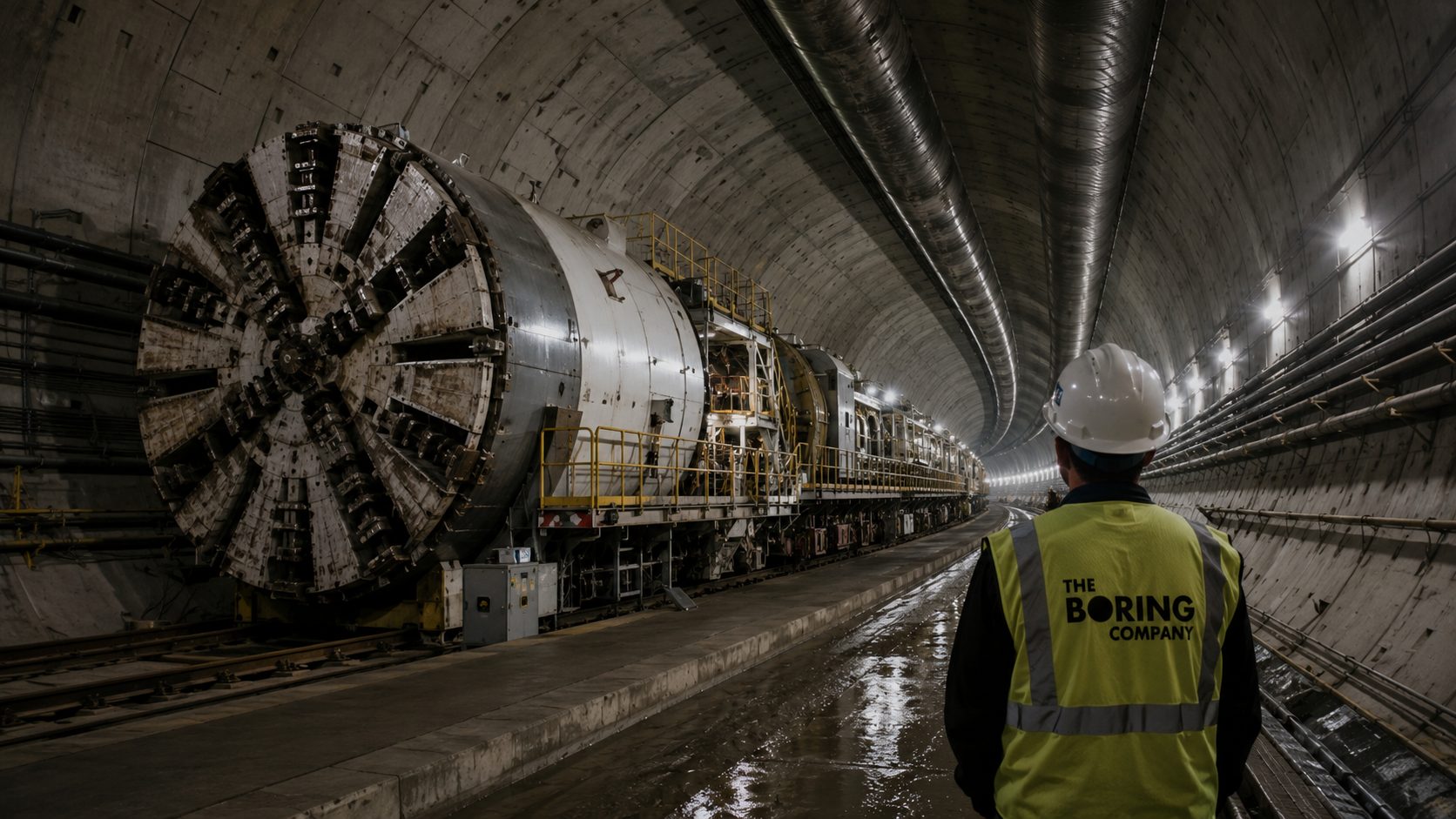
Boring Company is discussing a new funding round that could value Elon Musk’s tunneling startup near $20 billion, people familiar said.
The potential raise is around $4 billion, some of the people said. The round has not closed, and the final size, valuation and investor lineup could still change.
Steve Davis, Boring Company’s president, did not respond to requests for comment, according to the source material. The talks place the tunneling startup at the center of a broader test: how much private-market investors still want exposure to Musk-controlled companies after a volatile stretch across his business empire.
A $20 billion private-market test
The proposed valuation would mark a sharp increase from Boring Company’s last disclosed fundraising benchmark. The startup was valued at about $5.7 billion after a 2022 round that brought in $675 million from investors including Vy Capital, Sequoia Capital and Founders Fund.
Boring Company emerged from SpaceX in 2018 and has promoted tunnel-boring machines that it says can reduce underground construction costs. Its best-known operating project is beneath the Las Vegas Strip, where drivers use Teslas to carry passengers through a network serving the Las Vegas Convention Center.
That operating footprint matters because Boring Company is not only selling construction technology. It has also pitched itself as a transit operator that could build privately financed underground systems and generate revenue from passenger fares.
Las Vegas remains the proof point
The Las Vegas system gives Boring Company a live reference project, but the company’s broader municipal ambitions have been uneven. It has previously pursued privately funded tunnel projects in cities including Baltimore, Chicago and Los Angeles, and many of those proposals did not advance into full systems.
For investors, that record cuts in two directions. The Las Vegas network shows a functioning product tied to a major convention and tourism market, while the stalled city plans show how difficult it can be to convert tunneling concepts into approved, financed and politically durable transport networks.
The new funding talks also arrive during a rougher moment for Musk-linked market sentiment. Tesla shares fell 15% on Thursday, erasing $215 billion in market value after the electric-vehicle maker missed earnings targets and reported negative cash flow for the first time in two years, according to the source material.
Musk access carries a premium
Private investors have often treated access to Musk’s companies as scarce inventory. That demand has helped support large valuations even when the companies involved have long development timelines, heavy capital needs or uncertain regulatory paths.
The source material points to one recent example: investors in Musk’s $44 billion takeover of Twitter were underwater for months after the 2022 deal, then later benefited when the social-media company was rolled into xAI and the combined entity was subsequently folded into SpaceX. That history helps explain why some backers may accept a high entry price if they believe Musk’s companies can be reorganized or linked in ways that improve their economics.
For Boring Company, fresh capital could support machine development, tunnel construction capacity and the expensive early stages of new transport projects. It could also strengthen the company’s hand when negotiating with cities, venue operators and private landowners that want proof a contractor can fund and finish complex infrastructure work.
The risk is that valuation runs ahead of deployment. Urban transit projects face permitting, safety reviews, local politics, right-of-way issues and uncertain ridership economics, any one of which can slow revenue far more than a software or consumer-product launch.
Three paths for the round
If Boring Company closes a round near $4 billion at a valuation close to $20 billion, the deal would signal that private capital remains willing to fund long-duration infrastructure technology tied to a high-profile founder. For Boring Company, that would mean more financial room to pursue projects; for the tunneling sector, it could lift investor attention on alternatives to conventional public works procurement.
If the valuation is cut before closing, the signal would be different. A reset would suggest that weaker public-market sentiment, including Tesla’s selloff, is filtering into private-market pricing; Boring Company would still gain capital, but with less room to claim momentum, while infrastructure-tech peers could face tougher fundraising conversations.
If the talks stall, the macro message would be narrower but important: investor appetite for founder-led private assets has limits when execution risk is visible. Boring Company would then need to rely more heavily on existing funds and project-level financing, and the wider sector would keep facing the same question cities have asked for years: who pays before passengers show up?