Bitcoin price drop shifts retail money toward AI trades
A Bitcoin price drop to near $59,000 is coinciding with investor rotation into AI-linked trades, changing how selloffs unfold compared with past cycles.
Atlas Newsdesk ·
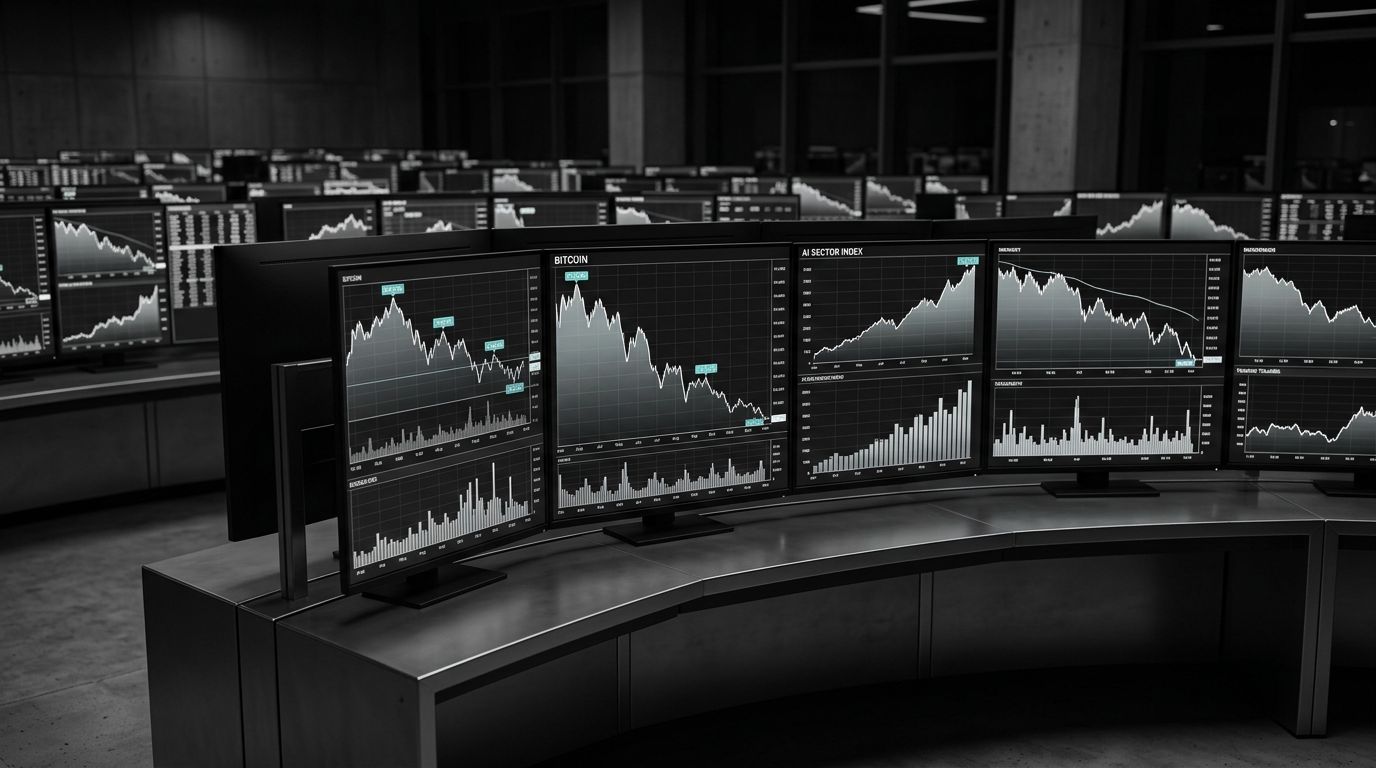
A Bitcoin price drop is reshaping risk appetite among speculative retail traders, as some capital shifts from crypto into AI-themed investments. Bitcoin sank as much as 5.4% to $59,023 in the latest session, marking its lowest level since October 2024.
The move left the original cryptocurrency roughly 50% below its record high set in October, despite a modest rebound in the following session. The magnitude and speed of the decline have renewed debate over whether the current cycle is being driven by a different mix of buyers and sellers than in prior downturns.
Rotation into AI reframes crypto’s competition for capital
Market analysts say the slide is notable not only for its depth, but for where funds appear to be going. Instead of exiting to cash, some investors have been reallocating toward AI-related opportunities, diverting flows that might previously have cycled back into digital assets.
That dynamic could alter how quickly downside momentum builds during periods of risk-off sentiment. If the competing destination for capital is another high-volatility theme rather than cash, rotations can occur rapidly and amplify moves across both arenas.
Marion Laboure, an analyst at Deutsche Bank, said Bitcoin’s “marginal buyer” has shifted away from the retail cohort that dominated earlier phases of crypto market history. In her view, the decision-maker increasingly resembles an exchange-traded fund allocator or a corporate treasury manager—participants who may compare Bitcoin with AI exposures when deciding where to deploy capital.
ETF allocators and treasuries can make moves more mechanical
The changing buyer base matters because it can influence the character of selloffs. Deutsche Bank’s Laboure argued that when larger allocators step back or rotate to other themes, the downturn can become “faster and more mechanical” than cycles largely driven by retail sentiment.
In retail-heavy periods, dips have often coincided with a shift into cash or stable holdings, with sentiment swings playing a central role in market timing. By contrast, allocator-led adjustments may be more systematic—tied to portfolio rebalancing, risk limits, or relative-return comparisons against alternative themes such as AI.
Bitcoin’s drop to $59,023 adds a clear technical marker for market participants monitoring levels not seen since October 2024. The fact that the drawdown is occurring even after the asset set a record high in October underscores how quickly crypto can reprice when demand at the margin changes.
What the pullback signals for retail traders and the next leg
For retail traders, the latest slide may test the asset’s appeal as a default “risk-on” trade, especially if AI-linked investments are perceived as offering a more immediate growth narrative. The divergence also highlights a broader reality: speculative capital is not fixed, and themes can compete directly for the same dollars.
For the broader market, the key implication is that Bitcoin’s next moves may increasingly hinge on institutional allocation decisions rather than solely on grassroots retail participation. If allocator behavior is now a bigger driver, volatility could remain elevated around portfolio rebalancing periods and sentiment shifts in adjacent themes.
Investors will be watching whether Bitcoin stabilizes after revisiting its October 2024 lows and whether AI-linked positioning continues to attract incremental inflows. Any sustained recovery would likely require renewed marginal demand from the same allocators now weighing crypto alongside other high-growth bets.