Beyond the Beltway: Why DC Could Be America’s Next Tech Hub
Focusing on the regional economy, this analysis highlights how talent, healthcare, finance, and global connectivity drive stronger long-term growth.
Sophie McAlister ·
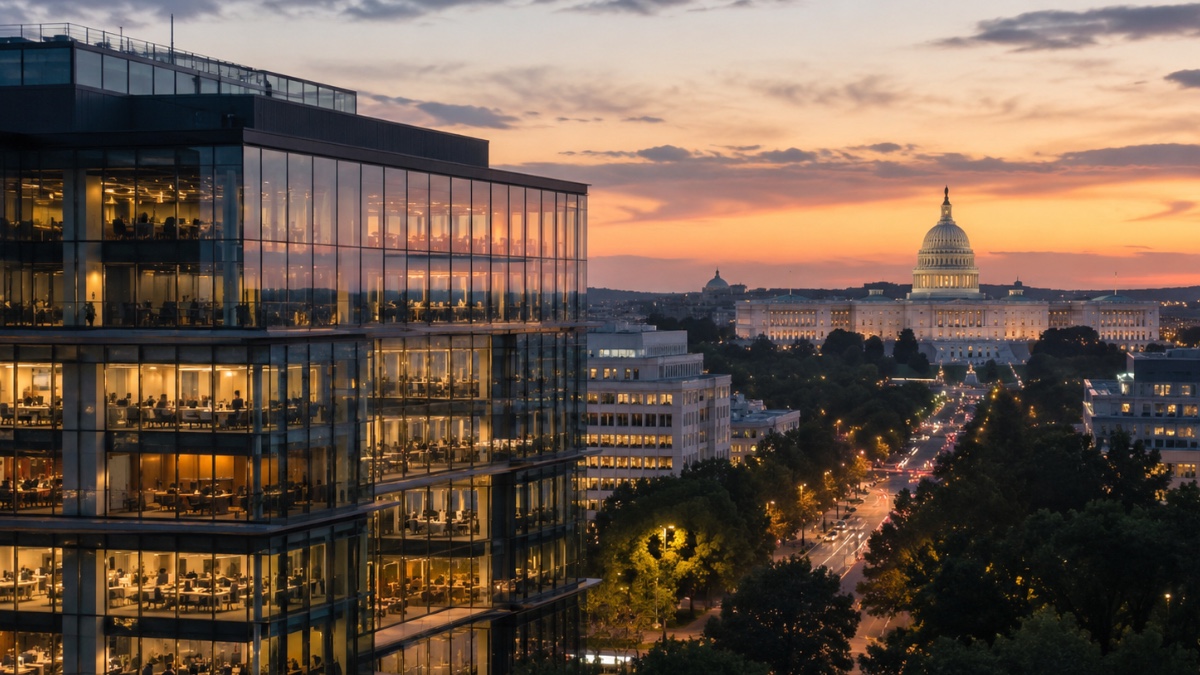
Washington’s strongest technology proposition is no longer confined to federal procurement, defense systems or political influence. The metropolitan area had nearly 6.44 million residents in 2024, giving consumer, financial, healthcare and business-software companies a substantial home market rather than merely a collection of government clients. Census data covering 2020 through 2024 show that 71.2% of employed civilians in the region worked for private businesses, compared with 23.5% employed by government, a balance often obscured by the capital’s public-sector identity. Amazon’s second headquarters in Arlington, Capital One’s base in McLean and AstraZeneca’s operations in Maryland illustrate the actual geography of the economy: a network stretching across the District, Northern Virginia and suburban Maryland rather than a single downtown technology district.
Dulles Opens 150 Doors
Geography gives that network an advantage few emerging technology centers can easily reproduce. Washington sits at the southern end of the Northeast Corridor, which links the capital by rail with Baltimore, Philadelphia, New York and Boston, while extending south toward Virginia’s growing cities. Dulles offered service from 46 airlines to more than 150 destinations during the summer of 2025, including over 60 international routes, making the airport valuable to companies managing overseas teams, customers or investors. The Silver Line connects Dulles with Reston, Tysons, Arlington and Washington, creating a commercial spine that joins cloud infrastructure, corporate headquarters, urban neighborhoods and an international airport within the same regional transit system.
One in Four Born Abroad
The region’s international character is an economic asset, not simply a demographic detail. The 2020-2024 American Community Survey counted almost 1.54 million foreign-born residents in the metropolitan area, equivalent to roughly one-quarter of the population, while more than 525,000 had entered the US in 2010 or later. Nearly one-third of residents aged five or older spoke a language besides English at home, and the foreign-born population included large communities originating in Latin America, Asia and Africa. That breadth can help companies recruit multilingual staff, understand overseas markets and design products for populations that are more varied than the early adopters found in a conventional technology enclave; it also leaves the region exposed to changes in immigration rules that could restrict the flow of students, scientists and experienced workers.
Bethesda’s $48 Billion Flywheel
Health technology may offer Washington its clearest path to a private-sector identity that is both commercially valuable and difficult for other cities to duplicate. The National Institutes of Health operates with a budget of nearly $48 billion and supports almost 6,000 scientists in its internal laboratories, most of them based at the Bethesda campus, while the surrounding corridor includes hospital systems, research centers and regulators. AstraZeneca already employs more than 4,500 people across its Montgomery County sites and opened a $300 million cell-therapy manufacturing facility expected to add over 150 skilled positions; Bethesda is also home to primary-care technology company Aledade, while Somatus operates its kidney and cardiovascular care platform from McLean. Children’s National has added another commercialization point through a pediatric research campus that houses genetic and rare-disease programs as well as JLABS incubator space, allowing researchers, clinicians and entrepreneurs to work within the same local ecosystem.
Capital One Meets HQ2
Washington also has the professional depth to build products outside medicine. Computer and mathematical jobs represented 7.4% of metropolitan employment in May 2025, more than twice the national share, while life, physical and social science occupations accounted for 1.9% compared with 0.9% across the US; local computer workers earned an average of $66.87 an hour. Capital One says engineers, designers and data scientists work together at its McLean headquarters, showing how a major regional employer can function as both a bank and a technology company, while Amazon reported in 2026 that nearly 8,500 employees were working from HQ2 in Arlington. Fairfax County companies attracted about $1.2 billion through 115 investment transactions in 2025, with information-technology businesses receiving more than $860 million, including funding for digital identity, satellite analytics and software-testing companies. These anchors matter because employees trained inside large organizations can eventually become founders, early hires, advisers and customers for the next generation of local businesses.
Broadband Reaches 94.7%
A sustainable technology center needs more than programmers and venture funds; it needs ordinary people who can use, test and pay for new products. The Washington metro combines high educational attainment with a broad consumer base: 55.5% of adults aged 25 or older held at least a bachelor’s degree in 2024, while median household income reached $126,244. Five-year Census estimates show that 94.7% of households had broadband subscriptions, 92.6% of residents had health insurance and more than three-quarters had private coverage, conditions that can support early adoption in telemedicine, financial services, education software and subscription-based consumer products. The population is also racially varied—18.7% identified as Hispanic or Latino, 24% as non-Hispanic Black and 11.2% as non-Hispanic Asian—giving companies a demanding real-world environment for identifying whether products work across income, language, age and cultural differences.
Seed Capital Sets the Ceiling
The remaining obstacle is not talent or market size but whether the region can consistently turn those resources into independent, fast-growing companies. Eighty percent of the capital invested in Fairfax County companies during 2025 went to later-stage transactions, while seed and early-stage funding together represented a much smaller portion of the total, suggesting that mature businesses have an easier route to money than first-time founders. High housing costs, long journeys between regional nodes and competition from New York, Boston and the Bay Area could also make recruitment difficult, while health and research companies remain vulnerable to shifts in federal science budgets even when their customers are private. Washington will become a genuine technology hub only if it connects its fragmented communities, expands early financing and builds companies that can sell nationally and internationally without depending on one agency, administration or institutional buyer.