Artemis II Crew Returns Safely After Lunar Orbit Mission
The Artemis II mission concluded with the Orion capsule's successful Pacific Ocean splashdown, bringing its four-person crew back to Earth after a nine-day…
Cuneyd Erdogan ·
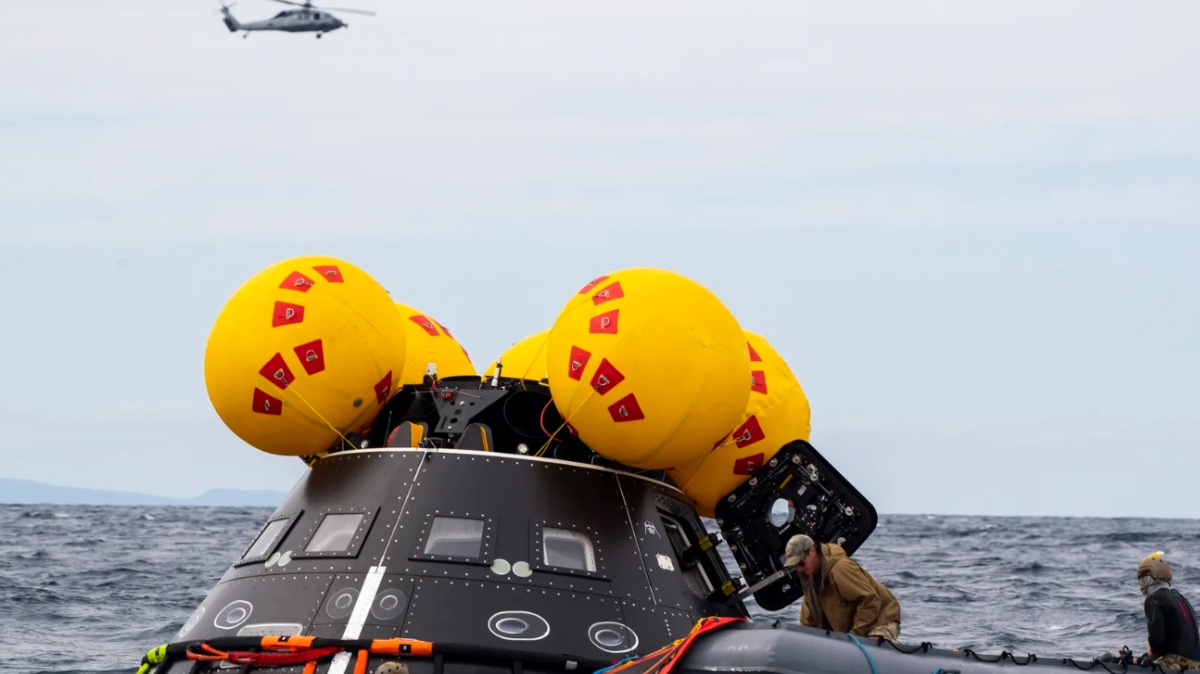
Historic Lunar Mission Concludes
The Artemis II mission, a pivotal step in NASA's human spaceflight program aimed at the Moon, successfully concluded with the Orion capsule's splashdown in the Pacific Ocean. The capsule, named "Integrity," landed off the coast of San Diego on Friday, around 8:07 PM Eastern Time. NASA officials confirmed a smooth landing with no technical issues and reported the crew to be in good health.
This crewed flight around the Moon spanned a total of nine days, one hour, and thirty-two minutes. The mission marks a critical phase in NASA's return to human deep space operations under the Artemis program. The program's overarching goal is to establish sustainable operations around the Moon and develop the necessary systems for future Mars missions.
Re-entry and Landing Sequence
The re-entry process, considered one of the mission's riskiest phases, was closely monitored. Approximately twenty minutes before reaching Earth's upper atmosphere, the Orion's crew module separated from its service module. The capsule was positioned to ensure the heat shield bore the maximum thermal load, with an option for a final orbital correction maneuver about sixteen and a half minutes before atmospheric entry.
According to NASA's flight plan, Orion entered the atmosphere at an altitude of 122 kilometers, where its heat shield endured temperatures reaching approximately 2,700°C. This segment was particularly scrutinized due to damage observed on the heat shield during the previous uncrewed Artemis flight. NASA stated that they successfully managed this challenge by adjusting the re-entry angle.
Communication Blackout and Recovery
The entire re-entry sequence, from atmospheric entry to splashdown, lasted approximately thirteen minutes. A communication blackout, expected to last about six minutes, occurred roughly twenty-four seconds after entry. This interruption is attributed to the plasma generated during re-entry, which blocks radio signals. Once communication was re-established, the capsule was estimated to be at an altitude of about 46 kilometers and rapidly descending.
Orion entered the atmosphere at speeds exceeding 40,000 kilometers per hour. Atmospheric drag served as the initial "brake" during deceleration; for crew safety, the re-entry profile was extended over approximately five minutes to reduce G-force loads.
Subsequently, the parachute system deployed: two drogue parachutes opened at 6.7 kilometers altitude, slowing the capsule to about 322 km/h. At 1.8 kilometers, the main parachutes deployed, reducing the descent speed to approximately 32 km/h for splashdown.
Crew and Future Implications
Upon splashdown, five airbags deployed to stabilize the capsule on the water, and the crew waited for the capsule to cool before opening the hatch. Recovery teams were on standby in the landing zone off the coast of California. The crew comprised Commander Reid Wiseman, Pilot Victor Glover, Mission Specialist Christina Koch, and Mission Specialist Jeremy Hansen.
This achievement allowed NASA to validate critical operational chains in real mission conditions, including re-entry, communication blackout management, heat shield performance, and sea recovery. The data collected from Artemis II will directly influence mission design, risk acceptance criteria, and supply chain planning for subsequent phases of the program.
The success of Artemis II is closely watched by nations with their own space programs, including Turkey, for potential collaborations. The program's progress could impact contract scopes and testing requirements for space industry suppliers.
Turkish space industry firms must monitor these developments for compliance with international standards and competitive positioning. Furthermore, public space expenditures and major contractor agreements continue to influence revenue visibility for defense, aviation, and space companies.
For Turkish space and defense firms, the market dynamics and technological advancements of such international programs play a significant role in shaping long-term strategies.
Broader Context and Risks
The Artemis program's continued success is crucial for maintaining public and political support for ambitious deep space exploration. Any significant setbacks could lead to budget reallocations or delays, impacting the entire space industry ecosystem. The technical challenges, particularly those related to human safety in extreme environments, remain a constant area of focus and potential risk for future missions.
The successful return of the Artemis II crew reinforces confidence in NASA's capabilities and paves the way for future lunar landings and eventual missions to Mars. However, the complexity of these endeavors means that each subsequent mission will present new and unique challenges that must be meticulously addressed.