AMD Anthropic partnership sets 2GW AI chip rollout plan
AMD said Anthropic will deploy 2 gigawatts of MI450 GPUs and that the chipmaker may invest up to $5 billion in the AI company.
Atlas Newsdesk ·
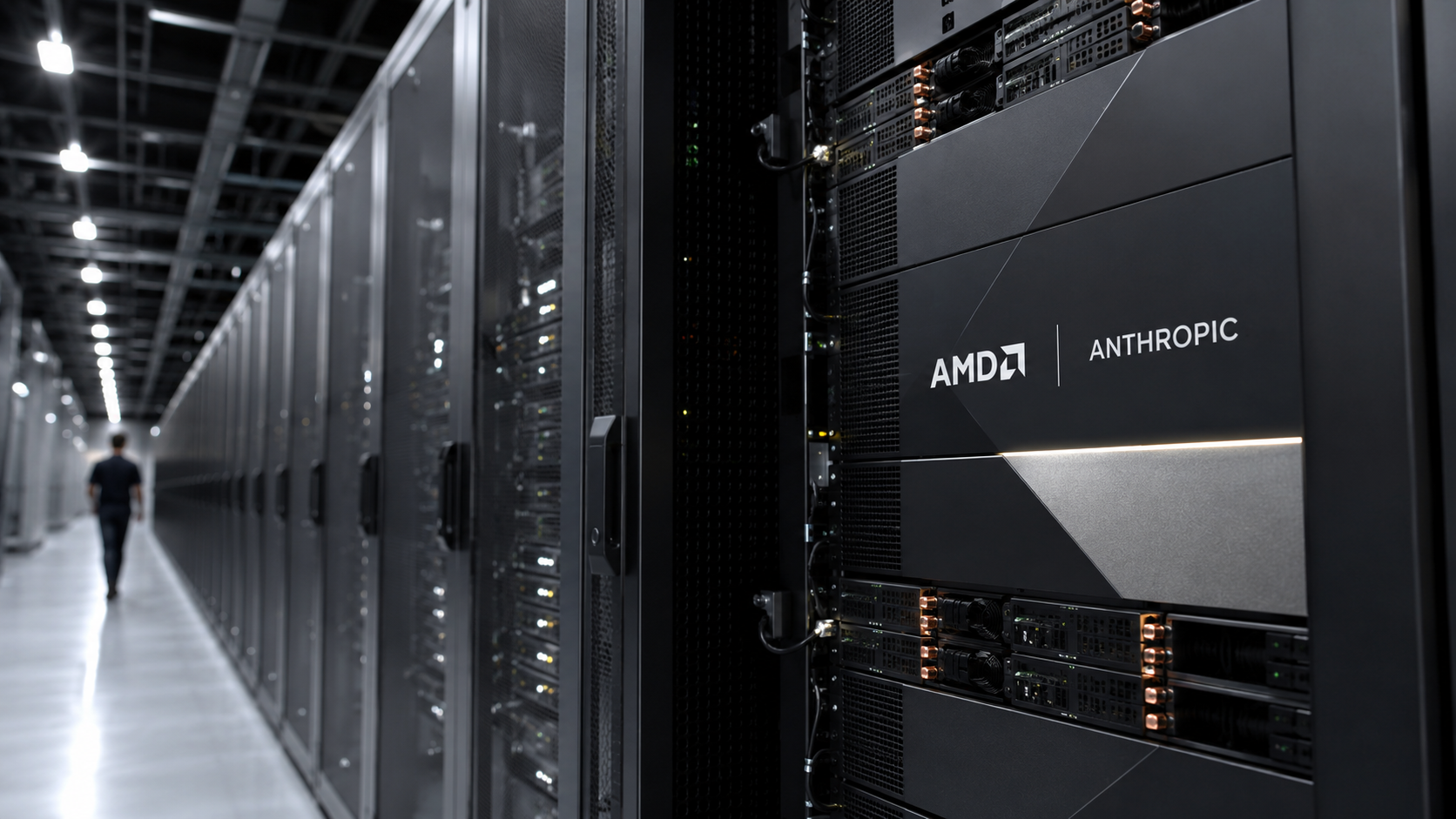
The AMD Anthropic partnership adds a planned 2-gigawatt AI chip deployment and a possible $5 billion investment. The rollout starts next year.
Advanced Micro Devices said Wednesday that Anthropic will use its AMD Instinct MI450 Series graphics processing units in AMD Helios rack-scale systems, giving the chipmaker a large new customer in the artificial intelligence infrastructure race. The company said the first 1 gigawatt of capacity is expected to be deployed in the first half of next year.
Two gigawatts for Anthropic
The agreement is framed around power capacity, a metric that has become common shorthand for the scale of AI data centers. AMD said Anthropic’s planned deployment totals 2 gigawatts, but it did not provide a full timetable for the second gigawatt in the provided announcement details.
The companies are pairing Anthropic’s AI workload needs with AMD’s Helios rack-scale platform, which is designed around the chipmaker’s Instinct MI450 Series GPUs. AMD Chief Executive Lisa Su said in the company’s statement: “We are thrilled to deepen our partnership with Anthropic and deploy AMD Helios at gigawatt scale.”
A $5 billion investment option
AMD also said it could invest up to $5 billion in Anthropic in the future. The wording leaves timing, structure and conditions open, so the announcement is not the same as an immediate cash investment of the full amount.
For AMD, the deal offers more than a hardware sale. A large deployment with a frontier AI company can help validate the MI450 platform with customers deciding how to allocate spending across GPUs, networking, power systems and data center capacity.
For Anthropic, the agreement adds another potential source of compute as AI developers seek enough infrastructure to train and run larger models. The company’s need is straightforward: advanced AI systems require dense clusters of chips, large amounts of electricity and tightly integrated servers that can operate at scale.
AMD chases Nvidia’s lead
AMD has become a major beneficiary of AI demand because its GPUs can train models and handle large computational workloads. The company competes directly with Nvidia, which the source describes as the dominant supplier in the market.
The Anthropic announcement follows another high-profile AMD arrangement with OpenAI, a rival AI developer. As part of that separate deal, AMD issued OpenAI a warrant for up to 160 million shares of AMD common stock, equal to roughly 10% of the company, with vesting tied at least in part to deployment volume, according to the provided source text.
Those agreements show how AI chipmakers are using commercial partnerships, equity-linked incentives and capacity commitments to lock in demand. They also show how AI companies are trying to avoid relying on a single hardware supplier while power availability becomes a constraint on expansion.
Power becomes the constraint
The use of gigawatts as a headline figure signals how AI infrastructure has moved beyond a simple chip-count story. A 2-gigawatt plan points to the physical limits shaping the sector: electricity supply, cooling, grid access, construction schedules and the ability to finance data center campuses.
If the first 1 gigawatt is deployed on schedule in the first half of next year, AMD gains a visible proof point for Helios and MI450 at large scale. That could strengthen its position with other AI customers, while the wider chip sector would face more pressure to package hardware with complete rack systems and reliable deployment schedules.
If deployment slips, the effect would run through several layers. Anthropic would have less new compute available than planned, AMD would lose momentum in proving its platform, and the industry would get another reminder that AI capacity is limited by data centers and power infrastructure as much as by chip supply.
A third path depends on the investment component. If AMD proceeds with a large financial commitment, it could deepen customer alignment but also raise questions about how much AI chip demand is supported by strategic funding arrangements between suppliers and buyers.
Open questions for AI infrastructure
The announcement leaves several items unresolved, including the exact investment timing, the schedule for the second gigawatt and the commercial terms of the GPU deployment. Those gaps matter because they determine how quickly the partnership turns into revenue, capacity and competitive evidence.
For global markets, the mechanism to watch is capital spending. If AI infrastructure demand remains strong, chipmakers, power providers and data center builders could keep drawing investment into the sector; if financing or grid access tightens, the buildout could slow even while model developers still want more compute.
For AMD, the next test is execution rather than announcement size. Anthropic’s deployment will be judged by whether MI450 and Helios can arrive on time, run large workloads efficiently and persuade other buyers that AMD is a credible alternative in the highest-end AI systems market.