Alan Greenspan, the Maestro Who Helped Invent Modern Central Banking, Dies at 100
Former Federal Reserve Chair Alan Greenspan has died at 100, leaving a complex legacy defined by his influence on monetary policy and deregulation.
Lauren Collins ·
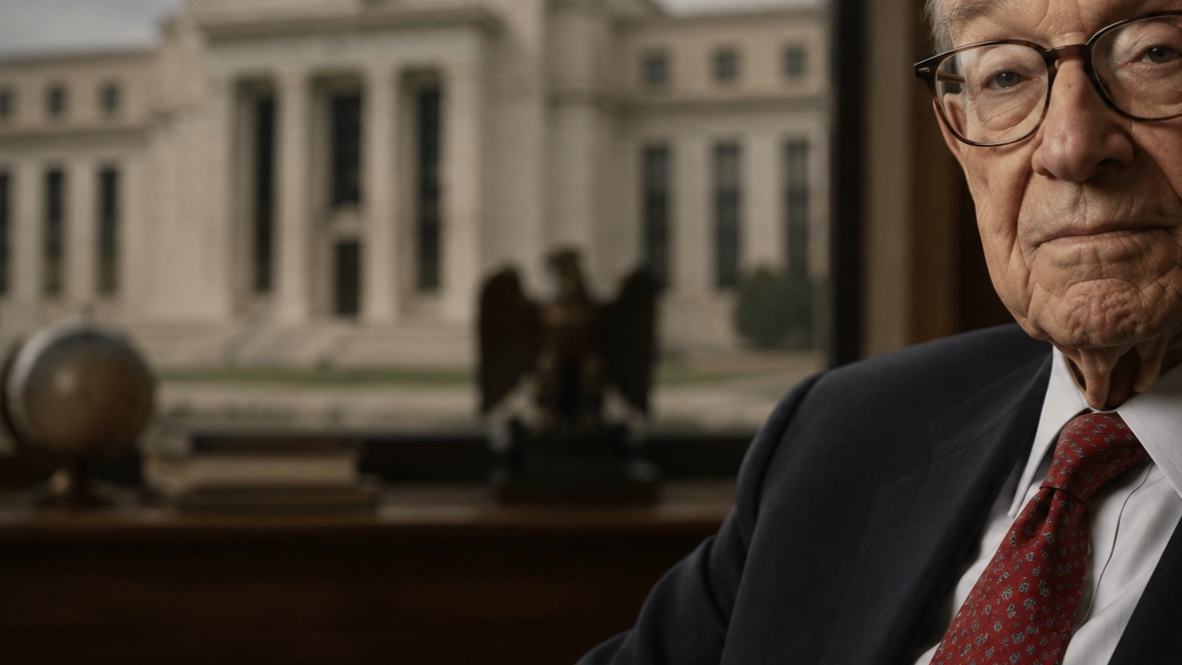
Alan Greenspan, who died on June 22, 2026, at age 100, was the most powerful central banker of the late 20th century: a jazz clarinetist turned economist whose long command of the Federal Reserve helped define the era of low inflation, financial deregulation and faith in markets. His wife, Andrea Mitchell, said he died at his Washington home from complications of Parkinson’s disease.
The man behind the mystique
Greenspan was born in New York City on March 6, 1926, and began adult life closer to music than monetary policy. He studied at Juilliard, played jazz professionally, and later moved into economics, earning degrees from New York University. Before becoming a public figure, he built a career as a private economic consultant, advising companies and politicians with the same appetite for data that later became his trademark at the Fed.
His intellectual formation was unusual for a central banker. He was close to Ayn Rand’s circle and absorbed a strong belief in markets, private enterprise and the dangers of excessive state intervention. Yet the job for which he became famous was not the abolition of central planning, but its most delicate modern form: deciding the price of money for the world’s largest economy.
Greenspan entered senior public service before the Federal Reserve. He chaired the Council of Economic Advisers under President Gerald Ford from 1974 to 1977, a period shaped by inflation, weak growth and the collapse of postwar economic certainties. That experience mattered. By the time Ronald Reagan nominated him to lead the Fed in 1987, Greenspan understood that central banking was never merely technical. It was a political art performed in the language of economics.
The crash that made him
His first great test arrived almost immediately. Greenspan became Fed chairman in August 1987. Two months later, US stocks suffered the Black Monday crash. The Dow Jones Industrial Average fell more than 22% in one session, a collapse that could have turned market panic into a broader financial crisis.
Greenspan’s Fed responded by signaling that it would provide liquidity to the financial system. That move became a template for later crisis management: central banks would not prevent markets from falling, but they would try to stop disorder from becoming collapse. It was a defining lesson for Wall Street and Washington. The Fed was no longer just a guardian against inflation; it was also the backstop for modern finance.
The long expansion
Greenspan led the Federal Reserve from 1987 to 2006, serving under Presidents Reagan, George H.W. Bush, Bill Clinton and George W. Bush. His tenure covered the savings-and-loan aftermath, the 1990s expansion, the Asian financial crisis, the dot-com boom and bust, and the economic shock after September 11.
For much of that period, he was treated with near-reverence. Inflation was contained, productivity accelerated, unemployment fell, and financial markets deepened. His admirers saw him as the central banker who had learned how to let capitalism run hot without letting prices run away. His critics later argued that this confidence encouraged complacency.
He also changed the way central banks communicated. Earlier Fed chairmen often preferred opacity. Greenspan mastered ambiguity, sometimes to the point of parody, but under his leadership the institution moved gradually toward more explicit signals about policy. The modern Fed, with its statements, forward guidance and ritualized market interpretation, owes part of its shape to his era.
The phrase that stuck
Greenspan’s most famous warning came in 1996, when he asked whether “irrational exuberance” had inflated asset prices. The phrase entered financial history because it captured both his power and his caution. He saw signs of speculation, yet he did not move aggressively to prick the bubble.
That tension ran through his career. Greenspan distrusted heavy regulation and believed markets were usually better at allocating capital than officials. But he also understood that markets were emotional machines, capable of panic and excess. His genius was to manage that contradiction for years. His failure, critics say, was to believe it could be managed indefinitely.
The shadow of 2008
Greenspan retired in January 2006 and was succeeded by Ben Bernanke. Less than two years later, the US housing market began to unravel, dragging the global financial system into its worst crisis since the Depression. By then, Greenspan’s reputation had changed.
The criticism was direct. He had supported financial deregulation. He had resisted tougher oversight of derivatives. He had kept interest rates low after the dot-com crash and September 11, a policy many later blamed for feeding the housing boom. The Financial Crisis Inquiry Commission faulted the deregulatory climate that Greenspan had long defended, while Greenspan himself conceded after the crisis that his view of banks’ ability to police their own risks had been flawed.
That admission did not settle the debate. Some economists argue that global savings flows, weak mortgage standards, securitization and political pressure for home ownership mattered more than Fed policy alone. Others contend that Greenspan’s central error was philosophical: he mistook the discipline of markets for a substitute for the discipline of rules.
A central banker’s legacy
Greenspan’s impact on central banking was enormous. He helped make the Fed the dominant actor in global economic management. Under him, interest-rate decisions became market-moving events watched by traders, presidents, foreign finance ministers and ordinary homeowners. His tenure also strengthened the idea that central-bank credibility is an economic asset in itself.
That idea survives him. The modern central banker is expected to manage inflation, employment, financial stability, market psychology and political pressure, often all at once. Greenspan did not create all those burdens, but he made the office appear capable of carrying them. That may have been both his achievement and his inheritance to successors.
His life also marks the rise of the technocrat as public celebrity. Greenspan was not elected, rarely spoke plainly and often seemed designed to repel popular attention. Yet his testimony could move bonds, stocks and currencies across continents. For a time, the chairman of the Federal Reserve rivaled presidents in practical influence over the daily lives of Americans.
The final verdict
Greenspan’s obituary cannot be written as triumph or indictment alone. He presided over prosperity, helped contain crises and gave the Federal Reserve a more central role in the world economy. He also became a symbol of the pre-2008 faith that sophisticated markets could spread risk so efficiently that regulators could afford to stand back.
The uncertainty is how history will weigh those two Greenspans. One was the Maestro, the data-obsessed steward of a long expansion. The other was the high priest of market self-confidence before a crash that exposed how fragile that confidence had become.
He leaves behind a central-banking world that still speaks his language: credibility, expectations, liquidity, confidence. It is a powerful vocabulary. It is also a warning that the people who control money can shape an age without fully understanding the one that follows.