

Afrohype performers reportedly earn up to 8m naira
The Lagos-rooted emceeing style is moving from party add-on to full-time work as Afrobeats economics push promoters toward hypemen.
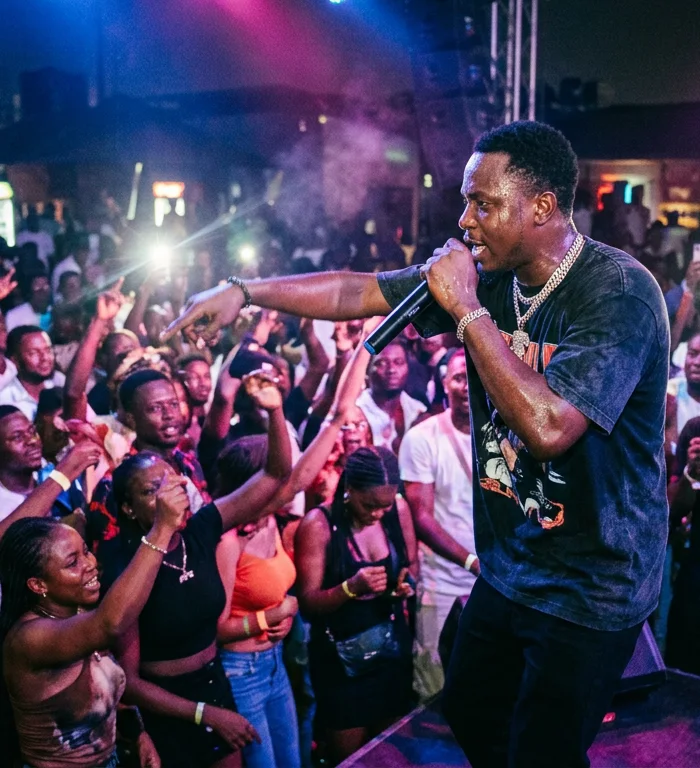
Some Afrohype performers are reportedly paid 5 million to 8 million naira (£2,844–4,550) for 30-minute or one-hour sets, The Guardian reported in an Oct. 18 feature.
The top cited fee equals £4,550, compared with £2,844 at the low end of the reported range, showing how the Afrobeats-adjacent style is becoming paid work rather than a party extra.
Afrohype, also called lamba by some performers and fans, sits between singing, rapping and live emceeing. Performers use improvised chants, comic phrases and percussive sounds over new beats or familiar instrumentals, with audiences often responding by spraying money, a Nigerian celebratory custom.
The Guardian focused on 32-year-old Toby Shang, born Tobi Michael Adeyeye, who built the style from school performances, private tutoring and campus events at the University of Lagos. “Even my mother calls me Shang now,” he told the newspaper near the university’s waterfront.
By his final year, Shang’s catchphrases had helped produce Shedibalabala, the article said. He has since released two EPs and run four editions of his School of Hype, a one-day masterclass with online mentoring.
Dami Ajayi, a London-based doctor and cultural critic, told The Guardian that a hypeman he saw at a party in Tirana used pauses in songs to command the room. “Hypemen have the gift of the gab and fine mic control,” Ajayi said, while adding that the jokes he heard were often “frontally risque and misogynistic.”
The form has older roots than its current Lagos club profile. The Guardian traced it to praise-singing, call-and-response traditions, West African griots and the atalaku style that developed in Kinshasa in the 1980s before influencing Congolese rumba, Ivorian coupé-décalé and later West African party scenes.
Women remain fewer in a male-dominated field, the article said, but several have shaped the scene. It named Yaoundé-based Lady Ponce, Lagos radio presenter Melody “M.I.A” Adigo and Deborah “Hype Queen Baddy” Francis, a Shang school alumnus who died in September. It also cited Lili Djely, who won a 2006 atalaku contest on Côte d’Ivoire’s RTI network.
The economics reflect wider Afrobeats demand. The Guardian reported that promoters turned more often to hypemen after artists became costlier to book after Covid-19, while some performers are now said to command the 5 million-to-8 million-naira range for short sets. The article did not publish booking records for those rates.
For Shang, the appeal is partly social as well as commercial. “People are facing a lot of challenges … they need somebody to tell them money is coming in the new week,” he said.
Source: Feature article, The Guardian, Oct. 18, 2026.
More stories
- Macron vows prosecutions after 400 arrests at France protests
- Lovejoy links Bonetta to 700,000-person indenture system
- Six Black Sea ship attacks reach Romanian waters
- Egypt offers Saudi defense help, seeks parliament's role
- Magyar puts Hungary's euro plans before first budget test
- Israeli settlers attack West Bank olive harvest, hurt two
- Pentagon cuts target 20% reduction in top brass by 2027
- Bessent says Iran sanctions close most external flights
Latest news
- Louvre pledges €20m a year for security after jewel theft
- Low-UPF diet links to lower depression scores in 20-person study
- Personalized gait retraining cuts osteoarthritis knee pain by 2.5 points
- Wigan stay bottom of League One after 1-0 win over Reading
- Ellie & Natasia creators refit BBC sketch show after 3-year gap
- The Traitors turns about 20 cues into global TV identity
- Wall squats may lower blood pressure after four weeks