AART preprint claims proteomics labs can merge data across platforms
A bioRxiv v1 preprint claims AART can translate proteomic data across platforms using ridge regression and residual learning.
Edward Mullen ·
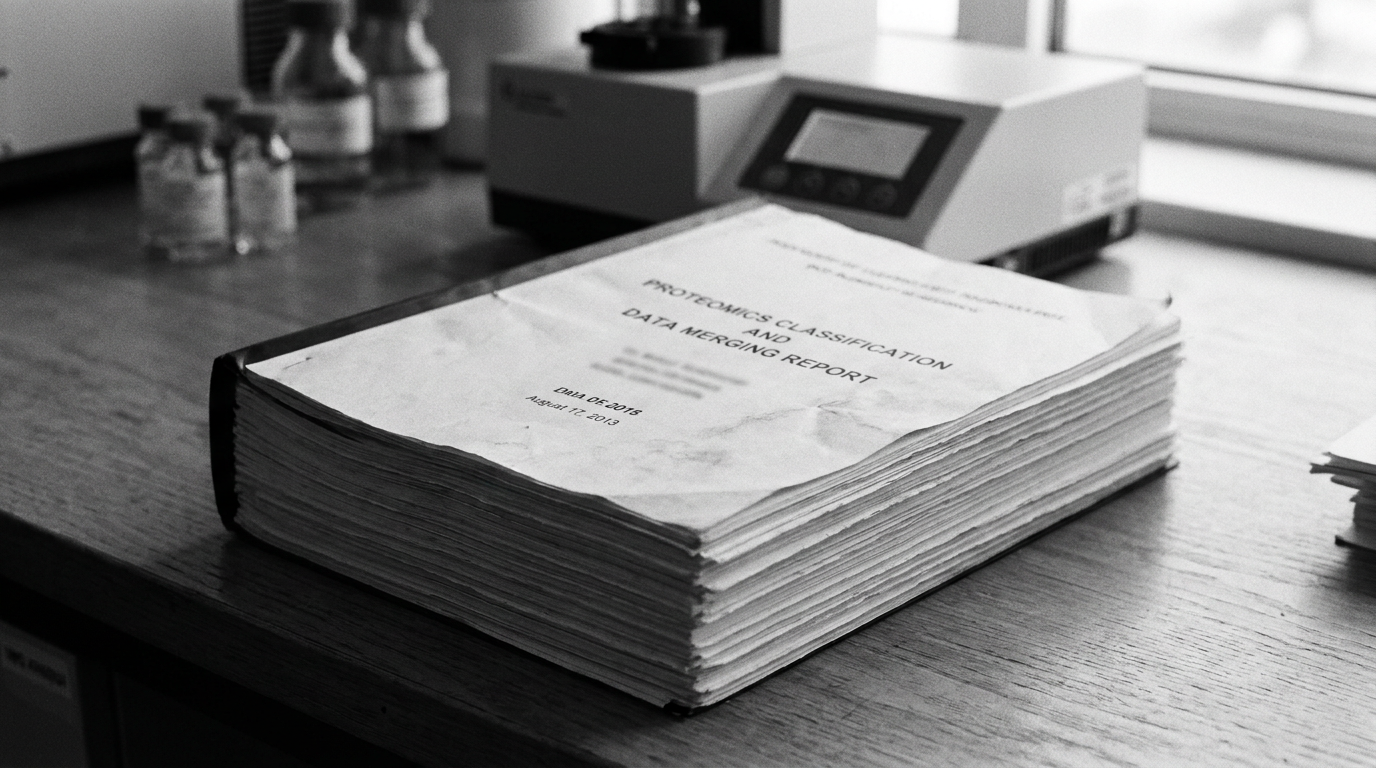
Conventional wisdom dictates that meaningful multi-platform proteomic studies demand bespoke reconciliation efforts, often requiring specialized, platform-specific expertise. Yet, a recent bioRxiv preprint argues for a different path entirely: a machine-learning framework designed to translate proteomic data across platforms. This audacious claim suggests a future where data, not platform, drives research integration.
AART aims at the translation tax inside proteomics work The paper’s stated target is “technical variability in multi-platform proteomic studies,” according to the bioRxiv preprint. Its proposed method, AART, uses a hybrid approach of ridge regression and residual learning to translate proteomic measurements across platforms.
That is a narrower claim than saying proteomics is solved, and a more important one for work allocation inside research organizations: the method is not presented as a new biological discovery engine, but as a way to reduce the cost of making data produced under different technical conditions comparable enough to analyze together.
The distinction matters because platform variability is not just a scientific nuisance. In a large proteomics program, it becomes a staffing and margin problem: analysts spend time reconciling platform-specific outputs, research managers plan studies around what can be compared cleanly, and sponsors may hesitate to combine datasets produced under different technical regimes.
If AART performs as described, the value of the work shifts away from bespoke platform reconciliation and toward study design, cohort integration, and downstream interpretation. That is the margin shift embedded in the preprint’s methods claim, not a finding the source independently validates in the market.
The paper claims method flexibility, not commercial readiness The source summary says AART “enables seamless integration” by combining ridge regression with residual learning. The plain-English version is this: one part of the system learns a stable statistical mapping, while another part tries to account for what the first mapping leaves behind.
That is a data translation architecture, not a procurement-ready product description, and the preprint summary does not say whether AART is licensed, packaged, maintained, or already integrated into existing bioinformatics workflows.
That omission is load-bearing. A research lab can tolerate a clever method that requires expert handling; a platform organization cannot build a recurring workflow around an unmaintained method that only one postdoctoral analyst understands.
The source does not tell executives who supports AART, how it is deployed, whether it runs efficiently on extremely large datasets, or how it behaves when the platform mix changes. Those are not secondary business questions.
They determine whether translation becomes a reusable layer in proteomics work or remains another custom analysis step.
“Fast and accurate” still needs a baseline
The headline promise is speed and accuracy, but the packet does not provide the benchmark table an operator would need to price the claim. Fast compared with what baseline: manual normalization, platform-specific modeling, another translation method, or a simplified internal workflow?
Accurate against what reference: held-out samples, known biological signals, agreement across platforms, or a downstream endpoint? The supplied summary also does not specify hardware, dataset scale, or whether the reported performance is reproducible outside the authors’ own setup.
This is the basic preprint test. If AART was measured only in favorable settings, the apparent gain may be a lab-specific gain rather than a general workflow gain.
If it requires heavy computational overhead on extremely large datasets, the labor saving could be partly offset by infrastructure cost and specialist oversight. If it breaks on edge cases where one platform captures signals another platform does not, translation could create a false sense of comparability.
The source does not resolve those questions, which is why the right reading is “promising method claim,” not operational proof.
The counter-read is that platform expertise does not disappear The strongest objection is that proteomic platforms are not interchangeable data sources waiting for a universal adapter. Technical variability can reflect differences in what each platform measures, how the signal is generated, and where errors enter the workflow. A statistical translator may reduce measured disagreement without proving that the resulting integrated dataset preserves the biological meaning a principal investigator actually cares about.
That counter-read does not make AART irrelevant. It changes the job it might do.
Rather than replacing platform-specific expertise, AART could become a triage layer: useful for identifying when cross-platform integration is plausible, but still dependent on specialists to decide when translated data should not be pooled. In that version of the future, the labor shift is not from experts to automation.
It is from routine reconciliation toward exception handling, validation, and governance of what counts as comparable evidence.
If it holds, the buyer changes before the science does Within 24 months, the most consequential change would not be that every proteomics study becomes cross-platform by default. It would be that research leaders ask a different budgeting question. Instead of funding platform-by-platform analysis as the safe path, they would start asking whether a translation layer can make existing and future datasets more reusable across programs. That pushes spending toward integrative bioinformatics capacity and away from repeated one-off reconciliation work.
The beneficiaries would be groups holding heterogeneous proteomic datasets and teams that can validate translation quality across study contexts. The exposed group is the narrow service function built around platform-specific cleanup without a broader role in study interpretation.
The under-noticed middle is the bioinformatics manager, who may inherit responsibility for deciding when translated data is good enough for exploratory analysis, when it is good enough for publication, and when it should not be combined at all.
The thesis would be wrong if independent labs do not pick up AART, if journals raise methodological doubts rather than accepting cross-platform translated analyses, or if third-party validation fails to show meaningful improvement in reproducibility or integration. The near-term signals are practical rather than promotional: whether the method appears in external workflows, whether reviewers accept studies that rely on AART-style translation, and whether tool maintainers make it usable without bespoke expert intervention.
Until those signals arrive, the preprint is best read as an argument that the margin structure of proteomics work could move — not evidence that it already has.