Wall Street stocks ease before CPI as gold hits June high
Wall Street indexes retreated as Brent crude settled near $88, putting Fed rate expectations and Hormuz diplomacy at the center of trading.
Amina Diallo ·
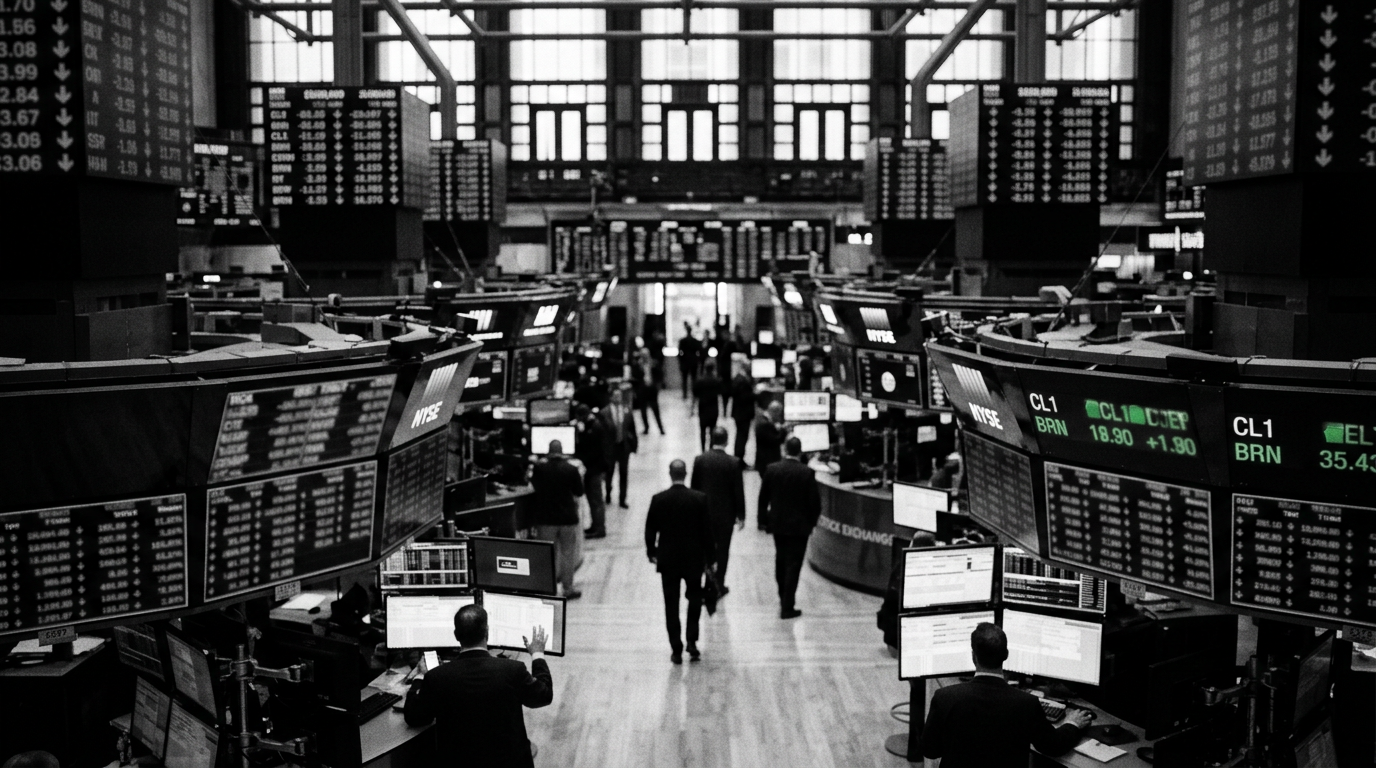
Wall Street indexes slipped Monday as oil jumped about 5%, putting Fed rate expectations and Hormuz diplomacy back at the center of trading.
The Dow Jones Industrial Average fell 0.11% to 53,975.98, the S&P 500 edged down 0.06% to 7,753.11 and the Nasdaq Composite lost 0.32% to 26,605.36. The declines followed record highs reached Friday, when a weaker-than-expected jobs report led traders to reduce bets on further Federal Reserve rate increases.
Brent settles near $88
Oil carried the clearest market move after Iran said a transit arrangement with Oman was in its final stages but tied any reopening of the Strait of Hormuz to additional U.S. concessions. Iran said its conditions included compensation, an end to sanctions and a halt to military threats.
Brent crude futures settled up $4.17, or 4.99%, at $87.72 a barrel, while West Texas Intermediate rose $3.95, or 5.05%, to $82.13. The move put energy prices back into the inflation debate before U.S. consumer price data due Wednesday.
Gold also gained as investors moved through a mix of energy, rate and geopolitical risks. U.S. gold futures rose 0.5% to $4,419.70, while spot gold was up 1.12% at $4,390.29 an ounce after touching its highest level since early June.
CPI follows Friday payrolls
The July consumer price index is the main U.S. data point for rate markets this week. A poll of economists expects annual CPI inflation of 3.4%, down from 3.5% in the prior month.
Mohit Kumar, a senior European economist at Jefferies, said the inflation release would be central to the near-term Fed debate. "We are keeping our view of no hikes from the Fed for this year," Kumar said, adding that lower oil prices from current levels would reduce pressure for another increase.
Treasury markets also faced supply pressure, with the yield on the benchmark 10-year note rising 4.25 basis points to 4.701%, from 4.658%, as investors prepared for $125 billion of new issuance this week. Bond yields move inversely to prices, so the yield increase pointed to softer prices for longer-dated government debt.
Earnings cushion global equities
Global equities were mixed rather than broadly weaker. The MSCI global stock index edged up 0.04%, Europe’s benchmark index was little changed near a record high, and MSCI’s broadest Asia-Pacific gauge outside Japan closed up 0.61% at 1,628.74.
Emerging market stocks gained 0.69% to 1,669.27, extending support from recent corporate results. Analysts at BofA said that with nearly 90% of S&P 500 companies reported, earnings per share were up 30% from a year earlier after excluding investment gains at Alphabet and Amazon.
The same BofA analysis put the S&P 500 earnings beat rate at 76%, matching the strongest level since 2021. JPMorgan strategists raised their 2026 S&P 500 earnings-per-share estimate to $365, implying 35% annual growth, and lifted their index target to 8,000 from 7,800, compared with the S&P 500’s current level near 7,758.
Dollar rises as yen weakens
The dollar index rose 0.17% to 99.81, while the euro slipped 0.14% to $1.1542. The Japanese yen weakened 0.94% to 159.31 per dollar, a level that kept investors alert to possible intervention.
Bank of Japan policymakers warned at their July meeting that inflation risks were building, according to a summary of opinions. Those comments strengthened the case for a September rate increase if price pressures continue.
If oil prices remain elevated, the mechanism for markets is direct: higher energy costs can slow inflation progress, complicate Fed policy and raise input costs for transport, chemicals and consumer companies. If Hormuz transit normalizes and crude reverses Monday’s move, the pressure shifts back toward earnings, the CPI print and whether bond supply keeps yields near current levels.