US mortgage rates hit 6.71% in new blow to buyers this week
Mortgage rates rose to 6.71%, the highest since July 2025, adding pressure to US housing affordability as bond yields climbed.
Jason Kwon ·
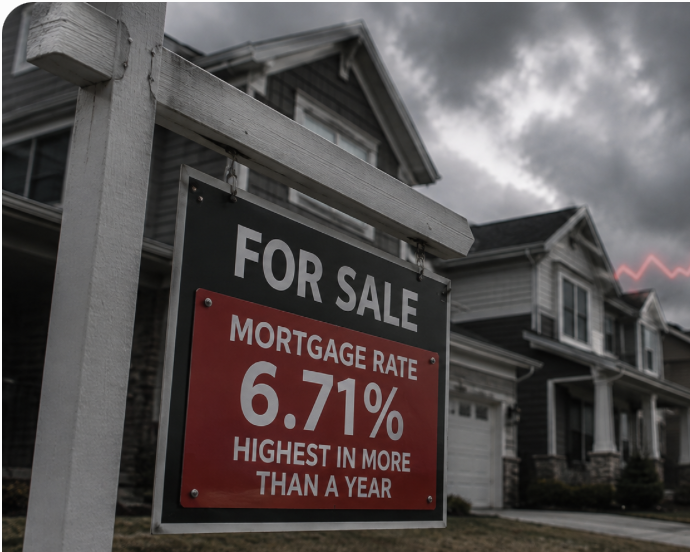
Mortgage rates rose to 6.71%, making US home loans the costliest since July 2025 and tightening affordability before November elections.
Freddie Mac said Thursday its weekly average for a 30-year fixed mortgage increased from 6.66% a week earlier. The same rate was 6.5% a year ago, leaving borrowers with both a weekly increase and a tougher annual comparison.
Freddie Mac’s 6.71% reading
The move followed a rise in government-bond yields, the benchmark that heavily influences mortgage pricing. Freddie Mac did not give a Treasury-yield level in the statement cited, so the useful hard comparison is the mortgage survey itself: 6.71% now, 6.66% last week, and 6.5% one year earlier.
For buyers, a rate closer to 7% changes the monthly-payment math before they reach the home-price negotiation. A borrower qualifying near 6.5% can lose room to bid as rates move higher, even if the sticker price of the home is unchanged.
Affordability enters election season
The timing gives the rate increase a political edge. Housing affordability is already a visible domestic issue before the November midterm elections, and higher borrowing costs add pressure through the mortgage channel rather than through home prices alone.
Realtor.com senior economist Jake Krimmel warned in a Wednesday report: “A year ago at this time, rates were declining, so that year-over-year comparison might just get uglier in the coming months.” His point is mechanical: if current rates stay elevated while last year’s figures moved lower, annual comparisons will worsen even without another large weekly jump.
The housing market had been operating with mortgage rates around 6.5%, a level high enough to keep affordability tight for many households. A move toward 7% does not need to be abrupt to matter; the effect compounds through qualification ratios, payment estimates and the size of buyer pools.
Housing channels the bond move
Mortgage lenders typically price loans off longer-dated funding markets, so higher government-bond yields can reach households quickly. The latest Freddie Mac reading shows that pass-through at the consumer level, even though the weekly change was 0.05 percentage point, or 5 basis points.
The pressure falls first on rate-sensitive buyers, then on brokers, lenders and homebuilders that rely on transaction volume. If buyers pause rather than accept higher payments, the industry effect shows up through fewer applications and slower deal flow before it appears in broader housing data.
Freddie Mac’s role in the story is as the weekly rate marker, not as the mortgage lender setting every quote. Its survey gives policymakers, lenders and consumers a common reference point at a moment when small rate changes can shift affordability screens.
Three paths for buyers
If bond yields keep rising, mortgage rates could move closer to 7%; under that path, household demand would likely weaken at the margin, Freddie Mac’s survey would become a higher-frequency stress gauge, and housing-linked firms would face slower volume. The macro channel would be consumption and residential investment, with housing acting as a restraint rather than a support.
If yields steady, the market may settle near the current 6.71% reading, leaving affordability strained but less volatile than in a renewed climb. In that scenario, Freddie Mac’s weekly print would matter less as a shock and more as confirmation, while lenders and brokers would compete around execution rather than lower rates.
If rates reverse, buyers would get payment relief compared with this week’s level, though the year-over-year comparison could still look unfavorable if last year’s decline continues to roll through the data. That path would ease some macro drag, help housing transactions at the margin and give mortgage-exposed companies a cleaner demand signal.
The open question is whether the rise in government-bond yields persists beyond this week’s survey. Until that changes, the 6.71% average is the number buyers, campaigns and housing firms have to price against.