US GDP forecast rises as AI capex lifts third quarter view
Economists now see third-quarter US growth at 2.5%, with AI-linked investment and household spending offset by inflation and oil-supply risks.
Jurgen Goldmeier ·
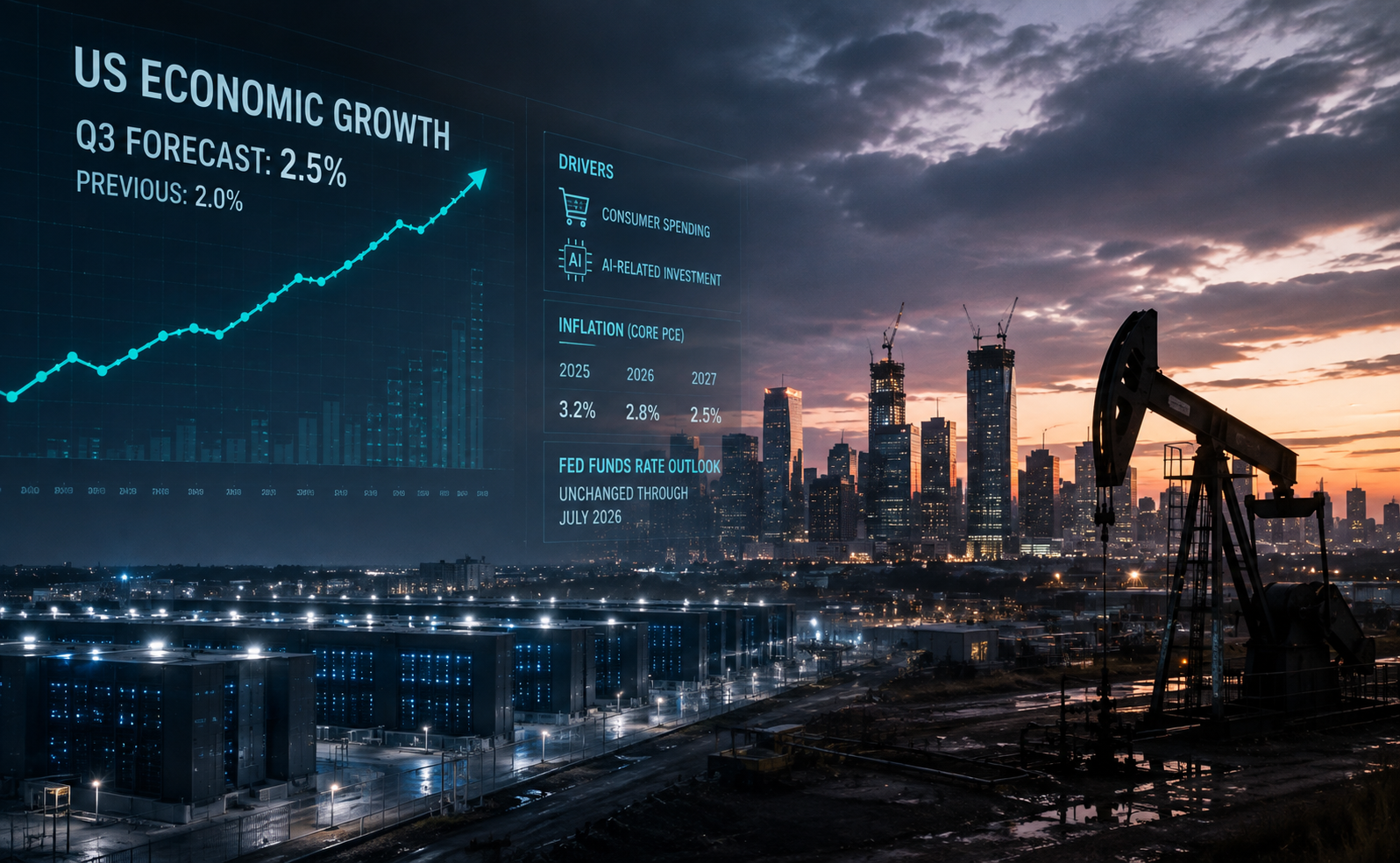
US GDP forecast upgrades put third-quarter growth at 2.5%, as economists lift consumer spending and AI-linked investment assumptions.
Growth is now seen running above the 2% annualized rate economists expected in the prior monthly survey. Forecasts for each quarter through the end of 2027 were little changed, clustered between 2% and 2.2%, which keeps the upgrade concentrated in the near term.
Spending lifts third-quarter estimate
The revision points to two parts of the economy that have carried more weight in recent projections: household demand and private investment. Economists raised their assumptions for consumer spending, while business capital expenditure estimates were helped by spending tied to artificial intelligence infrastructure.
James Knightley, chief international economist at ING, said the composition of growth matters as much as the headline rate. “Tech/AI related investment is the main factor driving higher business capex, while high-income household spending is responsible for the majority of consumer spending growth,” Knightley said.
Industry analysts cited in the survey material estimated that AI-related capital spending may exceed $1 trillion this year, compared with a possible $1.5 trillion in 2027. Those figures frame AI investment less as a narrow technology cycle and more as a source of demand for chips, data centers, power equipment and construction.
Core PCE path narrows Fed choices
Inflation forecasts moved less than growth. Economists see the personal consumption expenditures price index excluding food and energy averaging 3.2% this year, before easing to 2.5% in 2027.
That projected path remains above the Federal Reserve’s 2% inflation target, even as the direction points lower over the forecast horizon. On that basis, economists in the survey expect the central bank to leave interest rates unchanged through July of next year.
The rates outlook depends on whether inflation continues to cool without a sharper weakening in employment. Knightley said softer labor and price readings had made market pricing less aggressive, with a September rate increase seen at below 50% in the survey material.
Iran risk tests oil prices
The main risk identified in the survey is an escalation of the Iran war, which could disrupt energy supply and push oil prices higher. A longer supply shock would put pressure on consumer prices while weighing on real household incomes and business margins.
If consumer spending and AI-related investment hold near current expectations, US growth would remain close to the survey’s 2% to 2.2% quarterly range beyond the third-quarter bump. That path would support global demand, reinforce orders for AI infrastructure suppliers and keep capital-intensive technology investment central to the broader business cycle.
If energy prices rise instead, the mechanism would run through inflation, purchasing power and interest-rate expectations. The Federal Reserve would face less room to ease policy, households would have less capacity for discretionary spending, and rate-sensitive sectors such as housing, autos and smaller business investment would face tighter conditions.
The open question is whether AI capital spending can keep offsetting slower parts of the economy if inflation stays above target. For the wider industry, the answer will depend on whether data-center construction, chip demand and power-grid investment remain funded after the current round of large capital budgets is set.