Oil Prices Plunge 11% Amid Mideast De-escalation Hopes
Oil prices plunged 11% on Monday amid hopes for Middle East de-escalation, marking the largest daily drop since 2022.
Atlas Newsdesk ·
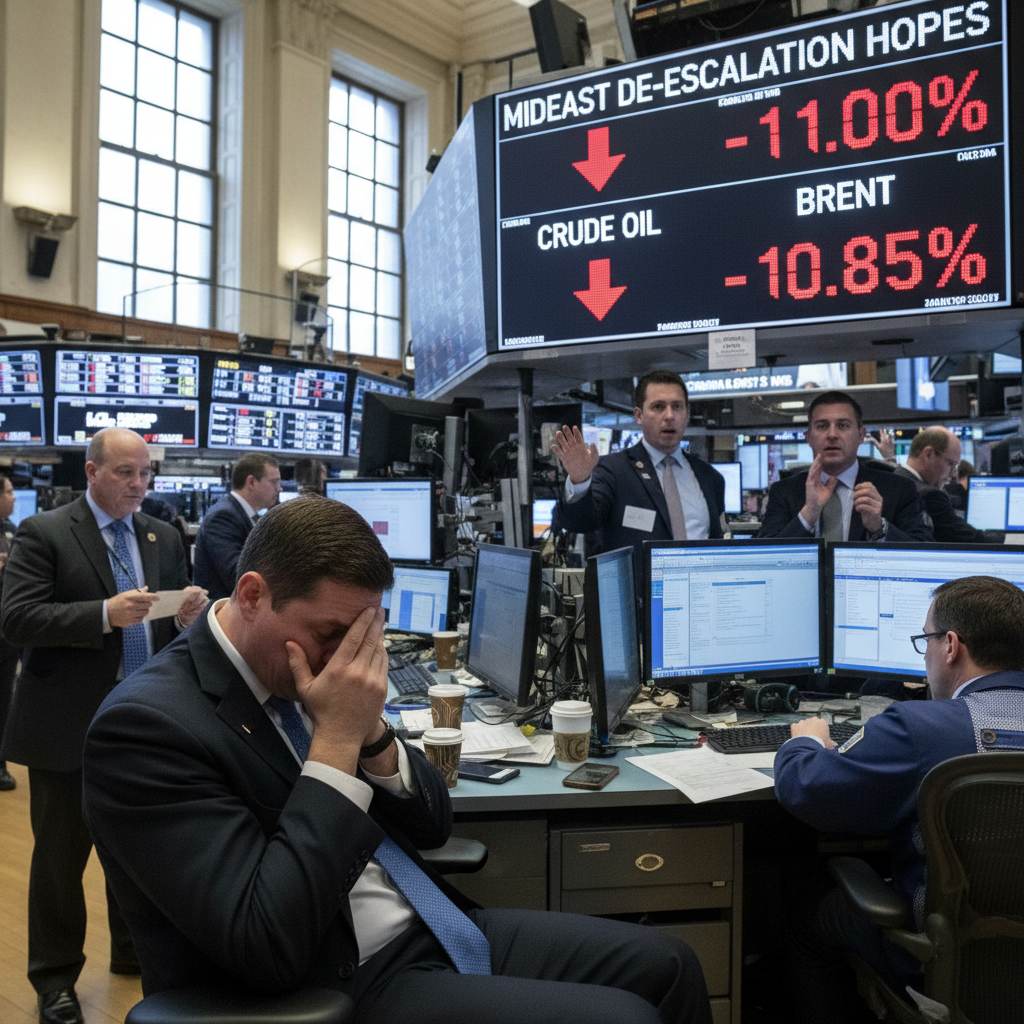
Global oil benchmarks recorded their most significant daily decline since 2022, falling by 11% on Monday, as market participants reacted to perceived de-escalation in Middle East tensions. This sharp movement introduced considerable intraday volatility, particularly affecting leveraged trading positions across commodity markets.
Simultaneously, international equity markets displayed a mixed performance. Asian and European stock exchanges registered notable gains, with South Korea's benchmark index advancing by 6% and broader European indices increasing by 3%. Conversely, major U.S. stock indices, including the S&P 500, Nasdaq, and Dow Jones Industrial Average, concluded the trading session with minor losses or remained largely unchanged, indicating a divergence from the positive sentiment observed in other regions.
Treasury Yields and China's Trade Performance
In the U.S. fixed income market, Treasury yields experienced a reversal, with longer-dated maturities closing marginally higher. The yield curve steepened by as much as four basis points, reflecting shifts in investor expectations regarding future interest rates. A three-year Treasury auction conducted during this period was described as having soft demand, suggesting cautious investor sentiment.
Economic data from China revealed robust export growth in the initial two months of the year. Chinese exports surged by 22% during January and February, significantly surpassing both the previous December's growth figures and analysts' projections. This strong export performance contributed to a substantial trade surplus of $213 billion for the period, positioning China to potentially exceed its record $1.2 trillion trade surplus from the previous year.
Global Market Dynamics and Geopolitical Factors
The pronounced drop in oil prices underscores the market's sensitivity to geopolitical developments, particularly those affecting major energy-producing regions. Expectations of reduced conflict risk often translate into lower perceived supply disruptions, thereby easing price pressures on crude oil. This dynamic highlights the interconnectedness of geopolitical stability and global commodity markets.
The varied response across global equity markets suggests differing regional economic outlooks and investor risk appetites. S. markets appeared to be influenced by domestic factors or a more cautious assessment of the broader economic landscape. The robust Chinese export figures, if sustained, could provide a significant boost to global trade and economic activity, potentially offsetting some of the headwinds faced by the global economy.
Implications
Country Impact: The U.S. market's subdued reaction, contrasting with gains in Asia and Europe, suggests a potentially cautious domestic economic outlook or specific U.S.-centric concerns. China's strong export performance could bolster its economic growth and global trade relations.
Industry Impact: The sharp decline in oil prices directly impacts the energy sector, potentially reducing revenues for oil producers while benefiting industries reliant on lower fuel costs, such as transportation and manufacturing. Increased global trade, driven by China's exports, could boost shipping and logistics sectors.
Market Impact: Global equity markets exhibited divergence, with oil's significant drop influencing commodity-linked assets. U.S. Treasury yields saw minor upward adjustments, indicating shifts in fixed income investor sentiment, while the overall market response reflects a complex interplay of geopolitical and economic factors.