Total solar eclipse to cross Europe on August 12, 2026
A total solar eclipse on August 12, 2026 will cross Arctic routes into Spain and Portugal, with officials urging certified eye protection.
Atlas Newsdesk ·
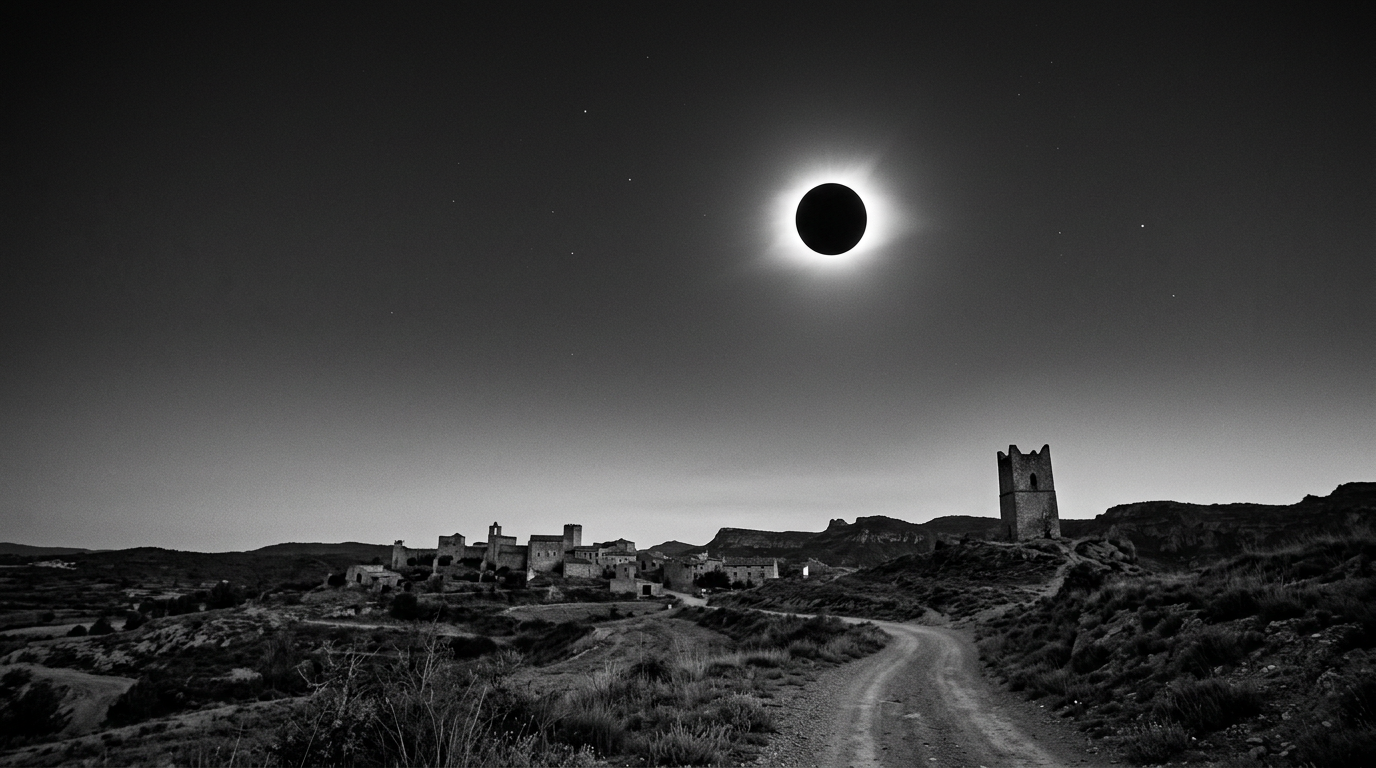
A total solar eclipse is expected on Wednesday, August 12, 2026, crossing parts of the Northern Hemisphere in what officials described as the first total eclipse visible in Europe in 27 years.
Astronomers said the moon’s shadow will travel over sections of the Arctic and the North Atlantic before reaching the Iberian Peninsula, with the most favorable viewing conditions expected along a narrow central corridor over Spain and Portugal.
Shadow track and key times announced by astronomers
Astronomers said the shadow’s track is due to Astronomers said the shadow’s track is due to begin at 15:34 GMT. They said it will then move from the Arctic across Greenland and Iceland before continuing toward Spain and Portugal. Officials said the path of totality is a thin band where the moon fully covers bright face, bringing a short interval of daytime darkness for observers within that corridor. Astronomers said the maximum totality is expected to reach Spain at about 18:27 GMT. Officials said that, within the central corridor, totality is expected to last about two minutes and 18 seconds.
How many people may see totality versus a partial eclipse Officials estimated roughly 15 million people will be Officials estimated roughly 15 million people will be located in areas where the eclipse reaches complete coverage. Astronomers said that outside the narrow totality band, viewers will see a partial eclipse, with the moon appearing to take a “bite” out of. Astronomers cautioned that skies outside the central track will not darken to the same extent as they do during totality, even if the change remains noticeable to observers. Astronomers said the eclipse’s partial phase could be visible across a much wider footprint. They said nearly 980 million people across Western Europe, Northwest Africa, Canada, and parts of the United States may be able to see at least part of the event, depending on local conditions and line of sight. Eye safety warnings for first-time eclipse viewers Officials said the broad reach of partial visibility could bring large numbers of first-time viewers who may not have specialist equipment. They and astronomy groups have repeatedly warned that eclipse-watching carries a specific risk that is not typical of most everyday sky observation.
Astronomers and public health officials said anyone looking toward during the partial phases should use certified solar eclipse glasses to avoid permanent retinal damage. They stressed that ordinary sunglasses are not adequate protection, even when they appear very dark.
Officials also warned against using cameras or unfiltered optical equipment for direct viewing during partial phases. They said the only exception is the brief period of totality, when disk is fully blocked and direct viewing is permitted for that short interval.
As August 12, 2026 approaches, officials said public guidance is expected to emphasize matching viewing behavior to the eclipse phase: certified protection during partial coverage and careful timing for any unfiltered viewing during totality. Astronomers said a key uncertainty for many people will be whether they are positioned inside the narrow totality corridor or within the much broader partial-visibility region.