Spatial transcriptomics labs may face margin reset as bioRxiv preprint reports tearing failures
A bioRxiv preprint reveals tissue tearing degrades spatial transcriptomics registration. This shifts the focus toward improving data usability.
Edward Mullen ·
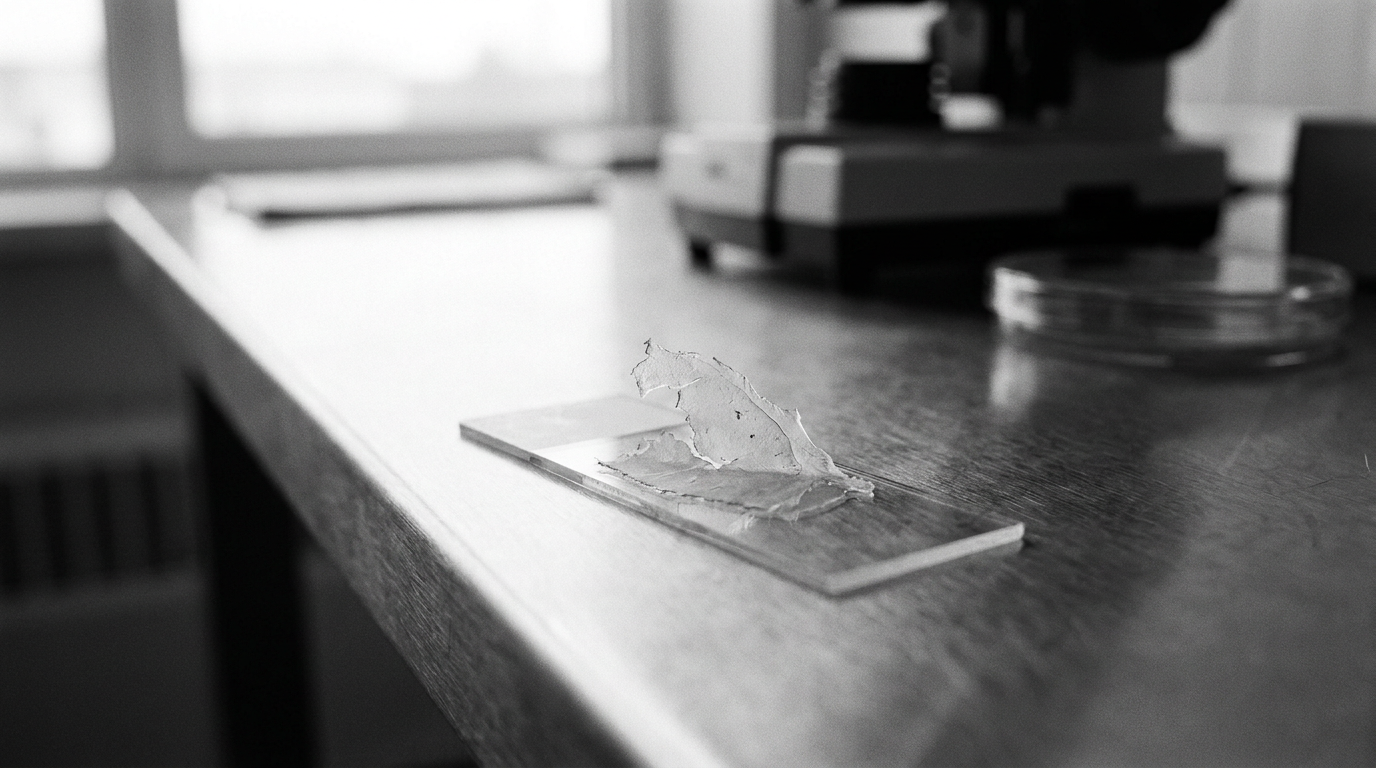
The prevailing wisdom holds that spatial transcriptomics will always require extensive manual data curation due to inherent biological variability and tissue artifacts. However, a recent preprint challenges this assumption by identifying physical tissue tearing as a structured geometric failure, rather than random noise. This implies that the highest-value software will explicitly model such deformations, shifting the focus from endless cleanup to automated, deformation-aware correction.
Tissue tearing is not just another registration nuisance
The source summary says spatial transcriptomics pipelines “rely on accurate slice registration,” then identifies physical tissue tearing as the damaging case because it introduces “non-isometric deformations” that current algorithms fail to handle. That phrasing matters.
A large shift can be corrected if the slice remains geometrically consistent enough for the model’s assumptions. A tear is different: the tissue is no longer merely displaced; local neighborhoods can be separated, warped, or made incomparable in ways that undermine the map between slices.
The preprint’s named comparison set is PASTE2, STalign, and GPSA, benchmarked against a controlled dataset described only partially in the supplied packet, which cuts off after saying “controlled dataset of tor...” That truncation limits what can be reported here. We can say the paper reports a benchmark involving those named methods and a controlled dataset; we cannot say how broad the dataset is, which tissue types it covers, whether the tearing protocol reflects clinical sample handling, or whether the results generalize to commercial workflows outside the paper.
The missing metric is the business clue
There is no headline accuracy number in the packet. That absence is not a minor editorial inconvenience; it is the core limitation for executives trying to translate the claim into procurement or staffing decisions.
Measured against what baseline: a perfectly aligned slice, a mildly distorted one, or a manually corrected expert reference? On what hardware and software environment?
Is the comparison reproducible from the preprint alone? Where does performance break down: at the tear boundary, across the whole slice, or only when biological signal is sparse?
The supplied summary does not answer those questions, so the paper’s claims should be treated as preliminary evidence of a failure mode, not as proof that any specific replacement method is ready.
That still makes the signal commercially relevant. Spatial transcriptomics is expensive not only because instruments and assays cost money, but because the data has to be made trustworthy before a scientist can ask a biological question.
If torn tissue forces manual review, repeated registration, or downstream exclusion of damaged regions, the margin problem sits inside knowledge work: computational biologists and pathologists spend time rescuing data rather than interpreting disease mechanisms. The preprint does not quantify that labor cost, but by naming tissue tearing as a non-isometric deformation problem, it points to a cost line that does not show up in glossy platform demos.
The consensus read leaves too much labor in the pipeline The easy interpretation is that spatial transcriptomics remains powerful but messy, and that biological variability plus tissue artifacts will keep expert oversight in the loop. That is plausible, but it treats every artifact as a reason for more manual correction. The stronger read is narrower: if tearing is a structured geometric failure rather than random mess, then the highest-value software will be the software that explicitly models that deformation before downstream analysis begins.
The counter-read is that the preprint may be over-weighting a visually obvious edge case. Tissue tearing is bad, but not every lab may see enough tearing for it to dominate cost, and a controlled benchmark can magnify a failure mode that experienced sample-preparation teams already avoid.
The packet also does not show whether PASTE2, STalign, and GPSA were tuned equally well, whether expert intervention would close the gap, or whether the benchmark reflects the messy mix of imaging, assay chemistry, and sample handling found in production translational research. Until those details are visible, the claim should not be read as a verdict on spatial transcriptomics pipelines generally.
The margin shift starts with data readiness, not discovery claims The locked thesis is a forecast: within 24 months, advanced computational methods could shift spatial transcriptomics margins from data preprocessing bottlenecks to disease mechanism discovery. The preprint itself does not prove that commercial transition.
What it does is sharpen the procurement question for software buyers: will registration remain a specialized cleanup step performed by experts after data generation, or will deformation-aware correction become a default capability expected from the platform?
That distinction changes who captures value. If vendors such as 10x Genomics or Vizgen incorporate advanced deformation correction into commercial spatial transcriptomics software releases, the buyer experiences the improvement as reduced rework and faster readiness for analysis.
If they do not, the value accrues to specialized computational pathology and image-registration groups that can sit between raw assay output and biological interpretation. The under-noticed middle is the internal bioinformatics team: it may gain leverage if it can standardize these corrections, but it is exposed if each damaged sample still requires bespoke judgment that no vendor contract covers.
This is why the story belongs under follow the data rather than follow the compute. The scarce resource is not described in the packet as GPU time or model scale. It is reliable spatial correspondence across tissue slices when the specimen itself violates the assumptions of common registration methods.
If the data cannot be aligned, a downstream model can become faster without becoming more useful. If alignment becomes robust to tearing, the same lab labor can move closer to hypothesis selection, biomarker interpretation, and disease mechanism work.
The adoption test is already more important than the benchmark The near-term signals are concrete. The scout’s own falsifiers say to look for whether commercial spatial transcriptomics software releases from 10x Genomics and Vizgen incorporate advanced deformation correction algorithms; whether leading biological research papers using spatial transcriptomics data continue to report significant manual preprocessing steps for tissue registration; and whether venture funding in spatial biology tools shifts toward computational pathology or image registration.
Those are better indicators than a single benchmark because they reveal whether the market treats tearing as an occasional artifact or as a recurring bottleneck worth productizing.
For executives, the preprint’s useful warning is not that PASTE2, STalign, or GPSA should be discarded. The useful warning is that registration failures may be caused by deformation type, not just displacement magnitude.
If that holds up under independent replication, the work of spatial biology changes in a specific way: less value sits in generating another richly profiled slice, and more value sits in proving that damaged, torn, real-world tissue can be aligned well enough for the next scientific decision.