NASA Names Artemis III Crew for 2027 Mission
NASA named Andre Douglas, Frank Rubio, Luca Parmitano, and Randy Bresnik for the 2027 Artemis III mission, focusing on research and docking procedures for…
Atlas Newsdesk ·
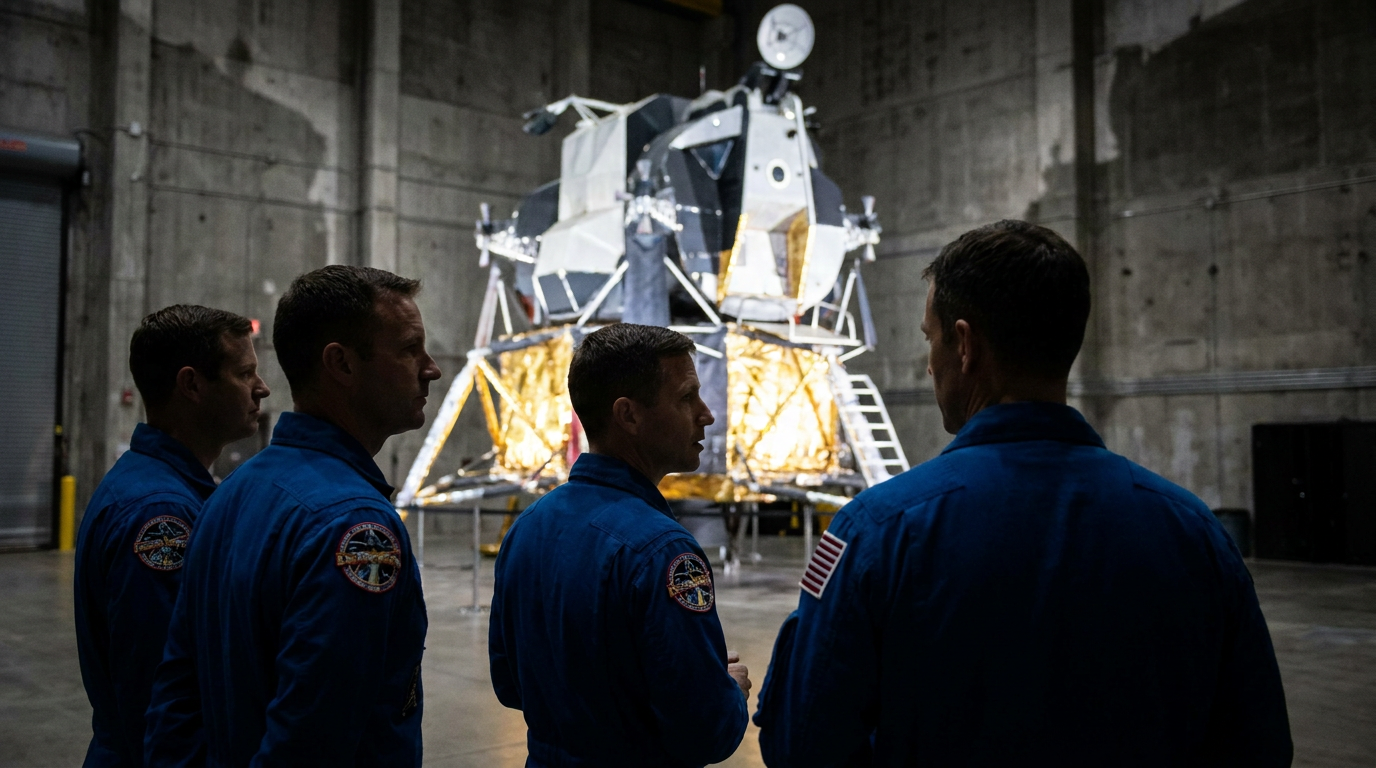
Aeronautics and Space Administration (NASA) announced on June 9, 2026, the four-person crew for its Artemis III spaceflight, scheduled for late 2027. Astronauts Andre Douglas, Frank Rubio, Luca Parmitano, and Randy Bresnik will undertake a mission focused on research and in-space docking procedures, serving as a preparatory step for future lunar landings.
The mission involves a public-private partnership, utilizing an Orion spacecraft to carry the crew into Earth orbit. Two additional rockets will transport Moon lander models from private firms Blue Origin and SpaceX. The Orion spacecraft will then practice rendezvous maneuvers with these landers, simulating procedures for subsequent Moon missions. Andre Douglas, 40, will make his first spaceflight as a mission specialist, becoming one of approximately two dozen African Americans to travel to space. Frank Rubio, 50, a Salvadoran American physician, will also serve as a mission specialist, holding the record for the longest single-duration spaceflight by a U.S. astronaut at 371 days. Randy Bresnik, 58, a former U.S. Navy test pilot, will command the mission, having previously participated in a space shuttle mission in 2009 and commanded the International Space Station in 2017. Luca Parmitano, 49, an Italian Air Force veteran, will be the pilot, having commanded the International Space Station in 2019.
The announcement followed an uncrewed Blue Origin New Glenn rocket explosion on May 28, which caused damage to a launch pad. NASA and Blue Origin representatives addressed these concerns, stating that the incident was an "anomaly" and that efforts were being redoubled to ensure readiness for Artemis III. NASA Administrator Jared Isaacman emphasized the collaboration between aerospace companies and European partners in showcasing technological capabilities. The mission also implicitly addresses the ongoing competition with China's lunar landing program, which aims to place a person on the Moon by 2030.