Mitch Chaiet claims Dell Pro Max with GB10 enables local robot motion
Dell Technologies' engineering blog presents an open-source pipeline, 'G1 Moves,' that runs motion capture and humanoid motion synthesis on a Dell Pro Max…
Edward Mullen ·
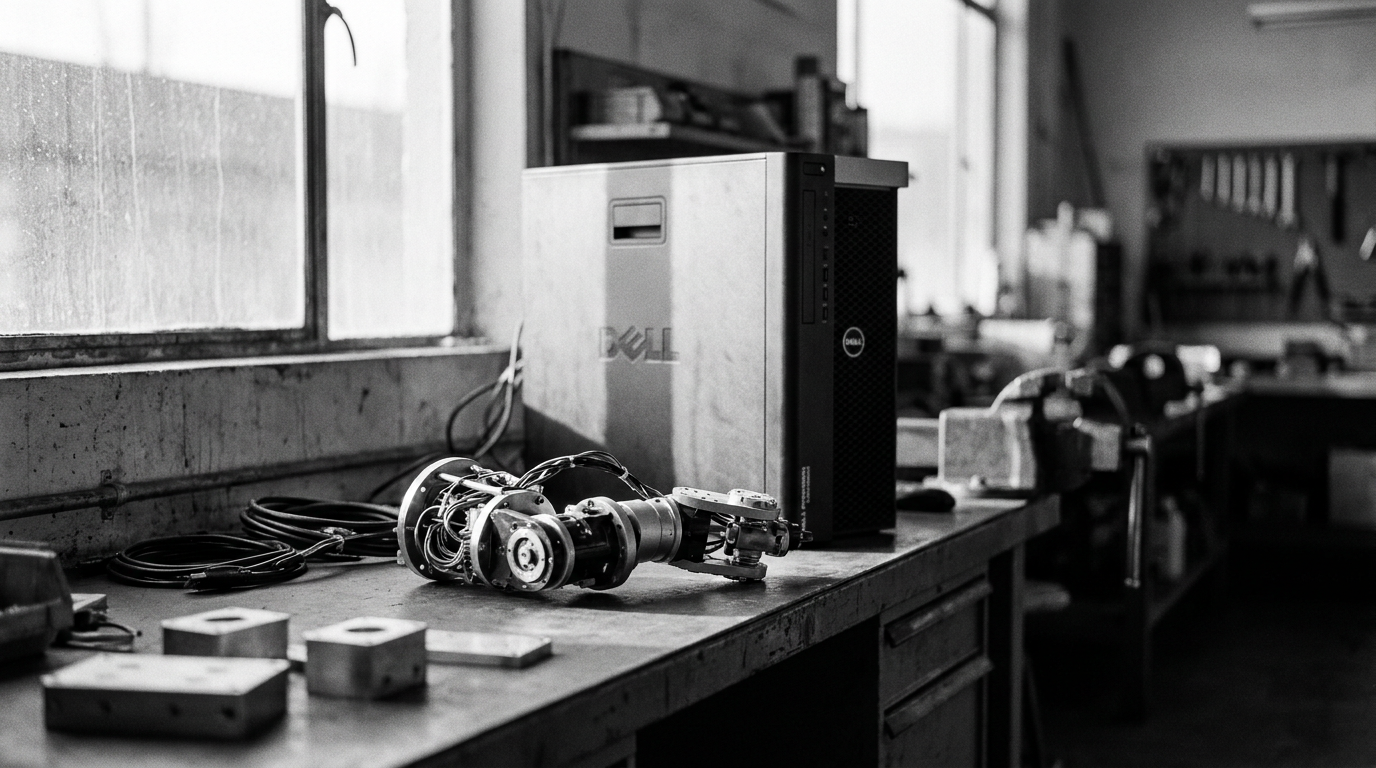
Mitch Chaiet, founder of Experiential Technologies, faced a familiar procurement choice: build motion capture for his humanoid robots in the cloud or on-premise. By deploying on a Dell Pro Max with GB10, Chaiet sidestepped recurring cloud expenditures, suggesting a potentially broader shift. This decision, if mirrored by other robotics buyers, redirects capital investment from continuous operational expenses to one-time hardware purchases and maintenance.
What Dell's post actually describes
The blog reports that "G1 Moves" takes video captured on a smartphone and converts it into executable motion for a humanoid, and that Chaiet ran the pipeline locally on a Dell Pro Max with GB10 to avoid cloud costs while producing robot-ready trajectories. The post frames the contribution as an open-source pipeline for motion capture-to-control with a local inference stack.
The blog does not provide benchmark tables, latency numbers, or comparative cost calculations against cloud-based alternatives. No one in the reported packet is on the record with a quoted, independently verifiable performance metric.
Why procurement buyers should care
If the core technical claim stands up in practice, the procurement implication is straightforward: buyers who commission robotics demonstrations or continuous real-time control may prefer to buy sealed, vendor-supported edge compute devices rather than contracting recurring cloud compute. Hardware purchased once and deployed on the shop floor or in an experiential studio converts what would have been ongoing cloud spend into a capital purchase and a new line item for maintenance, warranty, and refresh cycles.
That shift compresses cloud providers' recurring revenue for these specific use cases while enlarging margins for vendors that can capture hardware plus support.
What's missing from the blog that matters to a PO The Dell post omits the arithmetic procurement teams need: the upfront price of a Dell Pro Max with GB10, expected operating costs for a fleet of units, mean time between failures, software maintenance contracts, and the effective per-hour cost versus cloud VMs or managed robotics services. It also doesn't show edge-node aggregate throughput—how many simultaneous captures or how many robots a single unit can support—and it does not report the failure modes where local inference breaks down (for example, out-of-distribution motion, occlusions in smartphone video, or networked multi-robot coordination).
Those omissions hide the true total cost of ownership and the switching costs for enterprises tempted to adopt local boxes.
Who benefits, who is exposed, and the overlooked middle Dell and system integrators that bundle compute, deployment, and maintenance stand to win if enterprises prefer an appliance purchase; small studios and live-performance houses that cannot sustain recurring cloud bills may find a one-time hardware buy attractive. Large cloud vendors and software-as-a-service orchestration layers are exposed, but not uniformly: clouds still dominate training, large-scale model hosting, and analytics, while real-time control and low-latency motion synthesis can credibly move on-premise.
The under-noticed middle are the specialist services—motion-capture studios, latency-sensitive middleware vendors, and local IT teams—whose margins will be squeezed unless they repackage deployment, remote management, and device SLAs as billable services.
The skeptical counter-read
A skeptic will point out the post is a single vendor narrative aimed at selling hardware and developer mindshare; running a demo on one Pro Max is not proof of enterprise readiness. The Dell blog provides no reproducible benchmarks, no third-party replication, and no audit of edge failure cases—questions that matter to legal, security, and procurement teams before signing a multi-unit purchase order.
The skeptic's practical claim is that cloud providers will respond with specialized low-latency offerings or hybrid edge-cloud bundles that preserve recurring revenue, and that, unless Dell or others publish transparent cost-per-hour comparisons, procurement teams will default to cloud to avoid hardware lifecycle risk.
Observable signals procurement teams should watch in the next 6 months Procurement and finance leaders should watch several concrete signals: whether Dell reports rising order volume for the Pro Max with GB10 in its earnings commentary; whether independent integrators publish reproducible latency and cost comparisons between the Pro Max pipeline and cloud-hosted pipelines; whether major cloud vendors announce managed services for real-time robotics control that include SLOs tailored to motion capture; whether motion-capture studios publicly shift to buying hardware rather than leasing cloud time; and whether enterprise RFPs start listing local inference capacity as a mandatory requirement rather than optional. A consistent move across these signals toward hardware purchase would falsify the consensus that cloud remains the default for all AI infrastructure and would validate a procurement-driven margin shift.
How a pragmatic procurement response looks now
CFOs and procurement officers should not rearrange entire supplier stacks on the basis of one vendor blog, but they should add a question to any robotics or live-experience RFPs: ask vendors to provide reproducible latency and per-hour cost figures for both local and cloud deployments, warranty and refresh terms for on-premise boxes, and an optional managed service for device fleets. That forces vendors to surface the omitted economics in the Dell post and creates a defensible comparison framework for committees deciding between recurring cloud spend and upfront hardware acquisition.