Global stocks sink as Nasdaq futures slide in tech wipeout
Nasdaq futures slid more than 2.5% as a tech-led selloff hit Asian and European stocks, while oil held near $78 after a U.S. Iran waiver.
Atlas Newsdesk ·
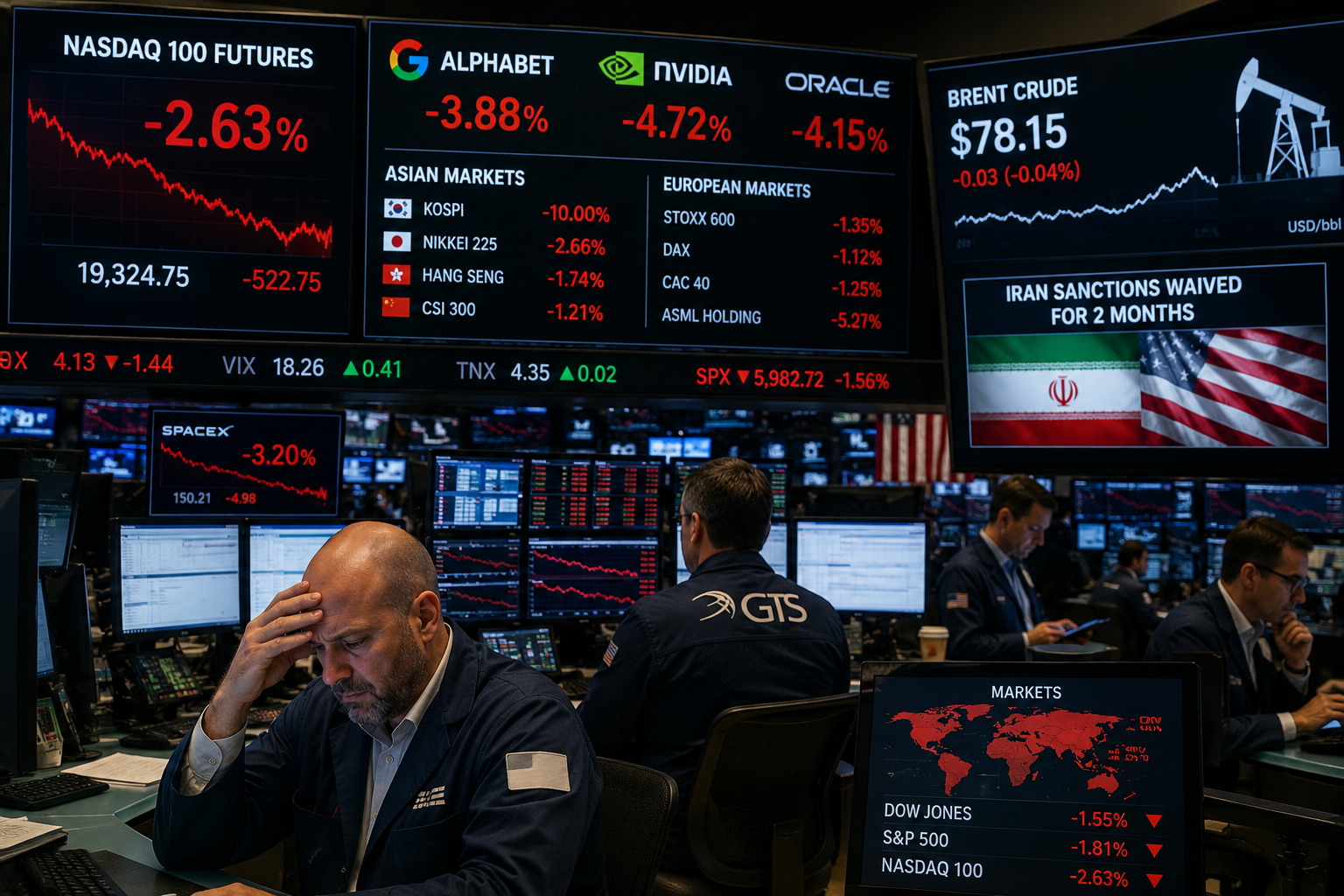
Nasdaq futures slid more than 2.5% before the open as a tech-led selloff rippled across Asia and Europe and kept risk appetite on the defensive.
The move extended a sharp retreat in mega-cap technology shares from the prior session. In premarket trading, Alphabet, Nvidia and Oracle were among the notable decliners.
The damage was not confined to U.S. screens. Equity benchmarks across the region opened lower in Asia, where chip exposure again set the tone.
Semiconductors drive losses from Seoul to Amsterdam
South Korea’s Kospi plunged 10%, one of the steepest drops cited in the session. Chip makers were a key drag, with Samsung Electronics singled out as part of the pressure point.
European equities also traded in the red. In the Netherlands, ASML fell about 5%, weighing on the region’s tech complex and reinforcing the sense that semiconductors remain at the center of the drawdown.
The premarket slide in the Nasdaq 100 futures contract underlined how quickly a sector rotation can turn into forced selling. When semiconductors and AI-linked names move together, index-level swings can accelerate.
AI trade reverses as spending and rates come back into focus
The recent reversal follows a period when artificial-intelligence leaders powered outsized gains across global benchmarks. Over the past several days, that rally has moved in the opposite direction.
Two concerns are driving the shift: unease about the scale of spending at AI-focused companies and renewed anxiety about the path of U.S. interest rates. Traders are also bracing for the possibility of additional Federal Reserve rate increases.
Higher expected rates typically raise the discount rate used for valuing long-duration growth stocks, a dynamic that hits tech first. At the same time, heavy capital outlays can spook investors when revenue payoffs look less immediate.
SpaceX added another source of volatility after what was described as an exuberant IPO earlier this month. The stock has fallen since the listing and was swinging between gains and losses ahead of the opening bell.
Oil holds near $78 as U.S. eases Iran restrictions temporarily
In commodities, crude prices were largely unchanged even as geopolitics stayed in the frame. The U.S. on Monday granted a two-month waiver on longstanding sanctions tied to Iranian oil sales.
The waiver was framed as a sign of progress in talks between Washington and Tehran. The immediate market response was muted, with Brent crude futures hovering around $78 a barrel.
That level sits close to prices seen in the early phase of the U.S.-Israeli war with Iran, offering a reference point for how the market is weighing supply risks against policy signals. For now, oil’s steadiness stands in contrast to the equity volatility, suggesting traders see the waiver as incremental rather than a near-term shock to balances.
Next comes the test of whether the selloff is concentrated in high-beta tech or broadens into other sectors. Watch whether semiconductor leaders continue to set the pace, and whether rate expectations keep tightening the vise on growth stocks.