CTOs face a new manager role as prompt engineering becomes a lifecycle discipline
An arXiv preprint argues for turning prompt engineering into a formal software engineering discipline, anchored by a five-pillar lifecycle. The piece calls for new managerial roles to govern standardization, evaluation, and human-AI collaboration, signaling a shift in how tech teams organize AI work
Edward Mullen ·
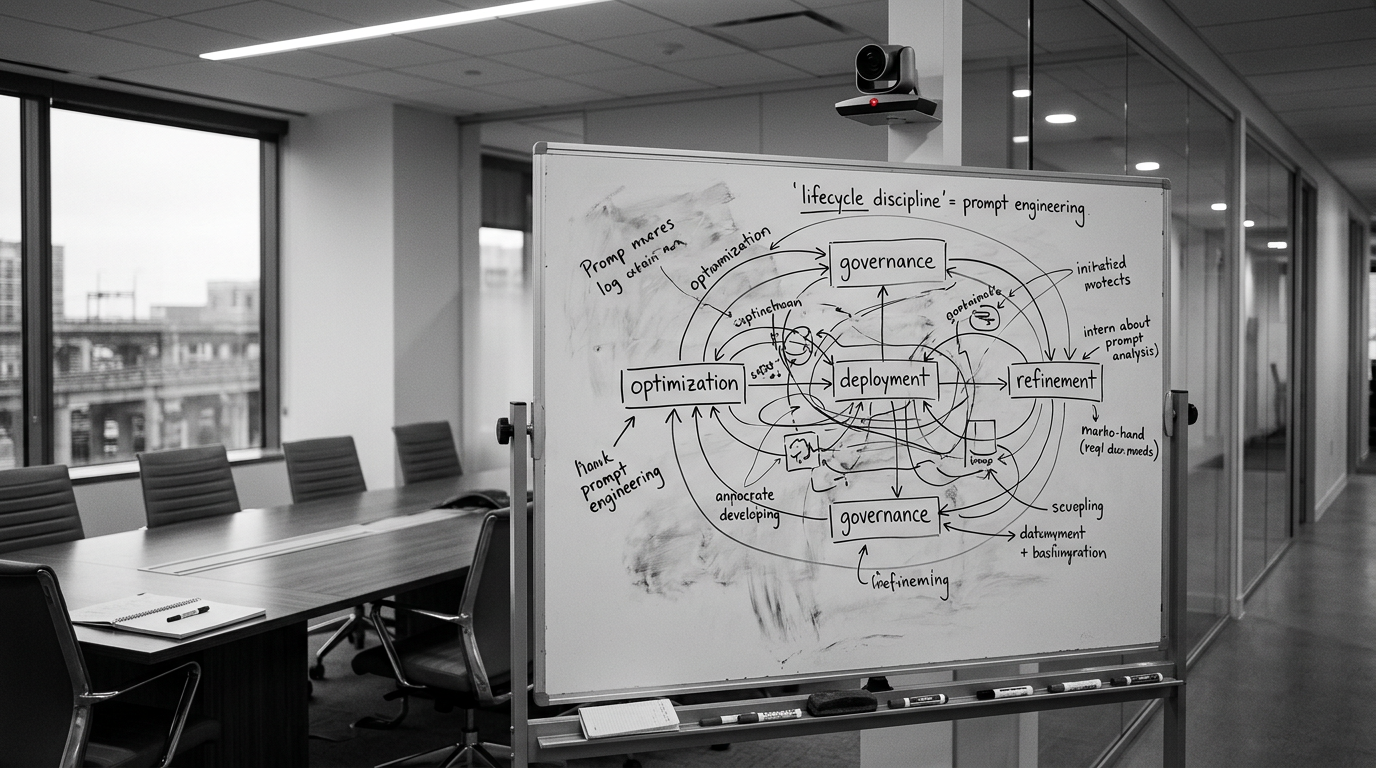
Many still view 'prompt engineering' as a casual skill for nudging AI, a fleeting trend. However, a recent academic paper posits a starkly different future: prompts are not disposable commands but complex software assets demanding rigorous lifecycle management. This recharacterization isn't just a technical shift; it forecasts a new class of specialized managers dedicated to governing these critical AI components, akin to product managers for code.
Turning prompts into a lifecycle
The signal the paper emphasizes is not merely clever prompts but a repeatable process. Five pillars are identified, including standardization, evaluation, lifecycle, human-AI collaboration, and governance-like elements, though the public summary truncates the final term.
In practical terms, this means prompts would be stored, versioned, tested, and rolled out with explicit release gates, akin to software artifacts rather than one-off ad hoc tips. The emphasis on lifecycle suggests prompts will travel through design, testing, deployment, monitoring, and retirement, all with traceable performance data.
The labor angle: a new spine for teams Rather than a drifting skill set isolated to senior data scientists or card-carrying researchers, the framework implies a spreading of accountability across product, engineering, security, and user-experience teams. The paper’s framing aligns with a second-order labor dynamic where governance and lifecycle responsibilities scale with the technology’s footprint. It hints at roles that oversee standards, evaluation metrics, and cross-functional collaboration, potentially creating a distinct class of manager whose remit covers prompt lifecycles as a product-like asset. This is the core of the labor argument: the discipline does not live in code alone but in organizational habit.
Why this isn’t a passing fad for software teams If prompts are treated like deployable software, the cost of failure becomes a governance issue rather than a purely technical one. The lifecycle lens pushes organizations to define entry criteria, maintain dashboards, and require reproducible experiments for prompts just as they do for algorithms. The consequence is a shift in how AI work is budgeted, measured, and governed, with a potential reallocation of headcount toward lifecycle management rather than perpetual prompt tweaking. The scale of this shift depends on how aggressively teams adopt standardization and cross-functional collaboration.
Cross-industry implications and procurement questions
Health care, manufacturing, and enterprise software all stand to be touched by this reframing, since prompts increasingly participate in decision-making, data routing, and user-facing interactions. The governance-first posture raises procurement questions: what counts as a verified prompt asset, who signs off on its lifecycle, and how do you price ongoing evaluation and monitoring?
If prompts are treated as software assets, then the budget line moves from one-off training to ongoing operational expenses that require governance, risk assessment, and contractual clarity about updates and retirement.
Counterpoint: is this engineering overreach or overdue discipline A skeptic might argue that a focus on lifecycle management could slow development and complicate teams that already juggle product, data science, and security. The claim that prompt engineering requires an enduring managerial layer risks over-engineering what remains a context-specific tool. The paper’s argument hinges on the belief that prompts will scale beyond novelty to mission-critical components of software, which is the very point under debate.
If the field remains patchwork at scale, the anticipated labor market effects could be delayed or muted. By Q4 2024, LinkedIn postings for 'Prompt Engineering Manager' show no significant jump; by Q3 2025, ICSE/FSE tracks on this topic are sparse; by Q2 2025, large firms may consolidate such work within existing Dev/ML Ops roles. If any of these turn out true, the argument weakens; otherwise, it strengthens. No one in the reported packet is on the record.
Implications for organizations today
Despite the skepticism, the prompts-as-assets view nudges executives toward concrete changes: codified prompt development workflows, measurable evaluation regimes, and cross-functional teams that own the lifecycle from design to retirement. In practice, that means aligning incentives so that prompt quality, not just model accuracy, anchors performance reviews; updating product roadmaps to include prompt inventory and retirement schedules; and updating procurement and vendor management to reflect ongoing costs for monitoring, auditing, and updating prompts as assets.
These are not minor tweaks; they are organizational and budgeting choices that must be made now if the discipline gains traction.
Signals to watch over the next 6–12 months
If the labor-market thesis is correct, you should start seeing concrete signs beyond scholarly chatter. The falsification tests proposed in the packet would watch for three near-term signals: first, a material rise in roles explicitly labeled around prompt lifecycle stewardship; second, conference tracks and workshops devoted to lifecycle management for prompts; and third, larger software firms formalizing prompt governance within Dev/ML Ops structures.
The dates cited in the signaling framework are Q4 2024, Q3 2025, and Q2 2025. If these do not materialize, the case for a distinct labor category weakens.
Where this leaves the load-bearing omission
The packet notes the need for a lifecycle approach but does not spell out exact organizational structures or job titles beyond the general manager-like role. That omission matters: the real test is whether companies will translate this governance rhetoric into concrete org charts, reporting lines, and compensation schemes.
For now, the record shows a single source in this cluster, and the lede flags that the preprint is unvalidated. Lacking additional corroboration, executive readers should treat the argument as a well-constructed hypothesis rather than a proven blueprint.