CSIS flags stakes of a potential Trump-Xi 2026 summit
CSIS published “Trump-Xi 2026 Summit,” outlining scenarios and questions for U.S. officials as Washington weighs the implications of a possible 2026 meeting.
Sophie McAlister ·
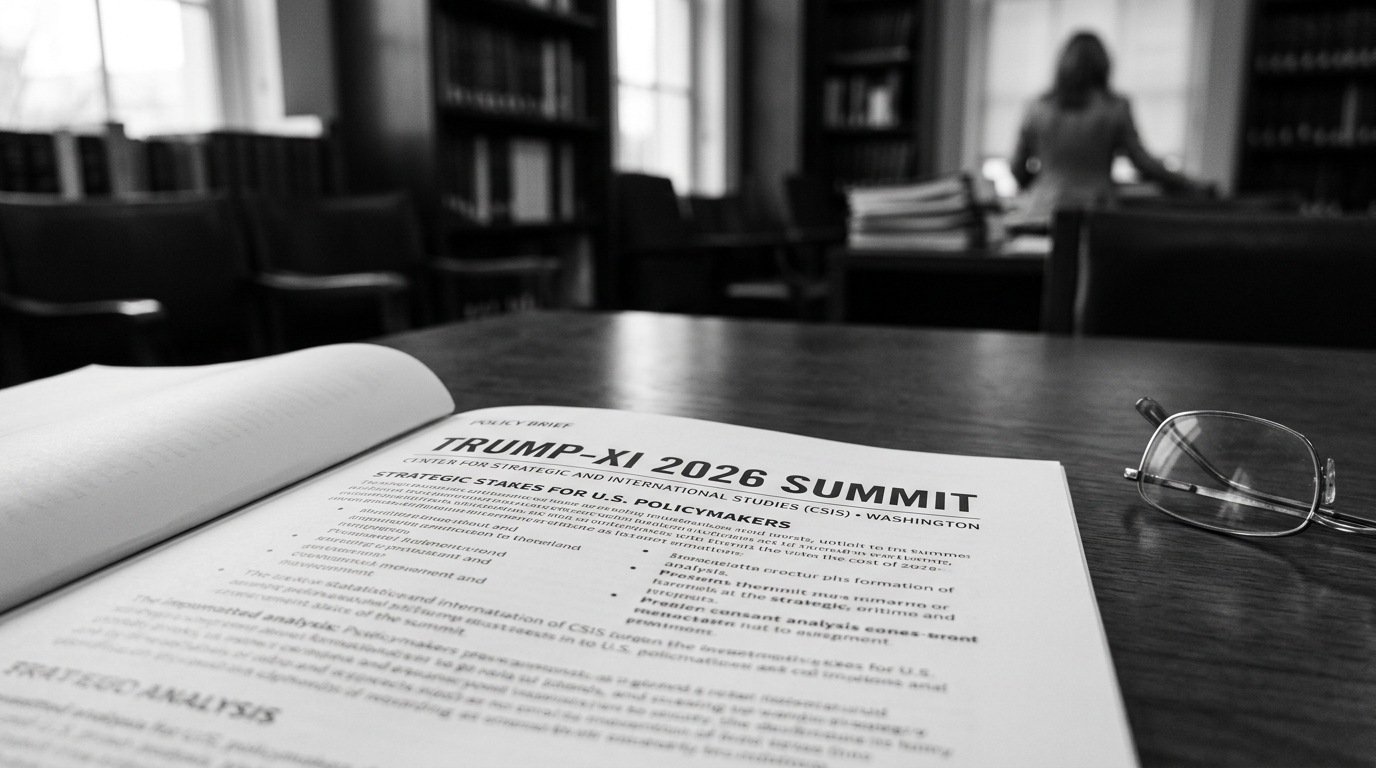
The Center for Strategic and International Studies (CSIS), a Washington, D.C.-based foreign policy think tank, has published an analysis titled “Trump-Xi 2026 Summit” examining the prospect of a meeting in 2026 between U.S. President Donald Trump and Chinese leader Xi Jinping.
The paper is presented as a resource for policymakers, analysts, and the broader foreign-policy community in the U.S. capital. It is available on CSIS’s website for policymakers, journalists, and the public to review.
CSIS positions the paper for Washington policy audiences
CSIS is described as one of Washington’s largest CSIS is described as one of Washington’s largest and most visible policy research organizations, with products that are routinely read by congressional staff, administration officials, and other think tanks. The analysis is framed as a contribution to ongoing conversations in Washington about U.S.-China relations. According to the description, CSIS sits at the center of the city’s policy ecosystem, where papers and events can feed into testimony, congressional briefings, and media coverage. CSIS is also portrayed as a convening venue for foreign-policy experts and government officials because of its downtown Washington location. What the “Trump-Xi 2026 Summit” analysis does not claim The CSIS document lays out scenarios and strategic considerations around a possible 2026 summit, but it does not present this as confirmation that a meeting has been scheduled. It is positioned as an analytical product intended to help U.S. policy audiences anticipate the diplomatic and strategic questions a high-level engagement would raise.
As an independent think-tank analysis
CSIS also does not present the document as a statement of policy by any government office. As an independent think-tank analysis, it does not have the force of government policy, even as the text suggests it could be used as a reference point by Capitol Hill staff, executive branch offices, and other Washington institutions focused on U.S.-China relations.
How the analysis could be used in hearings and briefings The write-up argues that, in practical terms, the analysis gives Washington interlocutors a shared framing for hearings, briefings, and media appearances. It also notes that think-tank outputs can shape agendas for policy panels and lead congressional offices to request additional briefings.
The fact that CSIS authored the paper is cited as a reason it may be more likely to be referenced in local panels and by analysts working on China policy in Washington. The publication is described as another data point in an evolving debate over how the United States should approach high-level diplomacy with China.
Uncertainties and indicators to monitor
The central uncertainty remains whether a Trump-Xi meeting in 2026 will be pursued, planned, or publicly acknowledged by the relevant governments, since the CSIS paper itself is not an announcement of any summit.
The write-up points to a specific indicator for readers watching Washington decision-making: whether congressional staff and agency officials begin to cite the CSIS analysis in hearings or briefings. Such references, it says, would suggest the paper is informing real-time discussion in the capital.
Implications
Country Impact: For the United States, the publication adds a structured framework to Washington discussions about how to approach high-level diplomacy with China. The immediate practical effect highlighted is potential use in hearings, briefings, and public commentary by policy actors in the capital.
Industry Impact: For the foreign-policy research and advisory ecosystem in Washington, the analysis reinforces CSIS’s role as a convening and agenda-setting institution. The paper is presented as material that could be incorporated into panel programming and internal briefing requests.
Market Impact: The source text does not provide specific market impacts or cite financial indicators. Its stated relevance is to policy debate and decision-making processes rather than near-term market movement.