China tech tours draw investors to factory floors at scale
China tech tours are bringing foreign investors and executives onto factory floors as interest rises in AI, robotics and electric vehicles.
Jason Kwon ·
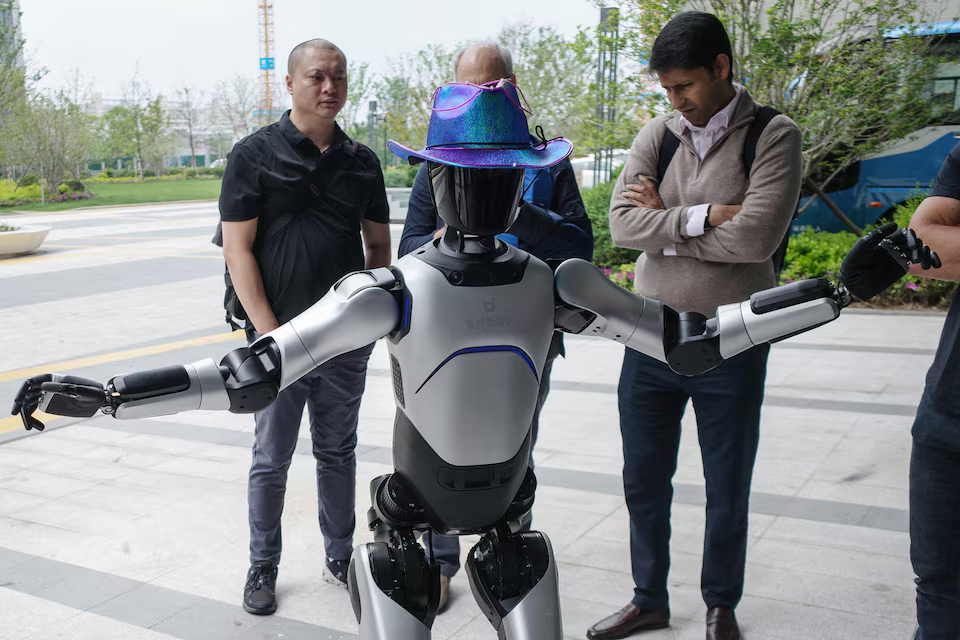
China tech tours are drawing foreign investors to factories and robotics labs as access programs charge up to $15,000 for five days.
The trips reflect a shift in how investors and entrepreneurs are assessing Chinese manufacturing, moving from conference rooms to production lines. Demand is rising as companies in electric vehicles, batteries, artificial intelligence and robotics turn Chinese plants into showcases for scale and speed.
Factory floors become itineraries
Robert Wu, chief executive of Shanghai-based data research firm Baiguan, has organized two tours for more than two dozen investors, entrepreneurs and executives. His five-day program costs as much as $15,000, and about half of the participants came from Southeast Asia.
Wu said visitors often arrive with assumptions that do not match conditions on the ground. He cited robotaxis as one example, saying China is not ahead of the US in that market because domestic policy has moved cautiously around possible job losses.
Other organizers have turned similar demand into repeat business. Rui Ma, founder of Tech Buzz China, has arranged 11 tours since 2019, while participants have included investors, executives and technology founders seeking access to companies they may later meet as rivals, suppliers or partners.
Bertrand Chen, chief executive of the Global Shipping Business Network, joined an April tour across three cities focused on robotics and emerging technology. "You cannot grasp the true scale, speed, and physicality of Chinese innovation without standing on the factory floor," Chen said.
Beijing turns plants into showcases
China's industrial tourism sector brought in $17.8 billion last year, according to state media, and is projected to exceed 300 billion yuan ($44.6 billion) by 2029. Beijing has pledged to "vigorously promote" industrial tourism and has designated more than 140 demonstration sites.
Public factory tours are also becoming a consumer business, with some plants charging about $60 for entry. Xiaomi's electric-vehicle factory in Beijing has received more than 250,000 visitors since March 2024, and lottery-awarded slots have been resold online for as much as 2,000 yuan ($300).
The tour circuit is concentrated in Beijing, Shenzhen, Shanghai, Hangzhou and Hefei, cities tied to China's electric-vehicle, battery, AI and robotics supply chains. Those visits give foreign executives a way to study how Chinese companies connect hardware, software and local industrial policy.
European executives study scale
European visitors have become a steady part of the traffic as companies assess productivity gaps and the pace of AI deployment. Alex Shengyun Lu, a Shanghai-based AI consultant at Praxis Advisory, has led seven delegations of as many as 50 corporate visitors since late 2025.
Lu said executives usually want to know what can be learned from Chinese companies and from the state's role in technology investment. "The smartest people in Europe are acutely aware of the situation. The insecurity is palpable," he said.
There are limits to the China-first reading of the trend. Ma said non-Chinese technology companies still hold much of the global market, the most advanced intellectual property and the largest profits, even as Chinese competitors expand in hardware-heavy sectors.
US visitors are still arriving despite technology restrictions and political tension between Washington and Beijing. Joshua Woodard, a US manufacturing consultant based in Shenzhen, said American robotics companies continue to rely on Chinese components and hardware, making a clean break difficult for firms building physical products.
Shenzhen converts traffic into leverage
Shenzhen has become the clearest example of the trend as it prepares to host the Asia-Pacific Economic Cooperation forum in November. Foreign visitor numbers rose 70% last year, increased more than 30% in the first quarter and passed 5 million entries through August.
The city has added English-language taxi announcements, hosted foreign influencers at technology exhibitions and supported Silicon Valley-style hacker houses for robotics and AI hardware entrepreneurs. Woodard said WeChat groups with hundreds of members now connect founders moving between Silicon Valley and Shenzhen in search of battery, display and prototype suppliers.
If tour demand holds, China gains another channel to market its industrial model, companies such as Xiaomi and Unitree get foreign visibility, and global manufacturers face closer comparison with Chinese production systems. If visa access narrows or technology controls tighten, visitors may rely more on intermediaries, raising costs for startups and slowing cross-border supplier discovery.
The main open question is whether factory access remains a learning tool or becomes another front in the technology rivalry. For now, Czech entrepreneur Jan Smejkal, who has lived in Shenzhen for 11 years, said foreign founders keep asking to visit: "There is no other place on earth that takes technology to its core and integrates it into daily life quite like Shenzhen."